- Animals
- ›Chordates
- ›Vertebrates
- ›Cartilaginous Fishes
- ›Sharks and Rays
- ›Sharks
- ›Squalean Sharks
- ›Squaliform Sharks
- ›Gulper Sharks
- ›Centrophorus
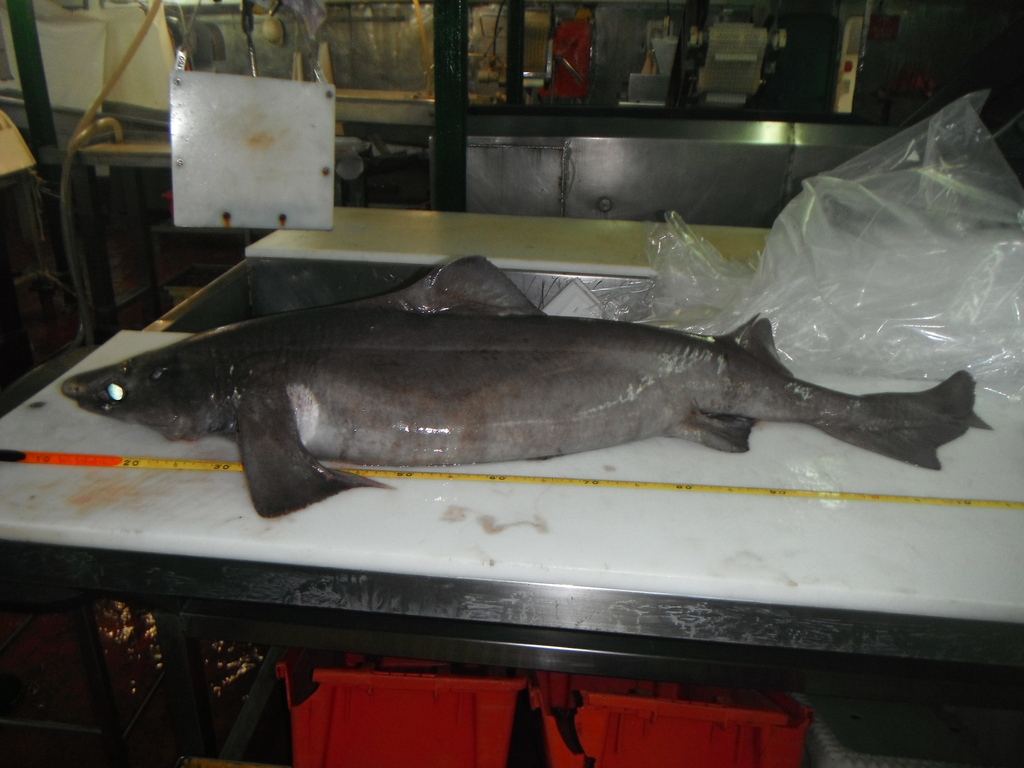
Large Gulper Shark
Centrophorus granulosus
The gulper shark (Centrophorus granulosus) is a long and slender dogfish usually about three feet in length generally found in deep, murky waters all around the world. It is a light grayish brown, paler ventrally, with a long snout and large greenish eyes. This deep water shark has two dorsal fins with long, grooved spines and the second dorsal fin smaller than the first. Its upper teeth are blade-like and lower have finely serrated edges. This tertiary consumer feeds on mainly fish such as bony fish, but also cephalopods such as squid and other invertebrates like crustaceans. The gulper shark is currently an endangered species mainly because of exploitation by humans and their abnormally long gestation period and low fecundity, preventing their population from recovering. Because of the depth of their habitat, they are considered little to no threat to humans.
From the article Gulper shark on Wikipedia (CC BY-SA), quoted section by section
Range & habitat
The gulper shark is a deepwater oceanic species, living in waters ranging between 100 and 1490 meters in depth, with the juveniles being the main occupant of the lower half of the depths. Acceptable habitats for gulper populations are found globally, wherever temperate and tropical waters are found. The gulper shark is most commonly found in the 300 to 800 meter depth range, inhabiting the upper continental slopes and outer continental shelves, the gulper is highly migratory species and has schooling habits based on multiple sharks being present around baited cameras. Due to the frequency and patterns of migration the gulper shark population estimates may be inaccurate with some sharks being counted twice, which are exacerbated by inappropriate tagging techniques. There are multiple species of gulper sharks, which has contributed to misidentification in the past. For example, populations of the gulper shark in the Southeast Atlantic Ocean may represent a separate species. Therefore, taxonomic confusion may influence current geographical range. The gulper sharks like deep, murky waters.
Wikipedia: “Geographic range”
What it does
Gulper sharks reach maturity at around age 12 to 16 years for females, and age 7 to 8 years for males. The maturity of a gulper shark can be determined by the seven-stage maturity scale for aplacental and placental viviparous sharks. This scale is good for practical field use, but may not be as accurate as other maturity scales that have more than seven stages. Maturity for gulper sharks is considered when they are at stage 3 or above, which for males is when gonads are enlarged and filled with sperm, and sperm ducts are tightly coiled. For females, stage three is when ovaries are large and well rounded. On average, male gulper sharks are smaller than females. The size of an average adult male is 80 to 95 cm. The size of an average adult female is from 90 to 100 cm long. Differences in size between the sexes may be due to the need for space to support offspring. It has been hypothesized that gulper sharks display a "depth distribution pattern associated with size" based on random human observation. Male gulper sharks tend to outnumber females 2:1, which is common for many fish species. The life expectancy, longevity, of female gulper sharks ranges between 54 and 70 years. …
Wikipedia: “Development and reproduction”
In human culture
The life history of an organism describes the timing of important events for the typical individual of a species. The life history of the gulper shark shows that vulnerability to harvesting is inherent in its biology. The slow rate of gulper growth and development leads to a life strategy that is more centered on competition with one another than escaping predation, especially from humans. This is demonstrated from even the earliest part of an individual gulper's life history where it consumes other fertilized eggs inside its parent's body. A long gestation period, later maturity, and long lifespan all contribute to a K-selected tendency that favors intraspecific competition, or competition with similar species, over survival defenses having to do with predation. Harvesting is a form of predation that slow, invested reproduction does not easily alleviate. The long gestation, low fecundity, and breaks in individual reproduction lead to slow repopulation ability. Slow reproduction is a part of the species biology, and cannot be changed in one generation based on sudden predation pressure. A group of gulper sharks that undergoes predation by humans may take fifteen years or longer to recover, if at all, based on their maturation time of twelve to sixteen years. …
Wikipedia: “Life history”
Where it lives
Recorded sightings
—
geo-referenced records in GBIF, from museums, herbaria and field observers.
Drag the globe to turn it. Dots are where records exist, not a range map; darker means more records.
In the stacks
Searching the stacks…
Every page naming Centrophorus granulosus in the Biodiversity Heritage Library →
This page is assembled live from iNaturalist, GBIF, Wikipedia, the Source Library and the Internet Archive. It is not yet part of the hand-edited codex. iNaturalist taxon 96918.