- Plants
- ›Vascular Plants
- ›flowering plants
- ›Dicots
- ›Mallows, Rock Roses, and Allies
- ›Mallow and Hibiscus Family
- ›Byttnerioideae
- ›Commersonia
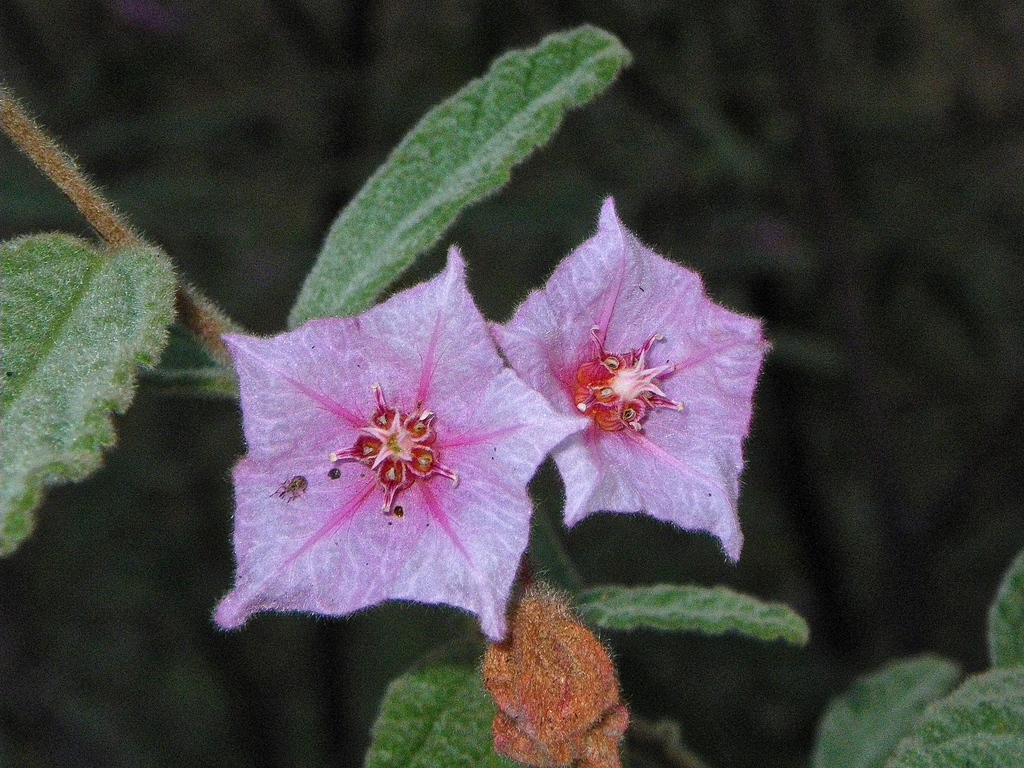
Commersonia magniflora
Commersonia magniflora is a species of flowering plant in the family Malvaceae and endemic to Australia. It is an erect shrub with wrinkled, narrowly oblong to elliptic or egg-shaped leaves, and deep pink flowers.
From the article Commersonia magniflora on Wikipedia (CC BY-SA), quoted section by section
Description
Commersonia magniflora is an erect shrub that typically grows to 1–3 m (3 ft 3 in – 9 ft 10 in) high and wide, its new growth covered with downy hairs. The leaves are narrowly oblong to elliptic or egg-shaped, 10–40 mm (0.39–1.57 in) long and 6–12 mm (0.24–0.47 in) wide on a petiole 1–5 mm (0.039–0.197 in) long with stipules 2–8 mm (0.079–0.315 in) long at the base. The upper surface of the leaves has the veins imprinted, giving it a wrinkled appearance, the edges are serrated and rolled under, and both surfaces are densely covered with star-shaped hairs. The flowers are arranged in groups of 3 to 10 on a peduncle 4–15 mm (0.16–0.59 in) long, each flower on a pedicel 4–12 mm (0.16–0.47 in) long. The flowers are 15–20 mm (0.59–0.79 in) wide with five deep pink, petal-like sepals joined for most of their length, and five cream-coloured petals that are much shorter than the sepals, the ligule narrowly oblong. There is a single, densely hairy staminode between each pair of stamens. Flowering occurs from May to December and the fruit is a hairy, elliptic capsule 8 mm (0.31 in) wide.
Range & habitat
Commersonia magniflora occurs in two disjunct populations. It grows in rocky outcrops, gorges along creeks from Ormiston Gorge and Kings Canyon in the Northern Territory to the north-west corner of South Australia. A second population grows in open woodland and shrubland between Coolgardie and Cunderdin in the Avon Wheatbelt, Coolgardie, Mallee and Murchison bioregions of Western Australia.
== References ==
Wikipedia: “Distribution and habitat”
Where it lives
Recorded sightings
—
geo-referenced records in GBIF, from museums, herbaria and field observers.
Drag the globe to turn it. Dots are where records exist, not a range map; darker means more records.
In the stacks
Searching the stacks…
Every page naming Commersonia magniflora in the Biodiversity Heritage Library →
This page is assembled live from iNaturalist, GBIF, Wikipedia, the Source Library and the Internet Archive. It is not yet part of the hand-edited codex. iNaturalist taxon 968030.