- Animals
- ›Chordates
- ›Vertebrates
- ›Cartilaginous Fishes
- ›Sharks and Rays
- ›Sharks
- ›Galean Sharks
- ›Ground Sharks
- ›Requiem Sharks
- ›Carcharhinus
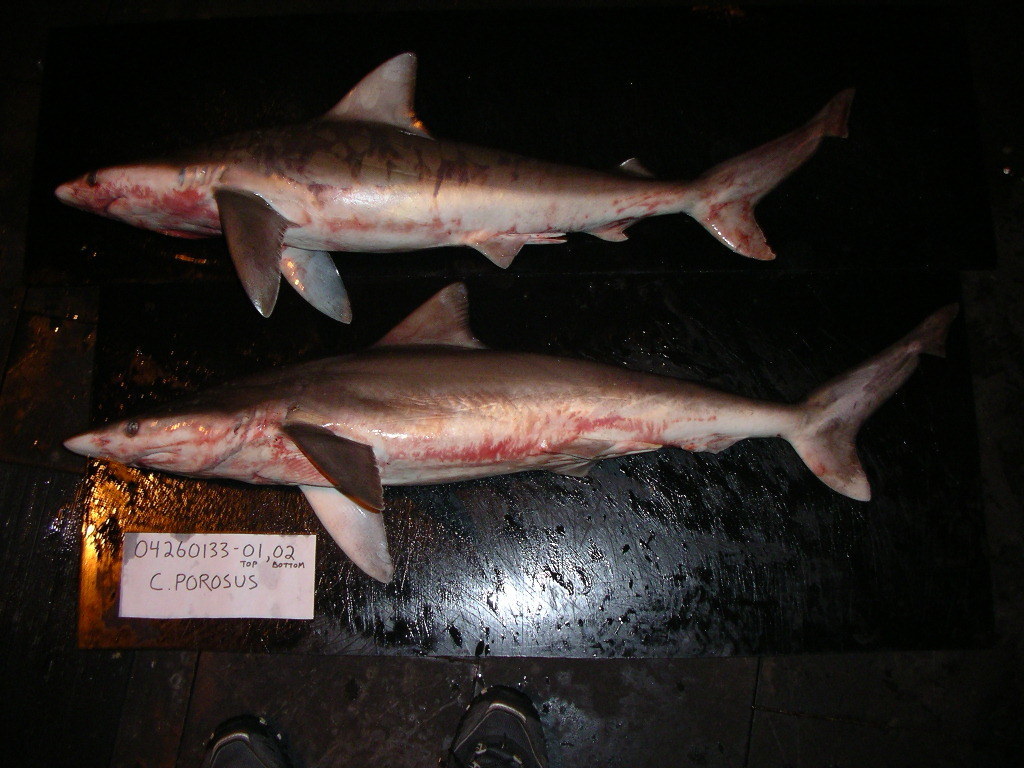
Smalltail Shark
Carcharhinus porosus
The smalltail shark (Carcharhinus porosus) is a species of requiem shark, and part of the family Carcharhinidae. It is found in the western Atlantic Ocean, from the northern Gulf of Mexico to southern Brazil. It inhabits shallow waters close to shore, particularly over muddy bottoms around estuaries. It tends to swim low in the water column and forms large aggregations segregated by sex. A slim species generally not exceeding 1.1 m (3.6 ft) in length, the smalltail shark has a rather long, pointed snout, a broad, triangular first dorsal fin, and a second dorsal fin that originates over the midpoint of the anal fin base. It is plain gray in color, without prominent markings on its fins.
The diet of the smalltail shark consists mainly of bony fishes such as croakers, while crustaceans, cephalopods, and smaller sharks and rays may also be consumed. It is viviparous, meaning the developing embryos are sustained by a placental connection. Females bear litters of two to 9 young on a biennial cycle, following a roughly 12-month gestation period. The smalltail shark is often caught as bycatch and may be used for meat, fins, liver oil, cartilage, and fishmeal. It seems to have declined significantly since the 1980s. Therefore, the International Union for Conservation of Nature has listed it as critically endangered.
From the article Smalltail shark on Wikipedia (CC BY-SA), quoted section by section
Description
The smalltail shark is a slender-bodied species with a fairly long, pointed snout. The leading margin of each nostril is enlarged into a narrow, pointed lobe. The large, circular eyes are equipped with nictitating membranes, and behind them is a series of prominent pores. The mouth bears short furrows at the corners and contains 13–15 tooth rows on either side of both jaws (usually 14 upper and 13 lower). The upper teeth are tall and triangular with strong serrations, becoming increasing oblique towards the sides. The lower teeth are comparatively narrower and more upright, with finer serrations. The five pairs of gill slits are short. The small pectoral fins are falcate (sickle-shaped) with relatively pointed tips. The first dorsal fin is broad, forming nearly an equilateral triangle in adults, with a blunt apex; it originates over the pectoral fin rear tips. The second dorsal fin is small and originates over the midpoint of the anal fin base. No ridge exists between the dorsal fins. The pelvic fins are small with pointed to narrowly rounded tips, and the anal fin has a deep notch in its trailing margin. The asymmetrical caudal fin has a strong lower lobe and a longer upper lobe with a ventral notch near the tip. The dermal denticles mostly do not overlap; each has three to five horizontal ridges leading to posterior teeth, with the central one the longest. …
Range & habitat
The known range of the smalltail shark extends from the northern Gulf of Mexico to southern Brazil, excluding the Caribbean islands (aside from Trinidad and Tobago). Its center of abundance is along the northern Brazilian coast, off Pará and Maranhão, where it is the most common shark. This species has not been reported east of the Mississippi River in the past 50 years, despite historical evidence of a nursery area off Louisiana. The smalltail shark can usually be found close to the bottom in inshore waters no deeper than 36 m (118 ft). Off northern Brazil, its environment is characterized by tides up to 7 m (23 ft) high and reaching 7.5 knots; the salinity fluctuates between 14 ppt in the rainy season and 34 ppt in the dry season, and the temperature ranges from 25 to 32 °C (77 to 90 °F). It favors estuarine areas with muddy bottoms.
Wikipedia: “Distribution and habitat”
What it does
The smalltail shark forms large aggregations segregated by sex, with the males generally found deeper than the females. It feeds mainly on bony fishes, including sea catfish, croakers, jacks, and grunts. Shrimp, crabs, and squid are secondary food sources, while adults are also capable of taking young sharpnose sharks (Rhizoprionodon), hammerhead sharks (Sphyrna), and stingrays (Dasyatis). Opportunistic in habits, the dietary composition of this shark generally reflects what is most available in its environment; off northern Brazil, the most important prey species are the croakers Macrodon ancylodon and Stellifer naso. Juveniles consume a wider variety of prey than adults. In turn, the smalltail shark may potentially be preyed upon by larger sharks. Like other members of its family, the smalltail shark is viviparous: once the developing embryos exhaust their supply of yolk, the yolk sac develops into a placental connection through which the mother delivers nourishment. Females produce litters of two to 9 (typically four to six) young every other year; litter size increases with the size of the female. The gestation period lasts around 12 months. Reproduction occurs throughout the year, with a peak in birthing from September to November. Known nursery areas occur in shallow, murky waters off northern Brazil and Trinidad, where many bays and estuaries provide shelter and food. …
Wikipedia: “Biology and ecology”
Where it lives
Recorded sightings
—
geo-referenced records in GBIF, from museums, herbaria and field observers.
Drag the globe to turn it. Dots are where records exist, not a range map; darker means more records.
In the stacks
Searching the stacks…
Every page naming Carcharhinus porosus in the Biodiversity Heritage Library →
This page is assembled live from iNaturalist, GBIF, Wikipedia, the Source Library and the Internet Archive. It is not yet part of the hand-edited codex. iNaturalist taxon 96764.