- Animals
- ›Chordates
- ›Vertebrates
- ›Cartilaginous Fishes
- ›Sharks and Rays
- ›Sharks
- ›Galean Sharks
- ›Ground Sharks
- ›Requiem Sharks
- ›Carcharhinus
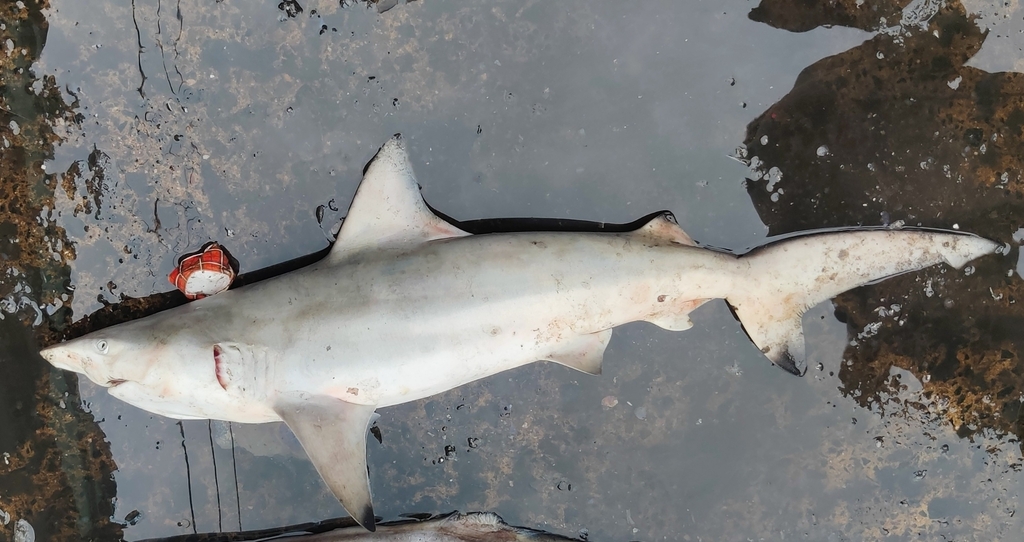
Pondicherry Shark
Carcharhinus hemiodon
The Pondicherry shark (Carcharhinus hemiodon) is an extremely rare species of requiem shark, in the family Carcharhinidae. A small and stocky gray shark, it grows not much longer than 1 m (3.3 ft) and has a fairly long, pointed snout. This species can be identified by the shape of its upper teeth, which are strongly serrated near the base and smooth-edged near the tip, and by its first dorsal fin, which is large with a long free rear tip. Furthermore, this shark has prominent black tips on its pectoral fins, second dorsal fin, and caudal fin lower lobe.
The Pondicherry shark is critically endangered. It was once found throughout Indo-Pacific coastal waters from the Gulf of Oman to New Guinea, and is known to enter fresh water. Fewer than 20 specimens are available for study, and most aspects of its natural history are unknown. It probably feeds on bony fishes, cephalopods, and crustaceans, and gives birth to live young with the embryos forming a placental connection to their mother. While the International Union for Conservation of Nature (IUCN) has listed the Pondicherry shark as Critically endangered, it had been thought to be extinct since the 1970s. It is probably threatened by intense and escalating fishing pressure throughout its range. The shark is among the 25 "most wanted lost" species that are the focus of Global Wildlife Conservation's "Search for Lost Species" initiative. The last definitive sighting was from 1979 in India, though putative sightings have been recently reported, some of which were considered to be erroneous.
From the article Pondicherry shark on Wikipedia (CC BY-SA), quoted section by section
Description
The Pondicherry shark has a robust build and a moderately long, pointed snout. The large and circular eyes are equipped with nictitating membranes. Each nostril is broad with a small, narrow nipple-shaped lobe on the anterior rim. The arched mouth lacks conspicuous furrows or enlarged pores at the corners. The upper and lower jaws contain 14–15 and 12–14 tooth rows on either side respectively; in addition, there are one or two rows of small teeth at the upper and lower symphyses (jaw midpoints). The upper teeth have a single narrow, smooth-edged central cusp, flanked on both sides by very large serrations. The lower teeth are narrower and more upright than the uppers, and may be smooth to finely serrated. The five pairs of gill slits are fairly long. Originating below the fourth pair of gill slits, the pectoral fins are short, broad, and falcate (sickle-shaped) with pointed tips. The first dorsal fin is tall and falcate with a distinctively long free rear tip, and is positioned just behind the pectoral fin bases. The second dorsal fin is large and tall without a notably elongated free rear tip, and is positioned over or slightly behind the anal fin. Usually there is no midline ridge between the dorsal fins, and when present the ridge is slight. The caudal peduncle has a deep crescent-shaped notch at the upper caudal fin origin. …
Range & habitat
The Pondicherry shark appears to have been broadly distributed in the Indo-Pacific. It may have once been common, as it was reportedly a regular catch off India and Pakistan, but is now extremely rare. Most of the known specimens were collected from India, with more specimens from the Gulf of Oman, Borneo, and Java. There are also less reliable records from the South China Sea, other parts of Southeast Asia such as Vietnam and the Philippines, New Guinea, and northern Australia. This species inhabits inshore waters. Several older sources reported that it could be found in rivers such as the Hooghli River and the Saigon River. These reports may have confused a river shark (Glyphis sp.) for the Pondicherry shark; if accurate, they would suggest this species to be tolerant of low salinity.
Wikipedia: “Distribution and habitat”
What it does
The diet of the Pondicherry shark is thought to consist of small bony fishes, cephalopods, and crustaceans. A parasite documented from this species is the tapeworm Acanthobothrium paramanandai. Like other requiem sharks, it is viviparous with the developing embryos sustained to term via a placental connection to the mother, though specific details are unknown. The smallest known specimen is a female 32 cm (13 in) long, which may be close to the birth size. Sexual maturity is attained at a length of over 60 cm (24 in).
Wikipedia: “Biology and ecology”
Where it lives
Recorded sightings
—
geo-referenced records in GBIF, from museums, herbaria and field observers.
Drag the globe to turn it. Dots are where records exist, not a range map; darker means more records.
In the stacks
Searching the stacks…
Every page naming Carcharhinus hemiodon in the Biodiversity Heritage Library →
This page is assembled live from iNaturalist, GBIF, Wikipedia, the Source Library and the Internet Archive. It is not yet part of the hand-edited codex. iNaturalist taxon 96757.