- Animals
- ›Chordates
- ›Vertebrates
- ›Cartilaginous Fishes
- ›Sharks and Rays
- ›Sharks
- ›Galean Sharks
- ›Ground Sharks
- ›Requiem Sharks
- ›Carcharhinus
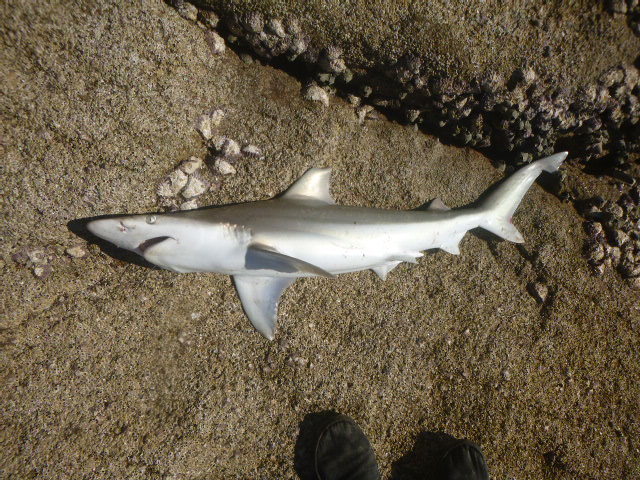
Creek Whaler
Carcharhinus fitzroyensis
The creek whaler (Carcharhinus fitzroyensis) is a common species of requiem shark, and part of the family Carcharhinidae, endemic to northern Australia. It frequents shallow waters close to shore, including estuaries. This small, stocky shark usually grows to 1.0–1.3 m (3.3–4.3 ft) long and is brownish in color without conspicuous fin markings. It can be identified by its long snout, large, triangular pectoral fins, and large, anteriorly positioned first dorsal fin.
The diet of the creek whaler consists mainly of small teleost fishes and crustaceans. It is viviparous, with the unborn young being sustained through a placental connection. The defined mating season lasts from May to July. Females give birth to one to seven pups annually, following a gestation period of seven to 9 months. A small number of creek whalers are caught incidentally in inshore gillnets and used for food, but the effect of fishing on its population seems to be inconsequential. As a result, the IUCN has listed this species under Least Concern.
From the article Creek whaler on Wikipedia (CC BY-SA), quoted section by section
Description
The body of the creek whaler is spindle-shaped and rather stocky. The long snout has a narrowly parabolic shape and large nostrils preceded by small, nipple-shaped flaps of skin. The eyes are circular and of medium size, and are equipped with nictitating membranes. The arched mouth has very short furrows at the corners. There are 30 upper and 28–30 lower tooth rows. The upper teeth are long and triangular with strongly serrated edges, and become increasing angled towards the sides of the jaw. The lower teeth are slender and upright with finely serrated edges. The five pairs of gill slits are short. The pectoral fins are distinctively large and triangular, with rounded to pointed tips. The large first dorsal fin originates over the rear of the pectoral fin bases. The second dorsal fin is relatively tall and long, and originates over or slightly behind the anal fin origin. There is no ridge between the dorsal fins. The anal fin is larger than the second dorsal fin. There is a crescent-shaped notch on the caudal peduncle just before the origin of the upper caudal fin lobe. The asymmetrical caudal fin has a well-developed lower lobe and a longer upper lobe with a ventral notch near the tip. The skin is densely covered by overlapping dermal denticles, each bearing three to five horizontal ridges leading to marginal teeth. …
Range & habitat
The range of the creek whaler is restricted to northern Australia, between Gladstone in central Queensland and Cape Cuvier in Western Australia. It is a common species that inhabits estuaries and inshore waters from the intertidal zone to a depth of at least 40 m (130 ft).
Wikipedia: “Distribution and habitat”
What it does
The creek whaler feeds predominantly on small teleost fishes (including threadfin breams and lizardfishes) and crustaceans (including penaeid prawns and mantis shrimps); cephalopods are also infrequently consumed. Known parasites of this species include the tapeworm Callitetrarhynchus gracilis, and a nematode in the genus Pulchrascaris. Like other members of its family, the creek whaler is viviparous, with the developing embryos receiving nourishment from the mother through a placental connection formed from the depleted yolk sac. Females produce litters of one to seven young every year. Mating occurs between May and July, with the females storing the sperm until ovulation takes place between July and September. After a gestation period of seven to 9 months, birthing occurs between February and May of the following year. The newborns measure 35–50 cm (14–20 in) long and spend their first few months of life in shallow, inshore nursery areas such as Cleveland Bay in north Queensland. Males and females attain sexual maturity at lengths of around 83–88 cm (33–35 in) and 90–100 cm (35–39 in), respectively.
Wikipedia: “Biology and ecology”
Where it lives
Recorded sightings
—
geo-referenced records in GBIF, from museums, herbaria and field observers.
Drag the globe to turn it. Dots are where records exist, not a range map; darker means more records.
In the stacks
Searching the stacks…
Every page naming Carcharhinus fitzroyensis in the Biodiversity Heritage Library →
This page is assembled live from iNaturalist, GBIF, Wikipedia, the Source Library and the Internet Archive. It is not yet part of the hand-edited codex. iNaturalist taxon 96755.