- Plants
- ›Vascular Plants
- ›flowering plants
- ›monocots
- ›Agaves, Orchids, Irises, and Allies
- ›Orchids
- ›Orchidoid Orchids
- ›Diurideae
- ›Prasophyllinae
- ›Prasophyllum
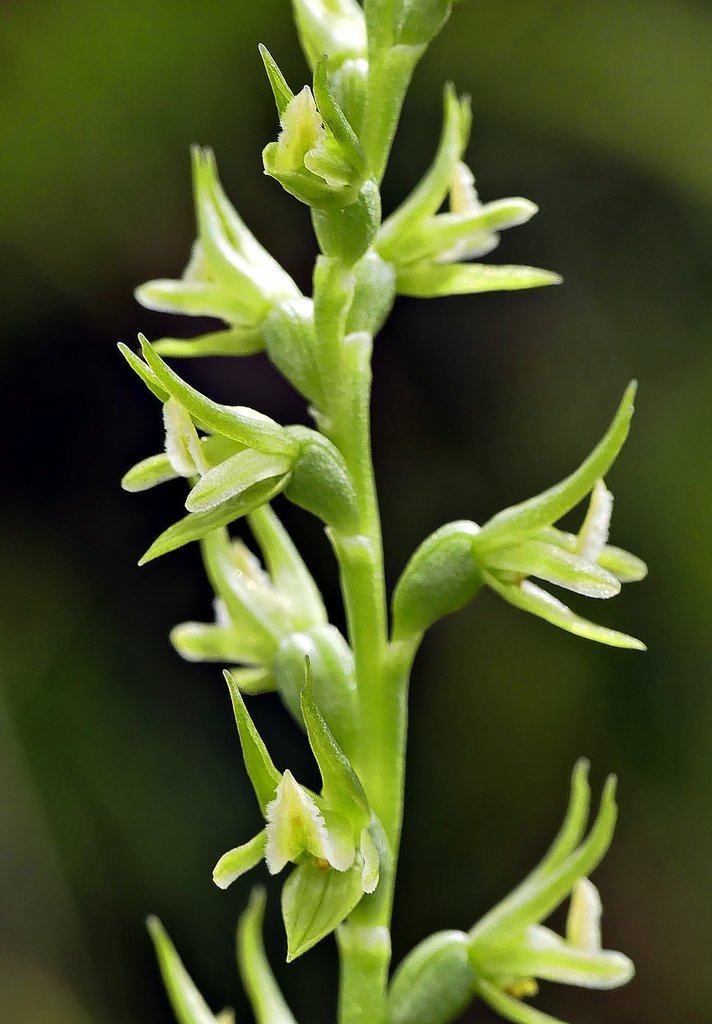
pale leek orchid
Prasophyllum pallidum
Prasophyllum pallidum, commonly known as the pale leek orchid, is a species of orchid endemic to a south-eastern South Australia. It has a single tubular leaf and up to thirty green or yellowish-green flowers. It was previously thought to occur in Victoria but records from that state are now recognised as P. roseum.
From the article Prasophyllum pallidum on Wikipedia (CC BY-SA), quoted section by section
Description
Prasophyllum pallidum is a terrestrial, perennial, deciduous, herb with an underground tuber and a single tube-shaped leaf 150–350 mm (6–10 in) long and 3–5 mm (0.1–0.2 in) wide. Between fifteen and thirty five flowers are well-spaced along a flowering stem 70–100 mm (3–4 in) long which reaches to a height of 300–500 mm (10–20 in). The flowers are green or yellowish-green and as with others in the genus, are inverted so that the labellum is above the column rather than below it. The ovary is swollen, realively large compared to the rest of the flower and stands out from the flowering stem. The dorsal sepal is lance-shaped to egg-shaped, 5–7 mm (0.2–0.3 in) long, about 3 mm (0.1 in) wide and slightly dished. The lateral sepals are a similar length to the dorsal sepal but narrower and are free from each other. The petals are 4–5 mm (0.16–0.20 in) long, about 1 mm (0.04 in) wide and curve forwards. The labellum is wedge-shaped to egg-shaped, about 5 mm (0.2 in) long and 3 mm (0.1 in) wide and turns sharply upwards near its middle. The edges of the labellum are crinkled and there is a pale green, fleshy callus along the centre of the labellum, extending almost to its tip. Flowering occurs from September to November and is stimulated by earlier fires.
Range & habitat
The pale leek orchid mostly grows in grassy forest from the Flinders Ranges to the Mount Lofty Ranges.
Wikipedia: “Distribution and habitat”
Where it lives
Recorded sightings
—
geo-referenced records in GBIF, from museums, herbaria and field observers.
Drag the globe to turn it. Dots are where records exist, not a range map; darker means more records.
In the stacks
Searching the stacks…
Every page naming Prasophyllum pallidum in the Biodiversity Heritage Library →
This page is assembled live from iNaturalist, GBIF, Wikipedia, the Source Library and the Internet Archive. It is not yet part of the hand-edited codex. iNaturalist taxon 957033.