- Plants
- ›Vascular Plants
- ›flowering plants
- ›Dicots
- ›myrtles, evening primroses, and allies
- ›myrtle family
- ›Myrtoideae
- ›Leptospermeae
- ›Leptospermum
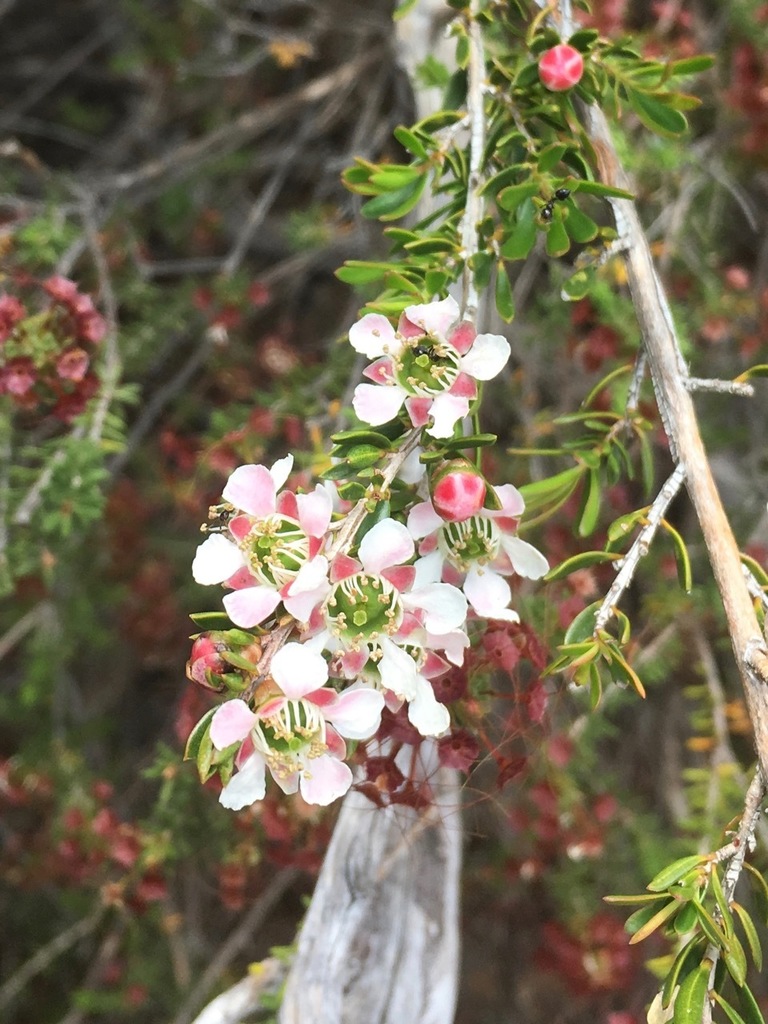
Leptospermum novae-angliae
Leptospermum novae-angliae is a species of shrub that is endemic to eastern Australia. It has elliptical leaves that are usually crowded, single white flowers on short shoots and fruit that remain on the plant until it dies. It usually grows in rocky places.
From the article Leptospermum novae-angliae on Wikipedia (CC BY-SA), quoted section by section
Description
Leptospermum novae-angliae is a shrub that typically grows to a height of up to 2 m (6 ft 7 in) with flaking bark on the older stems. Younger stems are silky-hairy at first, becoming glabrous later. The leaves are crowded, broadly to very narrow elliptical, 5–15 mm (0.20–0.59 in) long and 1–4 mm (0.039–0.157 in) wide tapering to a short, broad petiole. The flowers are borne singly on the ends of side shoots that continue to grow after flowering. The flowers are white, 10–12 mm (0.39–0.47 in) wide with reddish brown bracts at the base of the flower bud and sometimes the open flower. The floral cup is glabrous, about 4 mm (0.16 in) long and covered with conspicuous glands. The sepals are broadly egg-shaped, about 2.5 mm (0.098 in) long, the petals about 5 mm (0.20 in) long and the stamens 2.5–4 mm (0.098–0.157 in) long. Flowering mainly occurs from October to November and the fruit is a variably-sized capsule 5–12 mm (0.20–0.47 in) in diameter but often wider or narrower. The fruit remains on the plant until it dies, the sepal remnants having fallen.
Range & habitat
This tea-tree grows in heath and forest in rocky places, especially on granite outcrops on the New England Tableland and nearby areas of the Western Slopes of New South Wales and south-eastern Queensland, north from Point Lookout.
Wikipedia: “Distribution and habitat”
Where it lives
Recorded sightings
—
geo-referenced records in GBIF, from museums, herbaria and field observers.
Drag the globe to turn it. Dots are where records exist, not a range map; darker means more records.
In the stacks
Searching the stacks…
Every page naming Leptospermum novae-angliae in the Biodiversity Heritage Library →
This page is assembled live from iNaturalist, GBIF, Wikipedia, the Source Library and the Internet Archive. It is not yet part of the hand-edited codex. iNaturalist taxon 954670.