- Plants
- ›Vascular Plants
- ›flowering plants
- ›Dicots
- ›Mints, Plantains, Olives, and Allies
- ›figwort family
- ›Myoporeae
- ›Myoporum
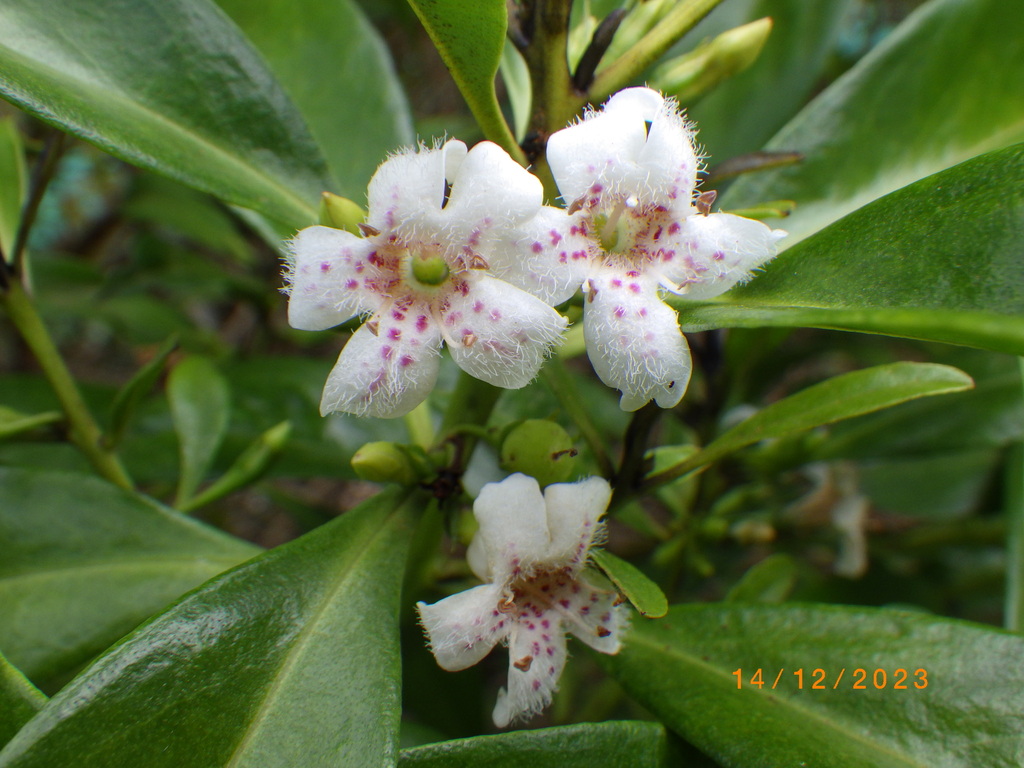
Myoporum obscurum
Myoporum obscurum, commonly known as popwood, sandalwood or bastard ironwood is a plant in the figwort family, Scrophulariaceae. It is a very rare shrub, endemic to Norfolk Island where it occurs in a few scattered locations.
From the article Myoporum obscurum on Wikipedia (CC BY-SA), quoted section by section
Description
Myoporum obscurum is a spreading shrub or small dome-shaped tree which sometimes grows to a height of 6 metres (20 ft). The leaves are arranged alternately and are thin, elliptic to lance-shaped, 69–135 millimetres (3–5 in) long, 25–40 millimetres (1–2 in) wide, have a shiny upper surface and a dull lower one with a distinct mid-vein. The edges of the leaf are wavy and occasionally have a few small teeth near the end. The flowers appear in groups of 3 to 6 in the axils of the leaves on the end of flattened stalks 6.5–11 millimetres (0.3–0.4 in) long. They have 5 lance-shaped sepals and 5 petals joined at their bases to form a tube. The tube is 4–6 millimetres (0.16–0.24 in) long and the lobes are about the same length as the tube. The tube is white, spotted purple on the lobes and inside the tube and the inside of the tube is hairy. There are 4 stamens which extend slightly beyond the petal tube. The fruit is an oval-shaped, reddish drupe.
Range & habitat
Only a few specimens of Myoporum obscurum remain and only in a few scattered locations on Norfolk Island. The species was common on nearby Phillip Island in 1830, but along with most of the rest of the vegetation there, was lost in the 19th century due to erosion caused by the introduction of pest animals such as rabbits. In 2003 only 5 plants were known on Norfolk Island, all in the national park. Since then, a management plan for the species has been prepared and a number of specimens of popwood have been planted. It does not tolerate shade and is generally found on forest margins.
Wikipedia: “Distribution and habitat”
What it does
Little is known of the ecology of popwood, other than it is threatened by competition from weed species.
Wikipedia: “Ecology”
Where it lives
Recorded sightings
—
geo-referenced records in GBIF, from museums, herbaria and field observers.
Drag the globe to turn it. Dots are where records exist, not a range map; darker means more records.
In the stacks
Searching the stacks…
Every page naming Myoporum obscurum in the Biodiversity Heritage Library →
This page is assembled live from iNaturalist, GBIF, Wikipedia, the Source Library and the Internet Archive. It is not yet part of the hand-edited codex. iNaturalist taxon 952787.