- Plants
- ›Vascular Plants
- ›flowering plants
- ›Dicots
- ›Buttercups, Poppies, and Allies
- ›buttercup family
- ›Anemones, buttercups, larkspurs and allies
- ›anemones and allies
- ›Anemonoides
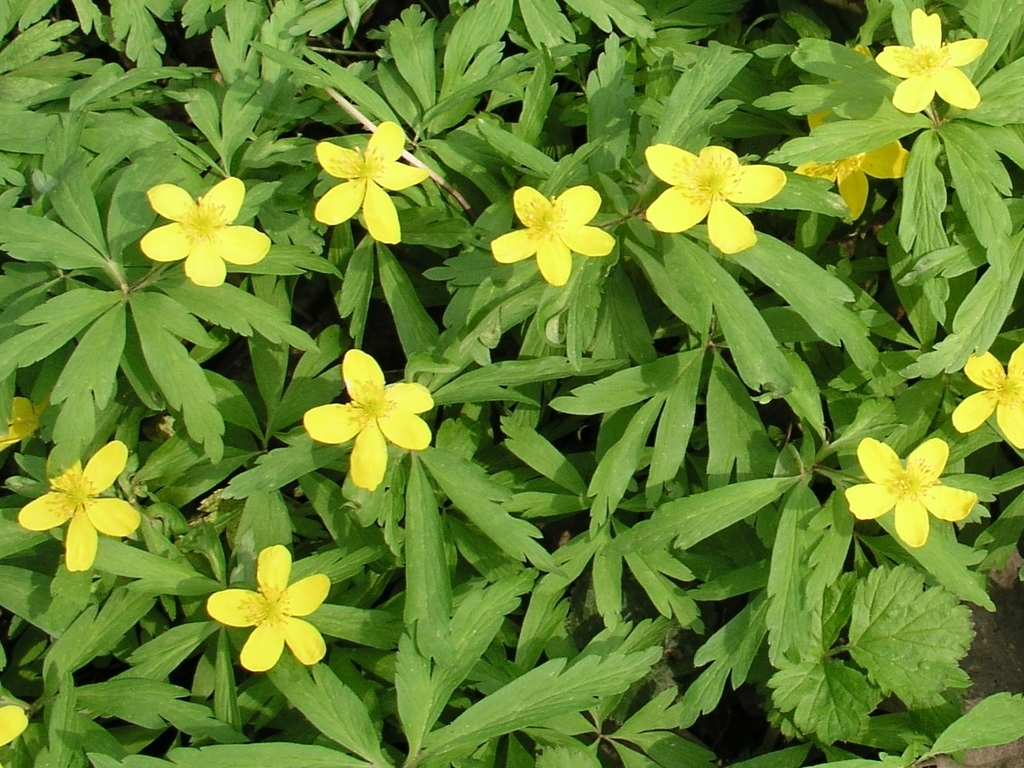
Yellow Anemone
Anemonoides ranunculoides
Anemonoides ranunculoides (syn. Anemone ranunculoides), the yellow anemone, yellow wood anemone, or buttercup anemone, is a species of herbaceous perennial plant that grows in forests across most of Continental Europe, and less frequently in the Mediterranean region. It is occasionally found as a garden escape.
From the article Anemonoides ranunculoides on Wikipedia (CC BY-SA), quoted section by section
Description
Growing to 5–15 centimetres (2.0–5.9 in) tall, the plant is herbaceous, dying back down to its root-like rhizomes by mid summer. The rhizomes spread just below the soil surface and multiply quickly, contributing to its rapid spread in woodland conditions. The flower is about 1.5 centimetres (0.59 in) diameter, with from five to eight petal-like segments (actually tepals) of rich yellow colouring. In its native range, it flowers between March and May.
Range & habitat
The native range of Anemonoides ranunculoides extends across Continental Europe to southwest Siberia, reaching as far south as the Caucasus Mountains in Turkey. The species has been introduced into Great Britain and elsewhere. In Canada, there is a naturalized population at a well-known site in Quebec.
Wikipedia: “Distribution”
How it is grown
The plant is widely grown as a garden plant, especially by rock garden and alpine garden enthusiasts. It has been awarded an Award of Garden Merit or AGM by the Royal Horticultural Society. The RHS describes it as H4 (hardy throughout the British Isles). The double-flowered form 'Pleniflora' (sometimes listed as 'Flore Pleno') is also a recipient of the award. 'Frank Waley', a larger-growing, more robust cultivar, is sometimes available, as are the miniature subspecies A. ranunculoides subsp. wockeana and a selection known as 'Laciniata', with finely divided leaves.
Wikipedia: “Cultivation”
Where it lives
Recorded sightings
—
geo-referenced records in GBIF, from museums, herbaria and field observers.
Drag the globe to turn it. Dots are where records exist, not a range map; darker means more records.
In the old herbals & bestiaries

In the stacks
Searching the stacks…
Every page naming Anemonoides ranunculoides in the Biodiversity Heritage Library →
This page is assembled live from iNaturalist, GBIF, Wikipedia, the Source Library and the Internet Archive. It is not yet part of the hand-edited codex. iNaturalist taxon 950596.