- Plants
- ›Vascular Plants
- ›flowering plants
- ›Dicots
- ›proteas, lotuses, planes, and allies
- ›Protea family
- ›Paired Proteas
- ›Embothrieae
- ›Hakeinae
- ›Grevillea
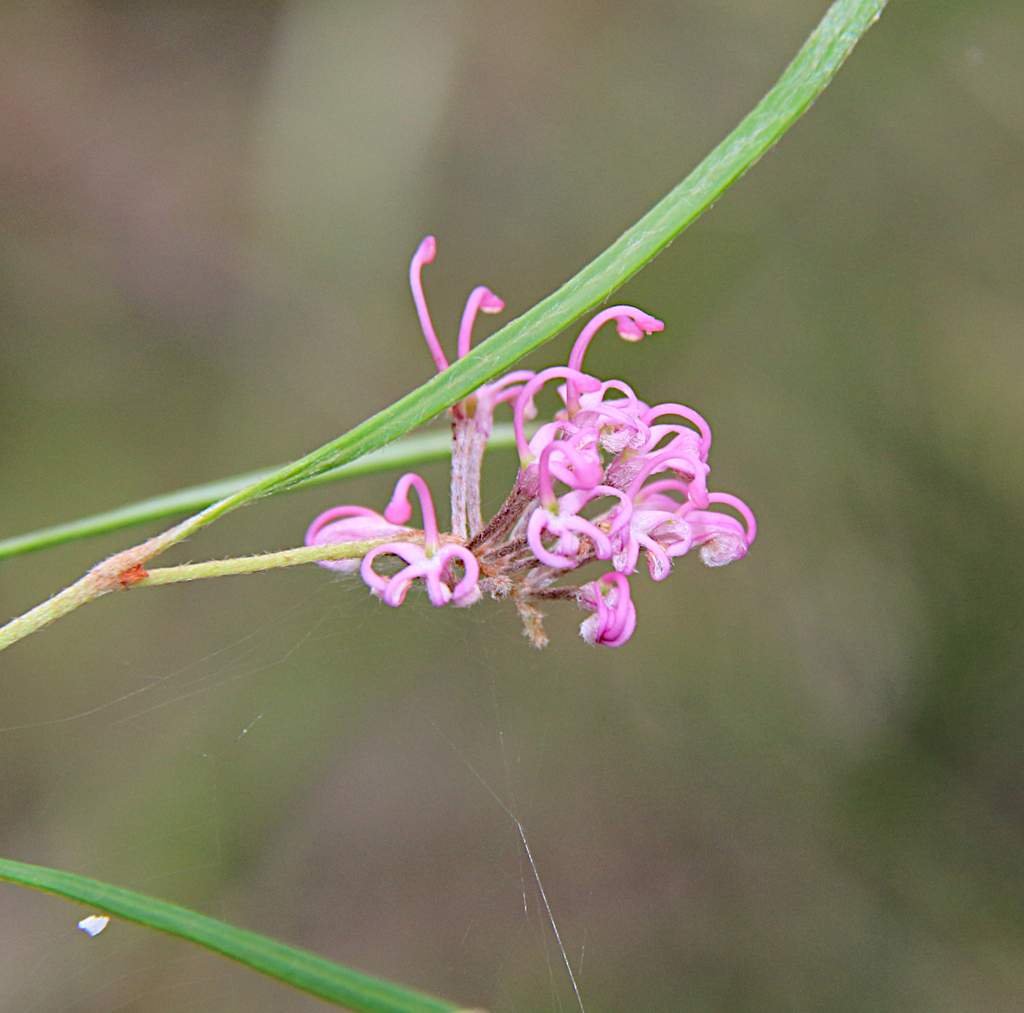
Grevillea reptans
Grevillea reptans, also known as the Tin Can Bay grevillea, is a species of flowering plant in the family Proteaceae and is endemic to south-eastern Queensland. It is usually a prostrate shrub with long vine-like or arching branches, more or less linear leaves, and branched clusters of mauve-pink flowers.
From the article Grevillea reptans on Wikipedia (CC BY-SA), quoted section by section
Description
Grevillea reptans is usually a prostrate to arching sub-shrub that typically grows to a height of up to 30 cm (12 in) and has long, pliable, vine-like or arching branches. The leaves are more or less linear, 6–12 mm (0.24–0.47 in) long and 1–2 mm (0.039–0.079 in) wide with the edges rolled under. The flowers are arranged on the ends of branches in branched clusters on a peduncle 10–40 mm (0.39–1.57 in) long, each branch of the flowering clusters with 16 to 24 flowers on one side of the flowering rachis, the youngest flowers towards the ends of the rachis. The flowers are mauve-pink and woolly- to shaggy-hairy, the style becoming red as it ages, the pistil 7–9 mm (0.28–0.35 in) long. Flowering mainly occurs from August to November, and the fruit is a follicle 7–9 mm (0.28–0.35 in) long.
Range & habitat
Tin Can Bay grevillea grows in shrubby woodland and heathy wallum in scattered places between Burrum Heads, Tewantin and Cooloola National Park, north of Brisbane in south-eastern Queensland.
Wikipedia: “Distribution and habitat”
Where it lives
Recorded sightings
—
geo-referenced records in GBIF, from museums, herbaria and field observers.
Drag the globe to turn it. Dots are where records exist, not a range map; darker means more records.
In the stacks
Searching the stacks…
Every page naming Grevillea reptans in the Biodiversity Heritage Library →
This page is assembled live from iNaturalist, GBIF, Wikipedia, the Source Library and the Internet Archive. It is not yet part of the hand-edited codex. iNaturalist taxon 946819.