- Animals
- ›Chordates
- ›Vertebrates
- ›Cartilaginous Fishes
- ›Sharks and Rays
- ›Rays
- ›Shovelnose Rays
- ›Sawfishes
- ›Anoxypristis
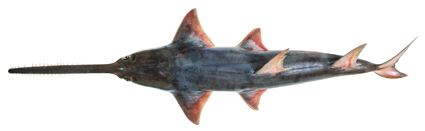
Narrow Sawfish
Anoxypristis cuspidata
The narrow sawfish (Anoxypristis cuspidata), also known as the pointed sawfish or knifetooth sawfish, is a species of sawfish in the family Pristidae, part of the Batoidea, a superorder of cartilaginous fish that include the rays and skates. Sawfish display a circumglobal distribution in warm marine and freshwater habitats. Their extant biodiversity is limited to five species belonging to two genera (Pristis and Anoxypristis). The sawfishes are characterised by the long, narrow, flattened rostrum or extension on their snout. This is lined with sharp transverse teeth, arranged in a way that resembles the teeth of a saw and are used for killing prey. It is found in the shallow coastal waters and estuaries of the Indo-West Pacific, ranging from the Persian Gulf to southern Japan, Papua New Guinea and northern Australia. It is the only living member of the genus Anoxypristis, but was previously included in the genus Pristis. Compared to Pristis, Anoxypristis has a narrower rostral saw with numerous teeth on the distal part and no teeth on the basal one-quarter (toothless section about one-sixth in juveniles). It reaches a length of up to 3.5 m (11 ft).
In addition to the living Anoxypristis cuspidata, this genus includes a few extinct species that are only known from fossil remains.
From the article Knifetooth sawfish on Wikipedia (CC BY-SA), quoted section by section
Description
The narrow sawfish grows to a maximum length of about 3.5 m (11 ft), although there are highly questionable and unconfirmed claims of much larger individuals. Its body is generally shark-like, but its most obvious feature is the flattened head, which is extended forward in a blade-like bony snout with, in Australian waters, 18 to 22 pairs of sideways-facing teeth. However, elsewhere there may be as many as 25. These teeth are short, flat, and roughly triangular in shape. The blade does not taper towards its point and in adults, the basal one-quarter is devoid of teeth. In juveniles, about one-sixth of the base is toothless. The nostrils are narrow and partially concealed by nasal flaps. The skin of young sawfish is smooth, but on older individuals, it is sparsely covered in dermal denticles. The dorsal (upper) side of the fish is greyish and the ventral (lower) side and fins are a pale grey color. The rostrum is grey with white teeth and sometimes has a chocolate-brown base portion.
Range & habitat
The narrow sawfish was historically distributed across a broad swathe of the Indo-Pacific Ocean. It is, or was, present in the waters off Iran, India, Sri Lanka, Bangladesh, Malaysia, Burma, Indonesia, and Papua New Guinea. At its western extreme, it is present in the Arabian Sea, extending as far south as Somalia. Its northern limit was the Bohai Sea, China, South Korea, and the most southerly parts of Japan, although its presence in the latter two countries may have been restricted to vagrants, and its southern limit is the northern Australian states of Western Australia, the Northern Territory, and Queensland. At present, it is known to exist only in the eastern Arabian Sea, parts of South Asia and Australia and Papua New Guinea. The narrow sawfish is bentho-pelagic and is found at depths of about 100 meters (330 feet). The narrow sawfish prefers soft bottom-substrates, such as sand, mud, or seagrass, to rocky or coraline habitats. It can tolerate low salinity levels and is found in inshore waters, including bays and estuaries. The narrow sawfish is euryhaline, meaning it can tolerate a wide range of salinity and move between estuarine and marine environments. It undergoes an ontogenetic shift in habitat. Larger individuals are commonly found offshore, whereas smaller individuals are found inshore. …
Wikipedia: “Distribution and habitat”
What it does
The breeding behavior of the narrow sawfish has been little studied. Fertilization is internal, and a number of young develop at one time in the oviduct, each one being nourished from a yolk sac. Mating season varies by geographic region, and pups are born after a gestational period of about five months. Litter sizes range from 6 to 23 pups with an average of 12. The pups are usually 43–61 cm (17–24 in) long at birth, and their rostral teeth are not fully developed, being covered by a membrane, which prevents them from damaging the mother's tissues. Only two studies have been conducted on the age and growth of the narrow sawfish. The longest-lived narrow sawfish found was nine years old. However, the theoretical longevity is calculated to be 27 years. Females begin to mature at 8 feet 1 inch (2.46 m) total length and are fully mature at 15 feet 5 inches (4.70 m). Males are fully mature at 8 feet (2.4 m) total length.
Wikipedia: “Reproduction and life history”
Where it lives
Recorded sightings
—
geo-referenced records in GBIF, from museums, herbaria and field observers.
Drag the globe to turn it. Dots are where records exist, not a range map; darker means more records.
In the stacks
Searching the stacks…
Every page naming Anoxypristis cuspidata in the Biodiversity Heritage Library →
This page is assembled live from iNaturalist, GBIF, Wikipedia, the Source Library and the Internet Archive. It is not yet part of the hand-edited codex. iNaturalist taxon 94203.