- Animals
- ›Chordates
- ›Vertebrates
- ›Cartilaginous Fishes
- ›Sharks and Rays
- ›Rays
- ›Skates
- ›Hardnose Skates
- ›Amblyraja
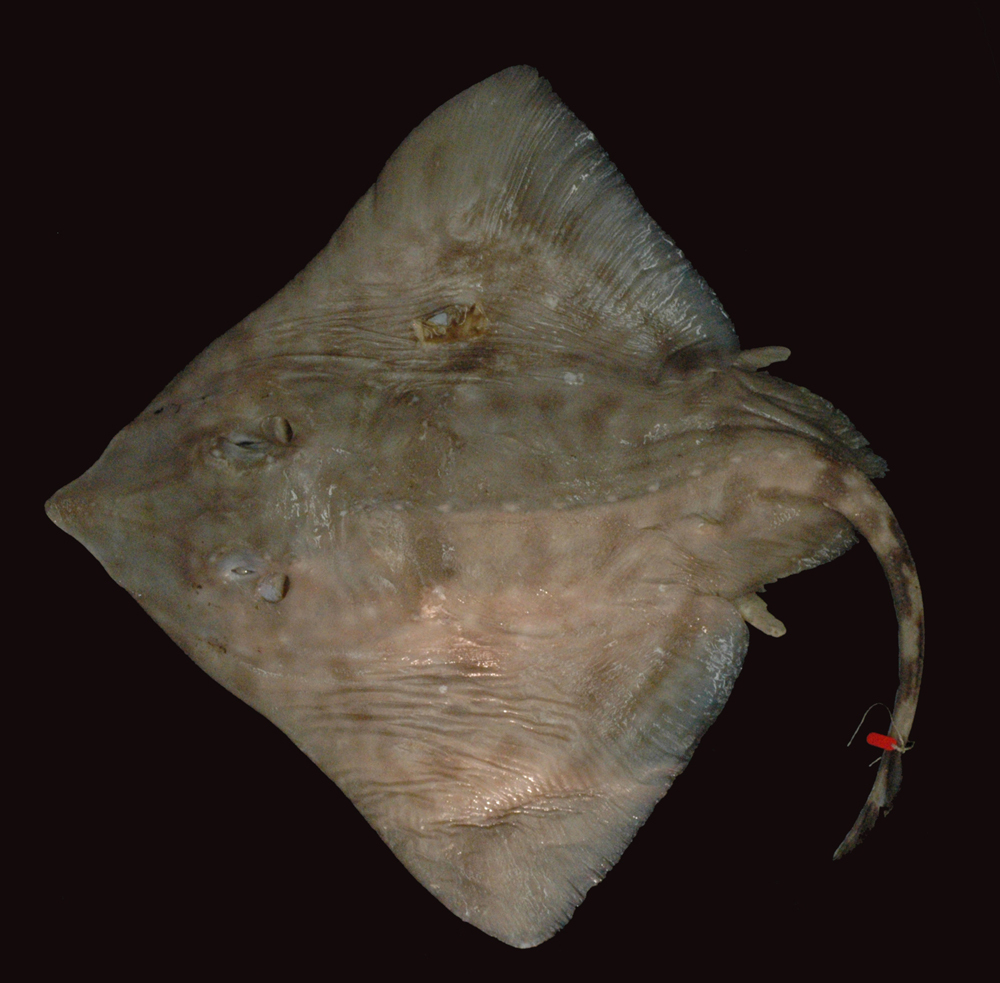
Shorttail Skate
Amblyraja jenseni
The Shorttail skate (Amblyraja jenseni) is a species of fish in Rajidae family. It occurs all around North Atlantic, off the coasts of New England, Nova Scotia, Grand Banks of Newfoundland, Iceland and Ireland and also on the Mid-Atlantic ridge in depths of 167 to 2,548 metres (548 to 8,360 ft). Its maximum size is 74.3 centimetres (29.3 in) for males and 85 centimetres (33 in) for females. It eats teleost fishes and crustaceans. The back of the animal...
From the article Jensen's skate on Wikipedia (CC BY-SA), quoted section by section
Range & habitat
Jensen's skate has been found in three main regions: the North-East Atlantic Ocean, the North-West Atlantic, and the Mid-Atlantic Ridge. The skate's known range includes the waters off the coast of North America near New England down to South Carolina, off the coast of Greenland, and across the Atlantic, west of the British Isles. Specimens derived from the three main regions have different morphological features, varying in color and size likely due to long-term geographical isolation. Given that only a few specimens have been analyzed (n=19), it is hard to define exact geographical morphology differences, but researchers conclude there are regional differences to some degree. Specimens from the North-East Atlantic and North-West Atlantic are more similar to each other morphologically than they are to specimens from the Mid-Atlantic Ridge. Jensen's skate is a benthic-benthopelagic species, inhabiting very deep marine environments. Specimens collected in the Mid-Atlantic Range were found at the greatest mean depth of 1996 m. Specimens from the North-East Atlantic were found in a similar range, with a mean of 1650 m, and specimens from the North-West Atlantic were found at the shallowest mean depth of 864 m. The North-East Atlantic waters Jensen's skate occupies have mean temperatures ranging (-0.1–6.9 ˚C).
Wikipedia: “Distribution and habitat”
In human culture
Jensen's skate feeds on fish, cephalopods, and decapod crustaceans, filling a similar ecological role as higher predators. Other species of deep-sea skates have similar diets. Sexual maturity in skates can be determined by measuring their reproductive organs, which are correlated with the total length of the organisms. Male Jensen's skates reach sexual maturity when they are greater than 106 cm long, while female Jensen's skates reach sexual maturity when they are greater than 96 cm. Male skates have reproductive organs called claspers, which help hold onto the female during copulation. Juvenile male Jensen's skates typically have 0.2 cm long claspers, which increase in length as the fish grows until it reaches sexual maturity. After copulation, female skates develop pairs of purses, or egg cases, within their uterus. Jensen's skates are oviparous, meaning that the female eventually lays the purses and does not give live birth. Very little research exists describing the reproductive season of Jensen's skate, but studies of closely related species indicate species in the Amblyraja genus are typically fertile year-round with variable seasonal peaks in reproduction. Related species lay about 41-56 egg cases per year, indicating that Jensen's skate probably lays a similar amount. …
Wikipedia: “Life history”
Where it lives
Recorded sightings
—
geo-referenced records in GBIF, from museums, herbaria and field observers.
Drag the globe to turn it. Dots are where records exist, not a range map; darker means more records.
In the stacks
Searching the stacks…
Every page naming Amblyraja jenseni in the Biodiversity Heritage Library →
This page is assembled live from iNaturalist, GBIF, Wikipedia, the Source Library and the Internet Archive. It is not yet part of the hand-edited codex. iNaturalist taxon 93837.