- Animals
- ›Chordates
- ›Vertebrates
- ›Cartilaginous Fishes
- ›Sharks and Rays
- ›Rays
- ›Stingrays
- ›Eagle Rays
- ›Aetomylaeus
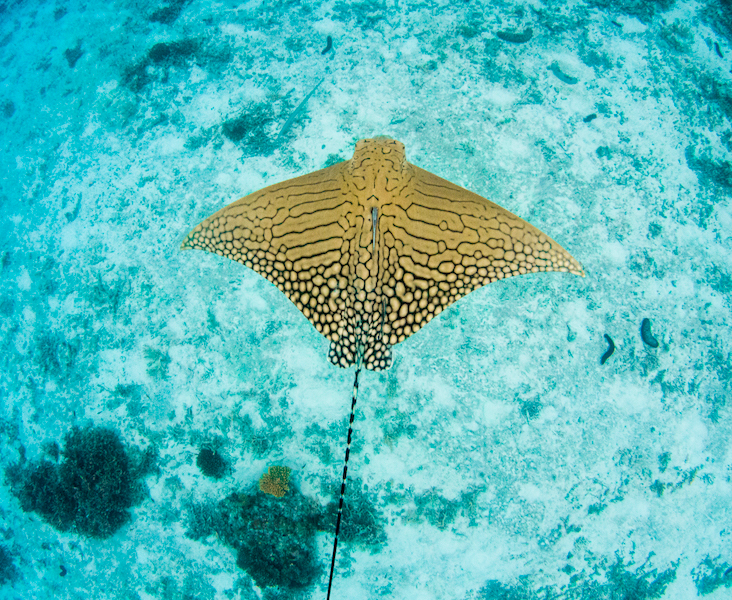
Ornate Eagle Ray
Aetomylaeus vespertilio
The ornate eagle ray or reticulate eagle ray (Aetomylaeus vespertilio) is a species of large stingray of the family Myliobatidae. Like other rays, the ornate eagle ray is ovoviviparous. Aetomylaeus vespertilio is estimated to have a low fecundity similar to other myliobatids. It has a generation length of 15 years, and can grow as old as 24 years. It is a predatory cartilaginous fish, preying mostly on small invertebrates, polychaete worms, and some echinoderms. It has earned the nickname "unicorn of the sea" due to how rarely it is spotted in the wild.
From the article Ornate eagle ray on Wikipedia (CC BY-SA), quoted section by section
Description
Aetomylaeus vespertilio has a maximum size of around 240 cm (94 in) in disc width and a clearly distinct pattern of reticulate dark lines and rings on its back. If the extremely long tail is unbroken, it can considerably add to the maximum body length of 4 m (13 ft). Lacking a spine on the tail, it is deemed harmless to humans.
Wikipedia: “Appearance”
Range & habitat
Aetomylaeus vespertilio lives in waters up to 110 m (360 ft) deep along the coasts of Australia, China, India, Indonesia, Malaysia, Maldives, Mozambique, Palau, Philippines, Seychelles, South Africa, Taiwan, and Thailand. Despite its wide range, it is rarely observed, and has been suspected to have had a large population decline within the past three generations. Currently, this species is considered Critically Endangered by the IUCN. There have been fewer than 60 confirmed sightings of Aetomylaeus vespertilio, giving it the nickname 'the unicorn of the sea.'
Wikipedia: “Distribution”
Where it lives
Recorded sightings
—
geo-referenced records in GBIF, from museums, herbaria and field observers.
Drag the globe to turn it. Dots are where records exist, not a range map; darker means more records.
In the stacks
Searching the stacks…
Every page naming Aetomylaeus vespertilio in the Biodiversity Heritage Library →
This page is assembled live from iNaturalist, GBIF, Wikipedia, the Source Library and the Internet Archive. It is not yet part of the hand-edited codex. iNaturalist taxon 93465.