- Animals
- ›Chordates
- ›Vertebrates
- ›Cartilaginous Fishes
- ›Sharks and Rays
- ›Rays
- ›Stingrays
- ›Eagle Rays
- ›Aetomylaeus
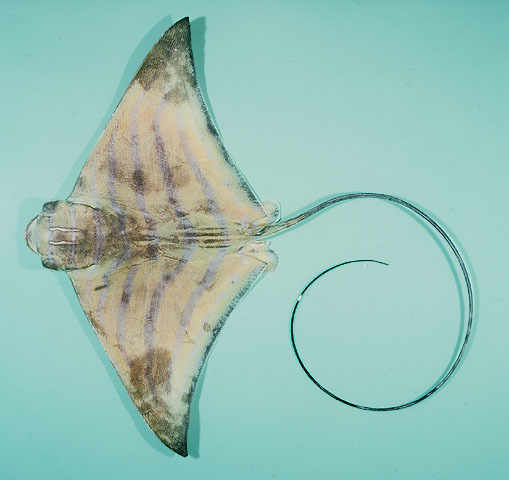
Banded Eagle Ray
Aetomylaeus nichofii
The banded eagle ray (Aetomylaeus nichofii) is a species of fish in the family Myliobatidae. The species was first described by Bloch and Schneider in 1801. As an elasmobranch, the banded eagle ray has a skeleton composed of cartilage. Like other eagle rays it has a depressiform, dorsoventrally flattened, shape to succeed in its benthic lifestyle. It preys mainly on benthic crustaceans, snails, and worms. Its natural habitats are open seas, shallow seas, and coral reefs. As of 2016, this species is classified as vulnerable by the IUCN. The main threats to the banded eagle ray are overfishing and habitat destruction.
From the article Banded eagle ray on Wikipedia (CC BY-SA), quoted section by section
Description
Aetomylaeus nichofii is a relatively small eagle ray with a maximum disc width of 72 cm, but most organisms are between 35 and 55 cm. Like other members of Myliobatidae, this eagle ray is diamond-shaped with broad pectoral fins and a long tail. Gas exchange is facilitated by their dorsal spiracles, located behind their eyes, and their five ventral gill slits. The species has a greyish brown dorsal coloration with 7 to 8 faint blue transverse bands. As the individual matures, the bands become less distinct and can be difficult to detect in adults. Their ventral side is pale and whitish with dusky pectoral fins. Their tail length is between 1.5 and 2 times the organism's disc width. The tail is characterized by faint blue banding with a greyish dorsal coloring and black ventral coloring. They have a small dorsal fin close to the pelvic fin insertion, near the base of the tail. This species has no caudal fin spine nor do they have any stinging apparutus, so they are not considered a stingray.
They have tapered pectoral fins that are broad relative to the organism's size. Their pelvic fins are rounded and small relative to the pectoral fins. Their mouth contains 7 rows of molariform teeth in both the upper and lower jaw. Three smaller teeth rows run down each side of their jaw. The head is small and narrow with a fleshy and rounded rostral lobe. …
Range & habitat
The banded eagle ray has a large distribution across the Indo-West Pacific. Historically it was estimated to occur from India to Papua New Guinea, north to Japan, and south to Northern Australia. The distinction of A. caeruleofasciatus, which appears in Northern Australia and Papua New Guinea, shrank the historic distribution of A. nichofii. The present distribution is now considered to be India to Indonesia and north to Japan (see Figure 3). There is also a fragmented population in the Persian Gulf. There has been sightings in Bangladesh, Bahrain, Brunei, Cambodia, China, India, Indonesia, Japan, North Korea, South Korea, Malaysia, Myanmar, Pakistan, the Philippines, Singapore, Sri Lanka, Taiwan, Thailand, Vietnam, possibly Maldives, and possibly Mozambique. The banded eagle ray is a benthic fish that inhabits intertidal, nearshore waters, and coral reefs of tropical and temperate seas. This species is often found in tropical or temperate seas. It is amphidromous, found in both marine and brackish waters. It is often found in areas with sandy substrates, at depths of up to 115m. Wild specimens caught by the Queensland Museum Research team were found at depths ranging from 8-43m. A study done from 2006 to 2012 in Bangladesh found the species to be abundant year round, but sightings were on the decline.
Wikipedia: “Distribution”
What it does
Eagle rays are aquilopelagic rays that use their wing-like pectoral fins for powerful propulsion. Rays move using the vertical muscles in their exaggerated pectoral fins, often flapping these fins up and down in unison. This allows for a flight-like movement along with large leaps out of the water characteristic of other eagle rays. While they do forage and inhabit the bottom, they swim above the seafloor instead of burrowing like other rays. They feed by disturbing the substrate, using their narrow head, to target small inactive prey. They eat crustaceans (such as shrimp), snails, worms, and other invertebrates. Due to their wide variety of prey, the banded eagle ray is considered a generalist species. Their molariform teeth are specialized for grinding up hard-shelled invertebrates. These teeth are replaced continuously throughout the organism's lifetime, allowing them to grow in size and crush larger prey as the fish grows. As benthic feeders, banded eagle rays release nutrients from the sediment via the process of bioturbation. Like other predatory organisms, this species contributes to the biological carbon pump through the production of feces and food falls (see whale fall). Like most other elasmobranchs, A. nichofii possess a lateral line and electroreception to aid them in sensing their surroundings. …
Wikipedia: “Ecology”
Where it lives
Recorded sightings
—
geo-referenced records in GBIF, from museums, herbaria and field observers.
Drag the globe to turn it. Dots are where records exist, not a range map; darker means more records.
In the stacks
Searching the stacks…
Every page naming Aetomylaeus nichofii in the Biodiversity Heritage Library →
This page is assembled live from iNaturalist, GBIF, Wikipedia, the Source Library and the Internet Archive. It is not yet part of the hand-edited codex. iNaturalist taxon 93464.