- Plants
- ›Vascular Plants
- ›flowering plants
- ›Dicots
- ›pinks, cactuses, and allies
- ›Old World pitcher plants
- ›Nepenthes
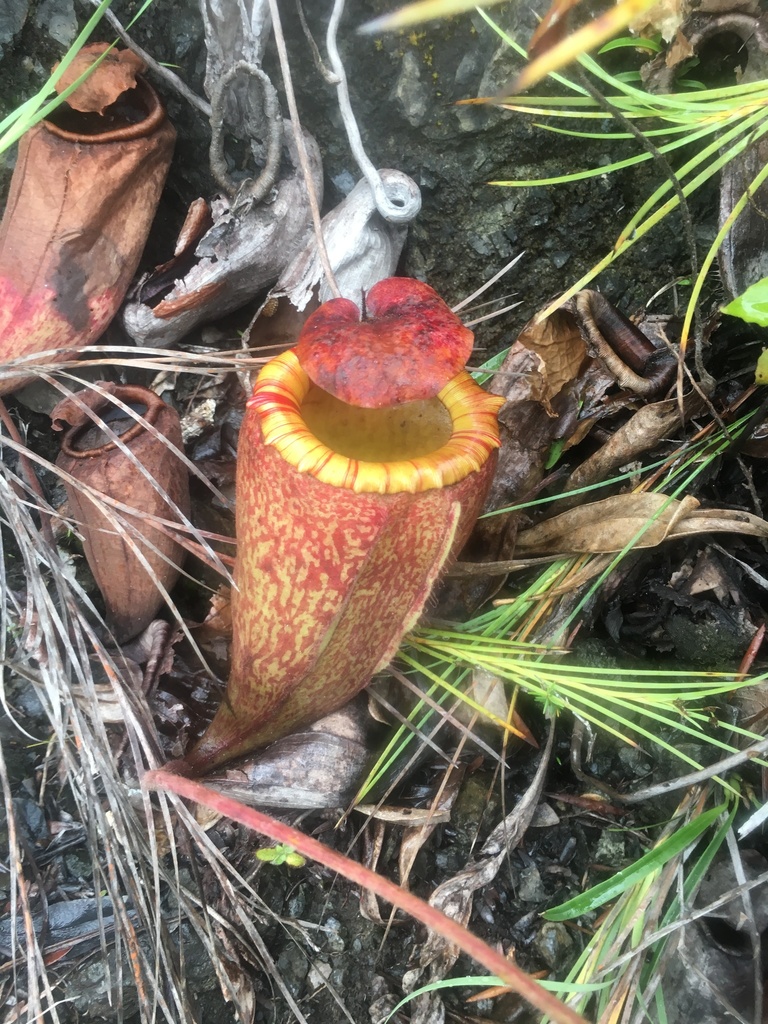
Nepenthes peltata
Nepenthes peltata is a tropical pitcher plant known only from the upper slopes of Mount Hamiguitan on the island of Mindanao in the Philippines. It is characterised by a peltate tendril attachment and conspicuous indumentum. The species typically produces ovoid pitchers with a prominent basal crest and large nectar glands on the lower surface of the lid.
The specific epithet peltata is Latin for "peltate" and refers to the distinctive tendril insertion of this species.
From the article Nepenthes peltata on Wikipedia (CC BY-SA), quoted section by section
Description
Nepenthes peltata is a scrambling plant typically growing to a height of 1 m, although stems up to 3 m long have been recorded. The species does not appear to produce a climbing stem.
The lamina (leaf blade) is oblong in shape and reaches 50 cm in length by 9 cm in width. The apex of the lamina is rounded, while the base is abruptly contracted into the petiole, which is canaliculate and up to 7 cm long in mature plants. Young plants may have sessile leaves lacking a petiole. The lower surface of the lamina is often dark red in colour, contrasting sharply with the dark green upper surface. The margins of the lamina are sometimes curled upwards. Tendrils have a peltate insertion, with the point of attachment being up to 27 mm from the apex.
Rosette and lower pitchers vary widely in morphology, ranging from ellipsoidal to urceolate or entirely ovate. They are relatively large, growing to 28 cm in height by 16 cm in width. A pair of wings (≤10 mm wide), with fringe elements up to 9 mm long, runs down the ventral surface of the pitcher cup. The peristome is approximately cylindrical and up to 2 cm wide. It bears ribs up to 1.5 mm high and spaced up to 2 mm apart, which may terminate in teeth up to 1 mm long. The pitcher lid or operculum is ovate to elliptic in shape and measures up to 8 cm in length by 6 cm in width. …
What it does
At present, N. peltata has only been recorded from the upper slopes of Mount Hamiguitan on the Philippine island of Mindanao. Much of the surrounding region has not been explored for Nepenthes, therefore this species may yet be found in other parts of southern Mindanao. Nepenthes peltata has an altitudinal distribution that stretches from 865 m above sea level to the summit at 1635 m.
Nepenthes peltata grows terrestrially in a wide range of habitats, including upper montane mossy forest, secondary vegetation, ridge tops, cliff sides, and landslides. Vegetation is often very stunted in the more exposed sites. While N. peltata tolerates shady conditions, it grows best under direct sunlight. Like many of its close relatives, N. peltata is restricted to ultramafic substrates. On Mount Hamiguitan, it grows together with N. alata (sensu lato), N. justinae (previously identified as N. mindanaoensis), and N. micramphora, and in the same altitudinal range as N. hamiguitanensis. Despite this, no natural hybrids have been observed with certainty. In his 2009 book, Pitcher Plants of the Old World, Stewart McPherson writes that N. peltata is "not currently threatened" owing to its extensive populations on Mount Hamiguitan and the fact that visitors are only permitted to climb the mountain with the assistance of a guide. The future of wild populations of N. …
Wikipedia: “Ecology”
In human culture
Nepenthes peltata was formally described by Shigeo Kurata in the January 2008 issue of the Journal of Insectivorous Plant Society. The herbarium specimen Koshikawa 44 is the designated holotype, and is deposited at the herbarium of the Botany Department of Kyoto University (KYO) in Kyoto, Japan. The specimen is a plant that was taken from the Mount Hamiguitan Range and later cultivated at Nanso Botanic Gardens.
Wikipedia: “Botanical history”
Where it lives
Recorded sightings
—
geo-referenced records in GBIF, from museums, herbaria and field observers.
Drag the globe to turn it. Dots are where records exist, not a range map; darker means more records.
In the stacks
Searching the stacks…
Every page naming Nepenthes peltata in the Biodiversity Heritage Library →
This page is assembled live from iNaturalist, GBIF, Wikipedia, the Source Library and the Internet Archive. It is not yet part of the hand-edited codex. iNaturalist taxon 932828.