- Plants
- ›Vascular Plants
- ›flowering plants
- ›Dicots
- ›pinks, cactuses, and allies
- ›Amaranth family
- ›Suaedoideae
- ›Bienertieae
- ›Bienertia
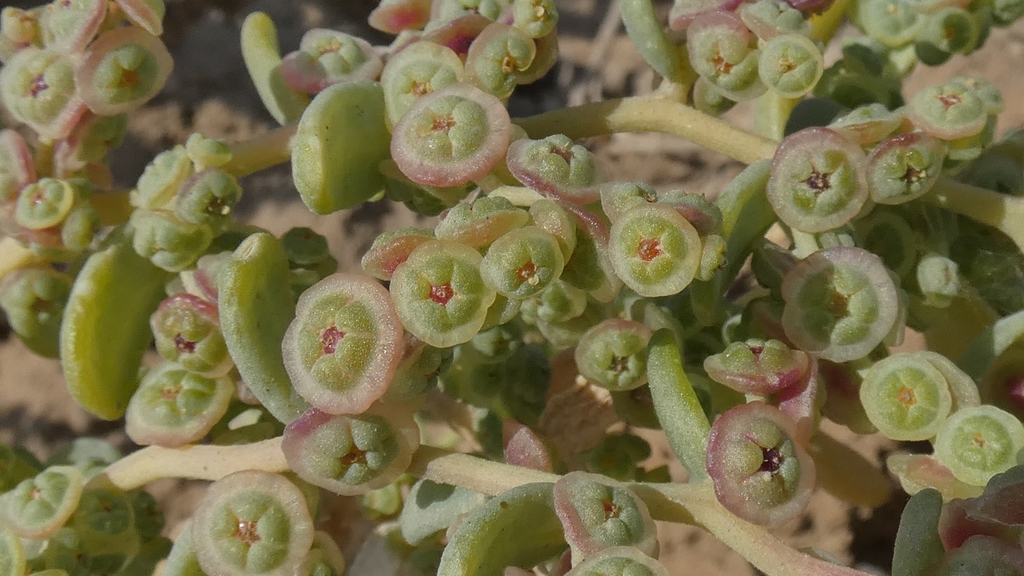
Bienertia cycloptera
Bienertia cycloptera is a species of flowering plant that is native to the Middle East, south-eastern Europe, and central Asia. It is a succulent, smooth annual plant with long, curved, cylindrical leaves. Its flowers have both male and female reproducing parts and its fruits are small and spherical. Bienertia cycloptera grows in hot, dry climates with little rainfall and tolerates soils with high salinity levels very well. Due to its specific growing conditions, B. cycloptera is not a very common, nor widespread plant. Even over most of its range, it often grows sparsely in small patches of growth.
One notable aspect of Bienertia cycloptera is its unique C4 photosynthesis mechanism. Unlike most C4 plants, in B. cycloptera the photosynthetic mechanism occurs within a single chlorenchyma cell, without Kranz anatomy.
From the article Bienertia cycloptera on Wikipedia (CC BY-SA), quoted section by section
Description
Bienertia cycloptera is characteristically a succulent, smooth, light green annual plant. It typically grows from 15 to 40 cm (5.9 to 16 in) in length. Habitually, the plant exists in a shrub-like form. They do not have an extensive branching pattern. The leaves are long, cylindrical, and curved. They are directly connected to the stem. They extend outwards. Since many B. cycloptera grow near each other, this pattern of leaves and the long stems lead to the shrub-like appearance of the plant.
Wikipedia: “Morphology”
Range & habitat
Bienertia cycloptera is located throughout the Middle East, south-eastern Europe, and central Asia. The plant can be found in Armenia, Azerbaijan, Turkey, Iran, Pakistan, and Afghanistan. The range of Bienertia cycloptera throughout the Eurasian supercontinent covers an area from 24° to 49° N latitude and from 43° to 67° E longitude. It has an estimated range of 180 km2 (69 sq mi) in the Yerevan floristic region of Armenia, but occupies a mere 28 km2 (11 sq mi) of area. It fits the Deborah Rabinowitz's definition of a rare plant, even though it has a wide geographical range but low abundance where it is present.
Wikipedia: “Distribution”
What it does
Bienertia cycloptera grows in warm climates. It grows in regions where the hottest months have a daily temperature between 20 and 30 °C (68 and 86 °F), and annual precipitation ranges from 400 mm to 76 mm. Bienertia cycloptera tolerates saline and, temporarily, moist clay soils. The soils are rich in sodium ions and sulfate ions, with salinity ranging between 21 ds/m to 90 ds/m. In most habitats, Climacoptera turcomanica can be found alongside Bienertia cycloptera. Bienertia cycloptera is an endangered species. Due to the historically saline soils of the Aarat Plain becoming more suitable for humans and therefore less saline, the B. cycloptera have not been able to regrow. It falls under Category 1 of endangered species according to the Red Data Book of Armenia. Conservation efforts have been underway with a protected population in the Vordan Karmir Reservation. These efforts include monitoring the remaining populations and searching for new habitats.
Wikipedia: “Habitat and ecology”
In medicine
In Persia, B. cycloptera is widely used for use in alternative medicine, especially for properties associated with antimicrobial, antihyperglycemic, and lipo catalytic properties. However, there is little scientific research showing evidence of this. A recent article that sought to rectify this lack of knowledge by testing B. cycloptera against different microbes and analyzing its lipid composition, finding a strong correlation with microbe reduction and a wide composition of lipids.
Wikipedia: “Medicinal use”
Where it lives
Recorded sightings
—
geo-referenced records in GBIF, from museums, herbaria and field observers.
Drag the globe to turn it. Dots are where records exist, not a range map; darker means more records.
In the stacks
Searching the stacks…
Every page naming Bienertia cycloptera in the Biodiversity Heritage Library →
This page is assembled live from iNaturalist, GBIF, Wikipedia, the Source Library and the Internet Archive. It is not yet part of the hand-edited codex. iNaturalist taxon 931390.