- Plants
- ›Vascular Plants
- ›flowering plants
- ›Dicots
- ›sandalwoods, mistletoes, and allies
- ›sandalwood family
- ›viscaceous mistletoes
- ›Arceuthobium
- ›Campylopoda
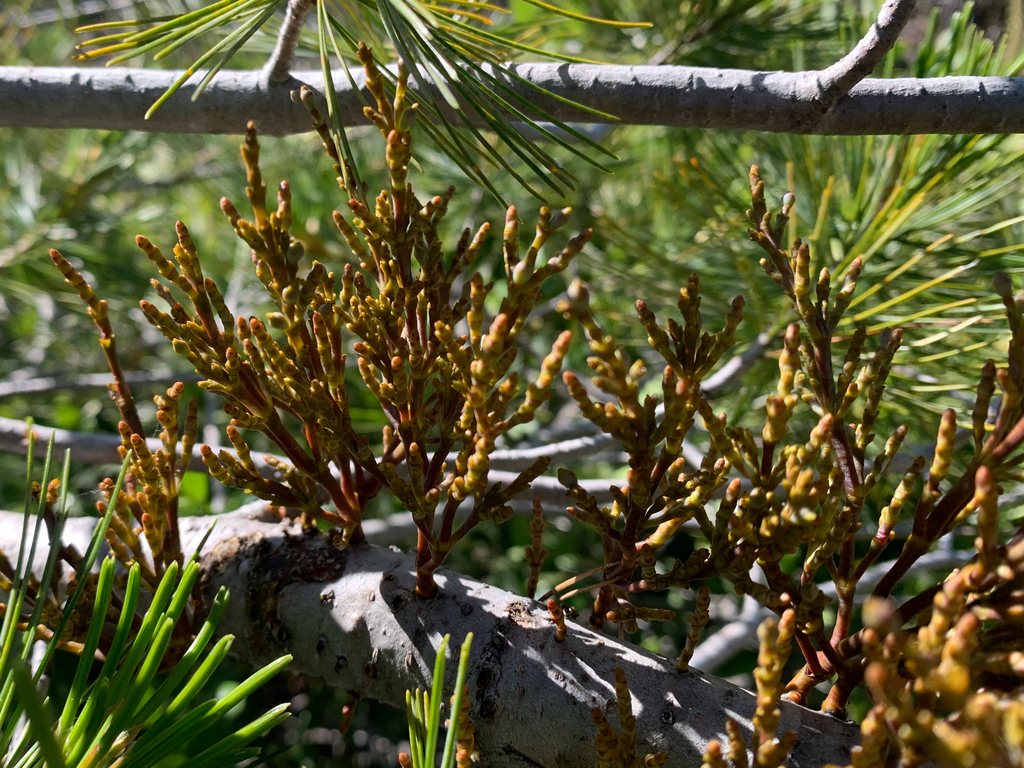
Western White Pine Dwarf-Mistletoe
Arceuthobium monticola
Arceuthobium monticola is a species of dwarf mistletoe known as western white pine dwarf mistletoe. It is a small shrub that grows on and parasitizes a small number of conifer species, primarily western white pines (Pinus monticola). It is endemic to the Klamath Mountains of northern California and southern Oregon, which has been identified as a major center of dwarf mistletoe biodiversity. This species impacts the ecology of coniferous forests significantly, negatively affecting the health of host trees but also creating valuable microhabitats for wildlife by inducing witch's brooms.
From the article Arceuthobium monticola on Wikipedia (CC BY-SA), quoted section by section
Description
As a parasite, A. monticola obtains water and most of its nutrients from a host tree on which it grows. For the first few years of its life, the mistletoe grows entirely within the host tree, developing a system of tissues called the haustoria that tap into the host's xylem and phloem. Thereafter, a network of flabellately-branched stems 5-10 cm in length emerges from the host. These shoots are reddish-brown, greenish-yellow, or brown-colored and bear small, scale-like leaves. Although all species of dwarf mistletoe contain some chlorophyll, they produce low amounts of sugar through photosynthesis and primarily rely on their host for carbohydrates.
A. monticola is dioecious, meaning that plants produce either male (staminate) or female (pistillate) flowers. Male flowers are 3 mm in diameter and have 3 or sometimes 4 petals. Male flowers bloom from late July to early September, with peak anthesis in August. The fruit is a waxy-blue, ovoid berry 4 mm in length, maturing from late August to early October. Peak seed dispersal occurs in September, when hydrostatic pressure builds up in the fruit until it explodes, propelling the seed at an initial velocity of nearly 27 m/s (89 ft/s). Seeds are covered in a sticky substance called viscin that helps them adhere to their target. Only one to two percent of seeds successfully germinate and infect a new host plant. …
Range & habitat
A. monticola is one of eleven dwarf mistletoe species occurring in the Klamath Mountains, which is a center of diversity for the genus. Moreover, A. monticola is one of three dwarf mistletoe taxa endemic to the region, the other two being Arceuthobium siskiyouense and Arceuthobium abietinum subsp. wiensii. The range of A. monticola is limited to the extreme southwest of Oregon in Curry, Coos, and Josephine counties and the extreme northwest of California in Del Norte and Siskiyou counties. It grows in coniferous forests where Pinus monticola is abundant, at elevations between 700 and 1900 meters. The 2002 Biscuit Fire destroyed a significant amount of habitat and may have impacted its distribution. Despite its narrow range and threats from large wildfires, the conservation status of this species has not been assessed.
Wikipedia: “Distribution”
What it does
Infection by dwarf mistletoes such as A. monticola negatively affects the health of the host plant, reducing its longevity and rendering it more susceptible to co-infection by fungal pathogens. Abnormal growth, including the development of witch's brooms, is common on trees infected by A. monticola, further reducing the health of the host plant and rendering it more susceptible to fire. While broom formation negatively impacts the host tree, it also provides cover and nesting habitat for small mammals and birds. Dwarf mistletoe plants are an important food source for arthropods, birds, and a range of mammals. While associations between A. monticola and other organisms have not been studied, some species of hairstreak butterflies specialize on mistletoes in the taxonomic group Campylopoda, to which A. monticola belongs.
Wikipedia: “Ecology”
Where it lives
Recorded sightings
—
geo-referenced records in GBIF, from museums, herbaria and field observers.
Drag the globe to turn it. Dots are where records exist, not a range map; darker means more records.
In the stacks
Searching the stacks…
Every page naming Arceuthobium monticola in the Biodiversity Heritage Library →
This page is assembled live from iNaturalist, GBIF, Wikipedia, the Source Library and the Internet Archive. It is not yet part of the hand-edited codex. iNaturalist taxon 918452.