- Plants
- ›Vascular Plants
- ›flowering plants
- ›Dicots
- ›Heathers, Balsams, Primroses, and Allies
- ›heath family
- ›Epacrids, Styphelias and Allies
- ›Epacrideae
- ›Epacris
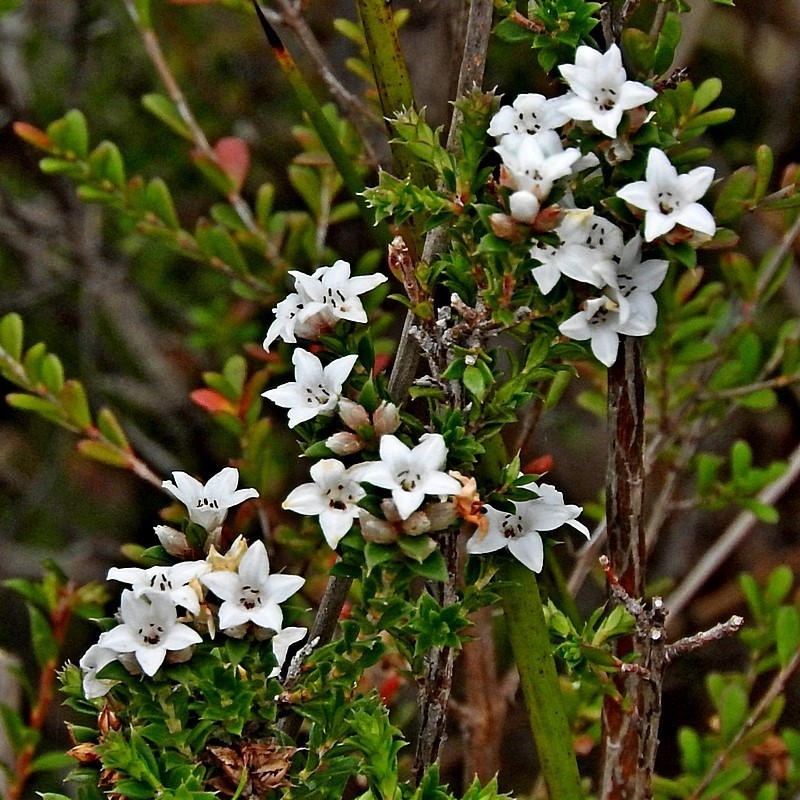
Epacris breviflora
Epacris breviflora, commonly known as drumstick heath, is a plant of the heath family, Ericaceae and is endemic to the south-east of the Australian continent. It is an erect shrub with egg-shaped leaves with a sharp-pointed tip and with clusters of white flowers arranged near the end of the branches. It grows in Victoria, New South Wales and the far south-east of Queensland.
From the article Epacris breviflora on Wikipedia (CC BY-SA), quoted section by section
Description
Epacris breviflora is an erect shrub that usually grows to a height of 0.5–1.0 m (2–3 ft) and has hairy young branches. The leaves are egg-shaped 4–7.5 mm (0.2–0.3 in) long and about 1.5–3.5 mm (0.06–0.1 in) wide. The leaves have a rounded base and a sharply pointed tip. The flowers are clustered in the axils of the upper leaves. There are 10 to 23 bracts at the base of the flowers and five sepals 3–4 mm (0.1–0.2 in) long. The petals are joined to form a white, bell-shaped tube 2–3 mm (0.08–0.1 in) long with five lobes on the end, 2.5–3.5 mm (0.098–0.14 in) long. The five stamens and the single style are mostly enclosed in the petal tube. Flowering is mainly in summer but flowers are usually present throughout the year. The fruit are capsules about 2 mm (0.08 in) long.
Range & habitat
Drumstick heath mainly occurs along the Great Dividing Range from far south-eastern Queensland to eastern Victoria, sometimes at lower altitudes subject to cooler temperatures. It grows in swamps and other damp places.
== References ==
Wikipedia: “Distribution and habitat”
Where it lives
Recorded sightings
—
geo-referenced records in GBIF, from museums, herbaria and field observers.
Drag the globe to turn it. Dots are where records exist, not a range map; darker means more records.
In the stacks
Searching the stacks…
Every page naming Epacris breviflora in the Biodiversity Heritage Library →
This page is assembled live from iNaturalist, GBIF, Wikipedia, the Source Library and the Internet Archive. It is not yet part of the hand-edited codex. iNaturalist taxon 918344.