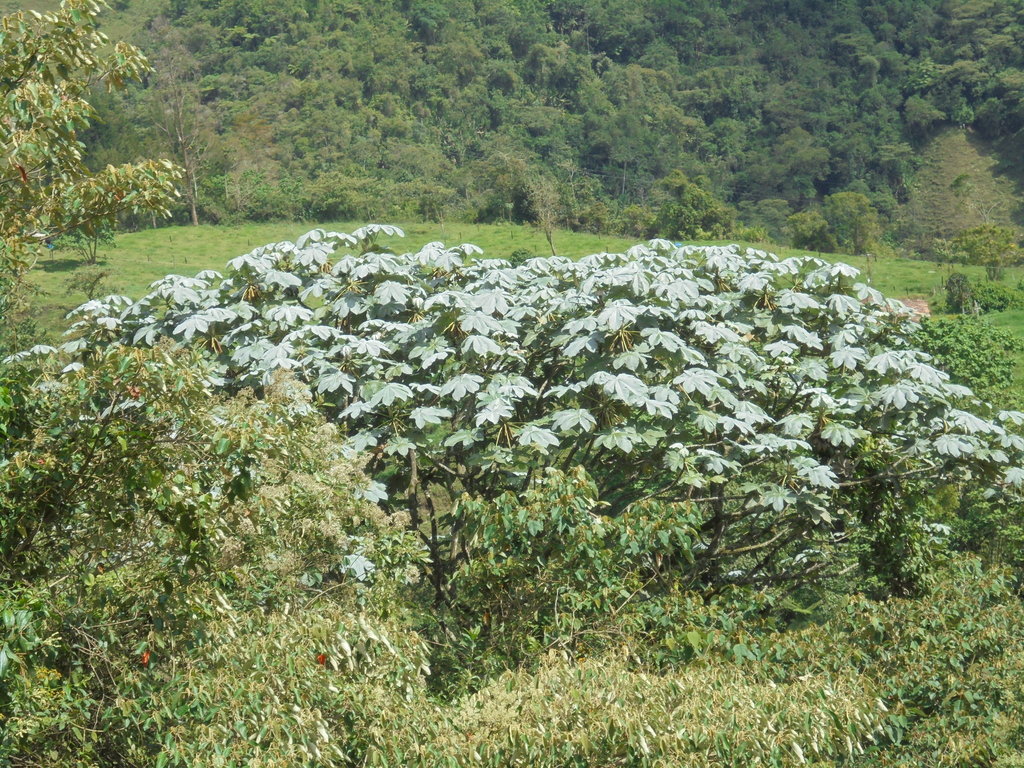
Cecropia telealba
Cecropia is a Neotropical genus consisting of 61 recognized species with a highly distinctive lineage of dioecious trees.
The genus consists of pioneer trees in the more or less humid parts of the Neotropics, with the majority of the species being myrmecophytic. Berg and Rosselli state that the genus is characterized by some unusual traits: spathes fully enclosing the flower-bearing parts of the inflorescences until anthesis, patches of dense indumenta (trichilia) producing Müllerian bodies (food) at the base of the petiole, and anthers becoming detached at anthesis. Cecropia is most studied for its ecological role and association with ants. Its classification is controversial; in the past, it has been placed in the Cecropiaceae, Moraceae (the mulberry family), or Urticaceae (the nettle family). The modern Angiosperm Phylogeny Group system places the "cecropiacean" group in the Urticaceae.
From the article Cecropia on Wikipedia (CC BY-SA), quoted section by section
Description
The genus is easily identified by its large, circular, palmately lobed leaves, about 30–40 cm in diameter and deeply divided into 7–11 lobes. The trees consist of very few branches, usually with candelabrum-like branching system. In Costa Rica, three-toed sloths are often spotted easily in Cecropia trees because of their open, leafless branches compared to other trees. Berg and Roselli state, “Branch development is often initiated in seedlings, even in the axils of the first formed (opposite) leaves; prophylls are formed, and often the development of the first leaf begins but is arrested (if the seedling is not decapitated). In the axils of the leaves formed during later development, the axillary branch primordia do not produce more than one or two prophylls and a bud.” The branches of C. garciae and C. hispidissima occur at a height of 0.6 to 1 m and the branches depart at acute angles. In most species of Cecropia, the branches depart at obtuse angles and the crown has a distinct umbrella shape. High variation is seen in the morphology of Cecropia species, but most form small to medium-sized trees, 5–15 m tall. Although some species (C. distachya, C. herthae, C. insignis, and C. sciadophylla) grow much taller, as large as 40 m, and some (C. ulei) rarely surpass 5 m. The high degree of variation can be attributed to regional habitat differences and longevity. …
Range & habitat
Between 40 and 50% of the 61 species of Cecropia are montane or submontane Andean, with the majority of species in the northern part of the Andes, in Colombia and Ecuador. The Andean region is regarded as the center of species richness and speciation because of the additional 25% of lowland taxa that reach the eastern or western foothills of the Andes. Therefore, only about 25% of the species occur outside of the Andean region. A map of the distribution of Cecropia can be found in the article written by Berg and Rosselli, 2005. Most species of Cecropia are lowland humid/rainforest species occurring from sea level to 1,300 m in altitude, while submontane species occupy an altitudinal range from 1,300-2,000 m, and montane species are found in cloud forest from 2,000-2,600 m. Many species have a narrow altitudinal and ecological niche, with certain species specializing in specific habitats, such as seasonally inundated habitats, rocky slopes, swamps, natural or man-made clearings, etc. Species in the genus Cecropia are some of the most abundant pioneer tree species in natural tree-fall gaps inside primary forests. Its geographic distribution extends along the Pacific and Atlantic Mexican coasts and in Central and South American forests, and are found over an elevation range of 0 to 2,600 m. Cecropia species are among the most abundant pioneers of other neotropical forests. …
Wikipedia: “Habitat and distribution”
What it does
Cecropia species have staminate and pistillate flowers on separate trees, more commonly referred to as a dioecious species. The fruits are achenes enveloped by a fleshy perianths, oblongoid, elliptic, subobovoid or subovoid. The pericarp is tuberculate in most species, although it is smooth in some species. Seeds can be viable for more than five years and germinate when triggered by full sunlight and changing temperatures. Full-grown Cecropia trees can produce up to a million seeds, and this regular presence of fruits allows this genus to play a major role in the ecosystem. It is often the keystone food supply for frugivorous animals, such as birds, fruit bats, monkeys, opossums, and even fish.
Pollination and dispersal. Traits of the staminate flowers and inflorescences are adapted to wind pollination- either by pendulous spikes, which can be moved by the wind to shed the pollen or by the special adaptation of detachment of anthers, and their secondary attachment allowing the shedding of pollen by motion of anthers. The dryness and its easy release by movement make it ideal for wind pollination. Wind pollination is the dominant form, but insects, small beetles, and flies can be pollinators. In the Neotropics, toucans and other birds help disperse the seeds of species with short infructescences, while bats are associated with species with long peduncles and spikes. …
Wikipedia: “Reproduction”
In medicine
So far, no pharmaceuticals in the North or South American markets are based on Cecropia species. However, scientists in Brazil have been studying the preparation of pharmaceutical products containing mainly C. glaziovii extracts. The preparation of pellets by extrusion-spheronization and polymeric nanoparticles has been reported.
Wikipedia: “Pharmaceutical applications”
In human culture
Cecropia was first recognized and accounted for by Marcgrave (1648) and Piso (1658), the latter including an illustration with characteristic features. Loefling (1758) coined the generic name Cecropia. In 1759, Linnaeus described Cecropia peltata which he applied to many species. Willdenow (1806) created C. palmate, which was also applied to a various species. Over the next decade, additional species were added by Bertoloni (1840), Martius (1841), and Liebmann (1851). Mixing of specimens was very common and a problem arose, which continues today, with many collections of Cecropia. Many species were also described by Hemsley (1883), Richter (1897), Donnell Smith (1899), Rusby (1907, 1910), Huber (1910), Robinson (1912), Pittier (1917), Bailey (1922), and the most extensive number by Snethlage (1923, 1924). Additional species were recognized by Burret (1924), Mildbread (1925, 1933), Standly (1929, 1940), Macbride (1937), Diels (1941), Standley & Steyermark (1944), and Stadley & Williems (1952). Hans Melchior (1964) placed Cecropia in the Urticales and Moraceae (Concephaleideae) because of its woody bark. Later based on the floral characters, most notably the basal ovule and gynoecium, which appears to be formed from a single carpel, Thorne (1976) moved it to the Malvanae- Urticales, family Urticaceae. Berg (1978), however, placed it in its own family Cecropiaceae. …
Wikipedia: “Taxonomic history”
Where it lives
Recorded sightings
—
geo-referenced records in GBIF, from museums, herbaria and field observers.
Drag the globe to turn it. Dots are where records exist, not a range map; darker means more records.
In the stacks
Searching the stacks…
Every page naming Cecropia telealba in the Biodiversity Heritage Library →
This page is assembled live from iNaturalist, GBIF, Wikipedia, the Source Library and the Internet Archive. It is not yet part of the hand-edited codex. iNaturalist taxon 911059.