- Plants
- ›Vascular Plants
- ›flowering plants
- ›Dicots
- ›carrots, ivies, and allies
- ›cheesewood family
- ›Bursaria
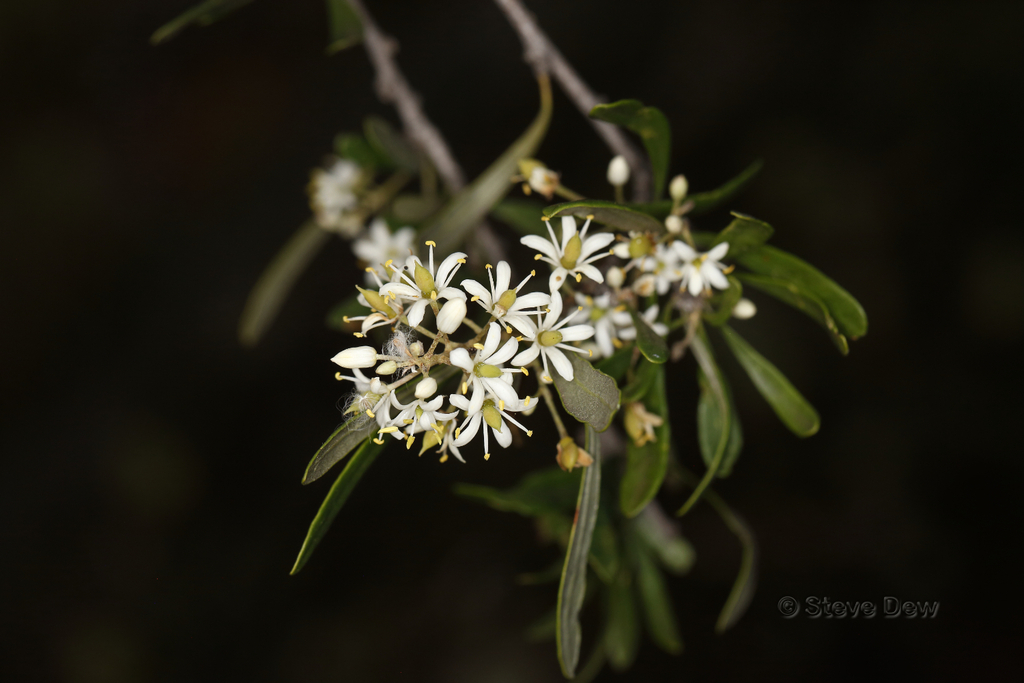
Bursaria occidentalis
Bursaria occidentalis is a species of flowering plant in the family Pittosporaceae and is endemic to Western Australia. It is a spiny tree or shrub with egg-shaped adult leaves, flowers with relatively small, hairy sepals and five spreading creamy-white petals, and inflated capsules.
From the article Bursaria occidentalis on Wikipedia (CC BY-SA), quoted section by section
Description
Bursaria occidentalis is a tree that typically grows to a height of 8 m (26 ft), sometimes a shrub to 1.2 m (3 ft 11 in), and usually only has spiny branches when young. The adult leaves are egg-shaped with the narrower end towards the base, hairy on the lower surface, 30–70 mm (1.2–2.8 in) long and 5–10 mm (0.20–0.39 in) wide on a petiole 3–8 mm (0.12–0.31 in) long. The plants have both andromonoecious and bisexual flowers borne in groups on the ends of branchlets, each flower on a pedicel 3–6 mm (0.12–0.24 in) long. The sepals are hairy, less than 2 mm (0.079 in) long and spread from their bases and the petals are creamy-white, 5–6 mm (0.20–0.24 in) long and also spread from their bases. Flowering occurs from August to December and the fruit is an inflated capsule 10–11 mm (0.39–0.43 in) long and wide containing winged, brown seeds.
Range & habitat
This bursaria grows in mallee woodland between Shark Bay, Dongara and Menzies in the Avon Wheatbelt, Coolgardie, Geraldton Sandplains, Murchison and Yalgoo biogeographic regions of Western Australia. In some places it may be the only tree species.
Wikipedia: “Distribution and habitat”
Where it lives
Recorded sightings
—
geo-referenced records in GBIF, from museums, herbaria and field observers.
Drag the globe to turn it. Dots are where records exist, not a range map; darker means more records.
In the stacks
Searching the stacks…
Every page naming Bursaria occidentalis in the Biodiversity Heritage Library →
This page is assembled live from iNaturalist, GBIF, Wikipedia, the Source Library and the Internet Archive. It is not yet part of the hand-edited codex. iNaturalist taxon 901259.