- Plants
- ›Vascular Plants
- ›flowering plants
- ›Dicots
- ›Mints, Plantains, Olives, and Allies
- ›figwort family
- ›Eremophila
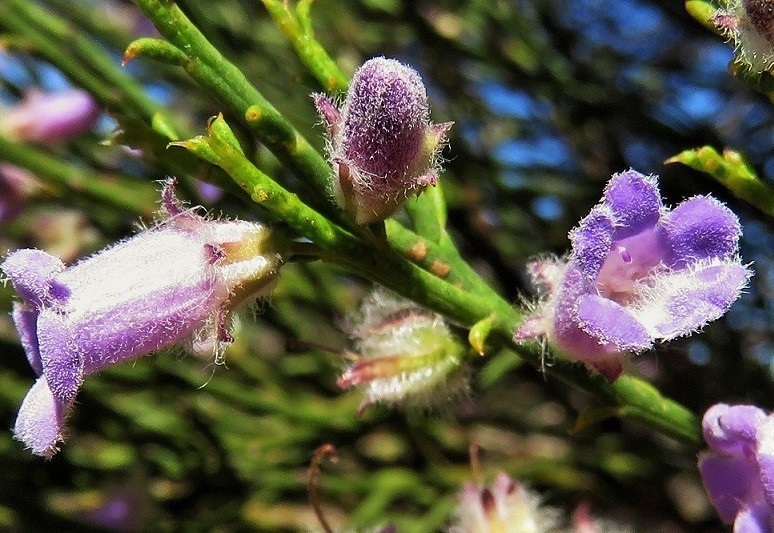
Eremophila dempsteri
Eremophila dempsteri is a flowering plant in the figwort family, Scrophulariaceae and is endemic to the south of Western Australia. It is an erect shrub with many upright stems, short, hooked leaves, and pinkish-purple to white flowers with distinctive woolly sepals.
From the article Eremophila dempsteri on Wikipedia (CC BY-SA), quoted section by section
Description
Eremophila dempsteri is an erect shrub which grows to a height of 1–4 m (3–10 ft) and has many erect branches, giving the plant a broom-like appearance. The branches have many raised resin glands making them sticky near the tips and there are grooves under the leaf bases. The leaves are arranged alternately along the branches and are dark green, mostly 2–7.5 mm (0.08–0.3 in) long, 0.5–1.3 mm (0.02–0.05 in) wide and have a curved, hooked tip.
The flowers are borne singly or in pairs in leaf axils on stalks 2–4 mm (0.08–0.2 in) long which are often sticky or scaly due to resin. There are 5 slightly oblong to lance-shaped sepals which are hairy on the inner surface and margins and are 4–6.5 mm (0.2–0.3 in) long. The petals are 9.5–13 mm (0.4–0.5 in) long and joined at their lower end to form a tube. The petal tube is usually lilac-coloured to white and lacks spots. The outside of the petal tube and petal lobes are hairy. The 4 stamens are fully enclosed in the petal tube. Flowering occurs from July to October and is followed by fruits, which are oval-shaped, hairy, and 3–5 mm (0.1–0.2 in) long.
Range & habitat
This eremophila is common between Balladonia, Coolgardie, Hyden, Cocklebiddy and Salmon Gums in woodland, growing in red-brown and calcareous soils.
Wikipedia: “Distribution and habitat”
How it is grown
This eremophila has unusual flowers and an attractive habit, making it useful as a specimen shrub. Its growth form also allows it to be used with other shrubs as a screening plant. It can be propagated from cuttings, which may take a year to strike, or by grafting onto Myoporum species. It will grow in most soils in full sun or part shade, is tolerant of drought, and is not damaged by severe frosts.
== References ==
Wikipedia: “Use in horticulture”
Where it lives
Recorded sightings
—
geo-referenced records in GBIF, from museums, herbaria and field observers.
Drag the globe to turn it. Dots are where records exist, not a range map; darker means more records.
In the stacks
Searching the stacks…
Every page naming Eremophila dempsteri in the Biodiversity Heritage Library →
This page is assembled live from iNaturalist, GBIF, Wikipedia, the Source Library and the Internet Archive. It is not yet part of the hand-edited codex. iNaturalist taxon 893103.