- Plants
- ›Vascular Plants
- ›flowering plants
- ›Dicots
- ›proteas, lotuses, planes, and allies
- ›Protea family
- ›Paired Proteas
- ›Embothrieae
- ›Hakeinae
- ›Grevillea
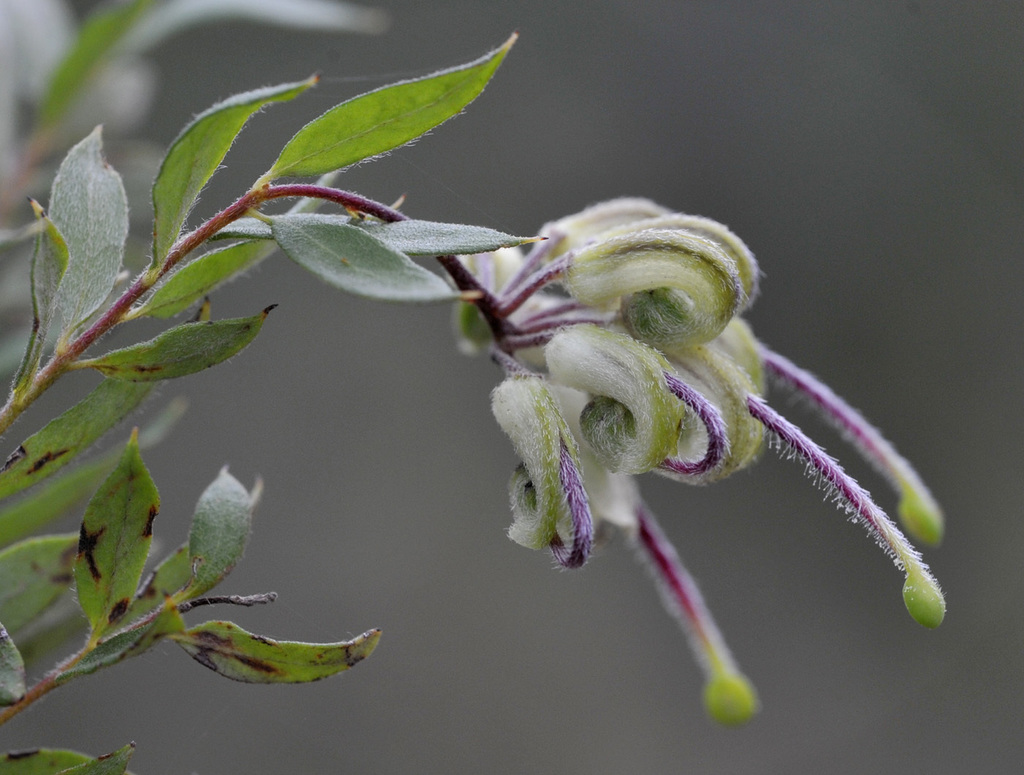
Green Spider Flower
Grevillea mucronulata
Grevillea mucronulata, also known as green spider flower or green grevillea, is a species of flowering plant of the family Proteaceae and is endemic to New South Wales in Australia. Described by Robert Brown in 1810, it is found in open sclerophyll forest or woodland around the Sydney region and New South Wales south coast. It grows as a small bush to 3 m (9.8 ft) high and wide, with variable foliage and greenish flowers that appear over the cooler months from May to October. The flowers are attractive to birds.
From the article Grevillea mucronulata on Wikipedia (CC BY-SA), quoted section by section
Description
Grevillea mucronulata is a spreading to erect shrub which usually grows to between 0.3 and 3 metres (1–10 ft) in height. Leaf shape is highly variable, ranging from narrow elliptic to almost round, and anywhere from 0.5 to 4 cm (0.2–1.5 in) long and 0.2–1.8 cm (0.1–0.7 in) wide. The green flower heads, known as inflorescences, appear predominantly from late autumn to mid spring (May to October in Australia). Each is composed of 6 to 18 individual flowers and measures 2.5–5.5 cm (1–2.3 in) long overall. They can produce large amounts of nectar. The 0.8–1.7 cm long perianth is pale- or yellow-green and covered with fine hair, while the 1.8–2.8 cm long style is a red or maroon colour and tipped with a green pollen-presenter. Several different forms have been described, though none have been given taxonomic status or rank, and further work and review of the species complex is required. The 'typical form' is found from the Lower Blue Mountains north to Singleton. It is a single-stemmed shrub with ovate leaves that end with a marked tapering apex. Forms around the Hunter River have narrower leaves. It lacks a lignotuber and regenerates after fire by seed. The 'Cumberland Plain form' grows on heavier Cumberland Plain soils in Sydney's northwest around Richmond and Blacktown. It is a shrub to 30 cm (12 in) high with small round leaves and sessile flower heads. …
Range & habitat
Grevillea mucronulata is found in the upper Hunter Region around Singleton, the Sydney region west to Rylstone and Denman, and southward along the coast towards Eden where it is found in isolated pockets. The average yearly rainfall is 600 to 1200 mm (24–48 in), and the range is from sea level to 800 m (2500 ft) altitude. It grows on nutrient-poor soils ranging from sandy to clayey, based on sandstone to shale or rarely granite. The species occurs in dry sclerophyll forest under such trees as Sydney red gum (Angophora costata), blue leaved stringybark (Eucalyptus agglomerata), Sydney peppermint (E. piperita), red bloodwood (Corymbia gummifera), New South Wales Christmas bush (Ceratopetalum gummiferum), or in more open woodland under Sydney red gum, scribbly gum (Eucalyptus sclerophylla), rough-budded calgaroo (E. parramattensis) or small-leaved apple (Angophora bakeri).
Wikipedia: “Distribution and habitat”
What it does
The flower heads appear to be adapted for bird pollination, as the pollen-holding flower tips are some distance from the petals. Honeyeaters such as the eastern spinebill (Acanthorhynchus tenuirostris) and the New Holland honeyeater (Phylidonyris novaehollandiae) forage among the flowers in the early morning and late afternoon, while honeybees (Apis mellifera) visit later in the morning and earlier in the afternoon. They do not appear to be effective pollinators.
Wikipedia: “Ecology”
How it is grown
As the green flowers are camouflaged within the foliage, this species has not proved as popular in horticulture as other species within the genus. The flowers are bird-attracting, appear over a long period, and the foliage and bronze new growth are horticultural features. It is tolerant of sun and part shade aspects in the garden. It is readily propagated by seed or cutting. Seeds germinate in 30 to 40 days, though this time might be slightly shortened with smoke treatment. Many plants sold as G. mucronulata are of hybrid origin.
Wikipedia: “Use in horticulture”
Where it lives
Recorded sightings
—
geo-referenced records in GBIF, from museums, herbaria and field observers.
Drag the globe to turn it. Dots are where records exist, not a range map; darker means more records.
In the stacks
Searching the stacks…
Every page naming Grevillea mucronulata in the Biodiversity Heritage Library →
This page is assembled live from iNaturalist, GBIF, Wikipedia, the Source Library and the Internet Archive. It is not yet part of the hand-edited codex. iNaturalist taxon 892451.