- Plants
- ›Vascular Plants
- ›flowering plants
- ›Dicots
- ›saxifrages, stonecrops, and allies
- ›stonecrop family
- ›Sempervivoideae
- ›Sedeae
- ›Sedum
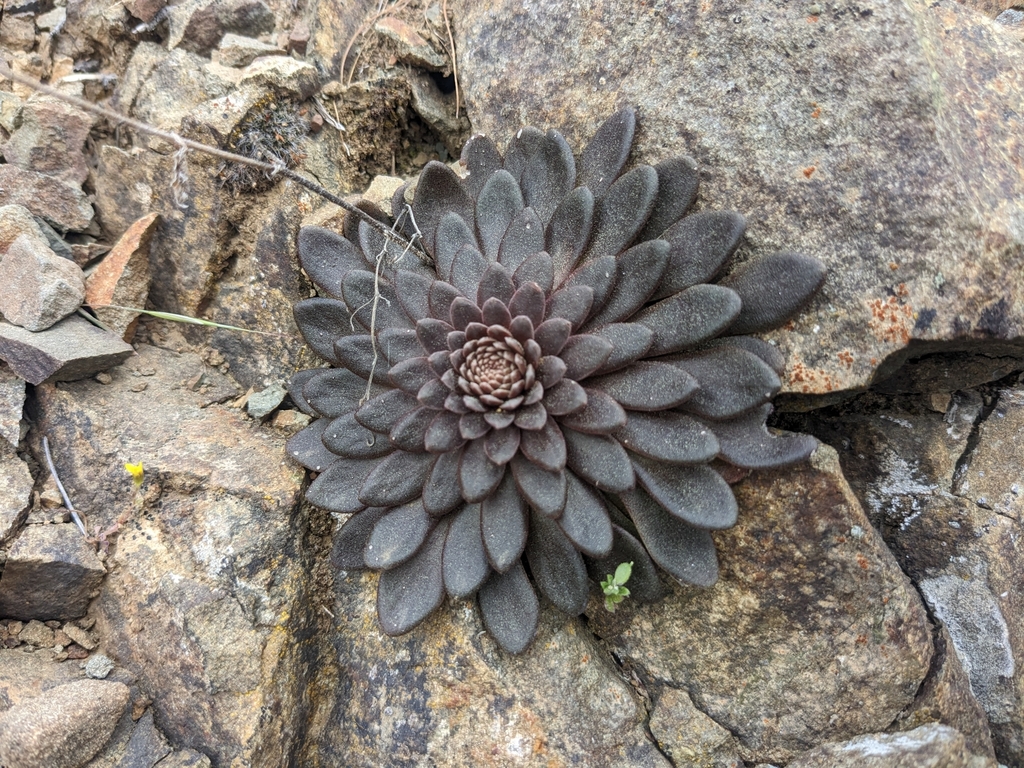
Sedum cyprium
Sedum cyprium, the Cyprus stonecrop, is an erect, monocarpic, succulent herb in the family Crassulaceae. The species is distinguished by its small brownish-red flowers and its ability to grow in harsh, rocky environments. It is considered relatively rare, being found only within a limited altitudinal range in Cyprus's Troodos Mountains where it has adapted to survive in shallow, free-draining substrates of weathered gabbro and schist. During summer heat, the plant often develops a distinct bronze-red colouration as a drought-resistance mechanism.
From the article Sedum cyprium on Wikipedia (CC BY-SA), quoted section by section
Description
Sedum cyprium is a small, upright stonecrop that usually completes its life cycle in one or two years. Mature plants stand 7–33 cm tall on a short, thickened root-stock about a centimetre wide. At the base they form a tight rosette, up to 9 cm across, of thick, spatula-shaped leaves that are 2.4–5 cm long and 0.5–1.2 cm wide; these leaves are smooth, fleshy and rounded at the tip but taper gradually toward the stalk. Higher up the stem the leaves become progressively smaller (4–7 mm long), elliptic to narrowly obovate, and many are edged with minute, sticky glandular hairs that give the surface a slightly tacky feel; most of these upper leaves are shed as the inflorescence develops. The flowering stem carries a slender, somewhat sticky panicle made up of overlapping cymes (small, repeatedly branched clusters). This inflorescence is 5–22 cm long and at most 4.5 cm wide at the base, giving it a narrow cylindrical to pyramidal outline. Each tiny flower has a five-lobed calyx whose lance-shaped teeth are only about a millimetre long and is surrounded by equally small, dull brownish-red petals 2.5–3 mm in length. Ten stamens with short, sometimes downy filaments surround the ovary. After pollination the plant produces erect, reddish-brown seed capsules (follicles) roughly 3 mm long; the persistent styles are at least twice this length. …
Range & habitat
Sedum cyprium is a narrow Cypriot endemic confined to the central Troodos Mountains. All confirmed records come from a clutch of localities such as Kryos Potamos gorge, Foini, Kokkinovouno, Pedoulas and the southern flanks of Mount Olympus. Most collections occur at elevations between about 850 m and 1,500 m; only isolated plants have been noted a little higher, on north-facing crags around 1,650 m. No populations are known from the limestone Kyrenia range or the lowland igneous hills that skirt the island's coast. Within this altitudinal window the species occupies extremely shallow, free-draining substrates. It threads its roots into narrow fissures of weathered gabbro and schist, settles on sun-baked terraces of angular scree, or perches on steep, north- or east-facing clifflets where seasonal runoff keeps crevices just moist enough for germination. Sparse pines and junipers may offer dappled shade, but most colonies occur on largely open rock where plants tolerate intense summer heat by turning bronze-red and shrinking the leaf rosette. Occasional individuals also appear on stony banks beside dry streambeds and on abandoned terracing, provided the soil remains thin, acidic and fast-draining.
Wikipedia: “Habitat and distribution”
Where it lives
Recorded sightings
—
geo-referenced records in GBIF, from museums, herbaria and field observers.
Drag the globe to turn it. Dots are where records exist, not a range map; darker means more records.
In the stacks
Searching the stacks…
Every page naming Sedum cyprium in the Biodiversity Heritage Library →
This page is assembled live from iNaturalist, GBIF, Wikipedia, the Source Library and the Internet Archive. It is not yet part of the hand-edited codex. iNaturalist taxon 890925.