- Animals
- ›Chordates
- ›Vertebrates
- ›Mammals
- ›Therians
- ›Placental Mammals
- ›Ungulates, Carnivorans, and Allies
- ›Even-toed Ungulates and Cetaceans
- ›Ruminants
- ›Bovids
- ›Bovines
- ›Cattle and Bison
- ›Bos
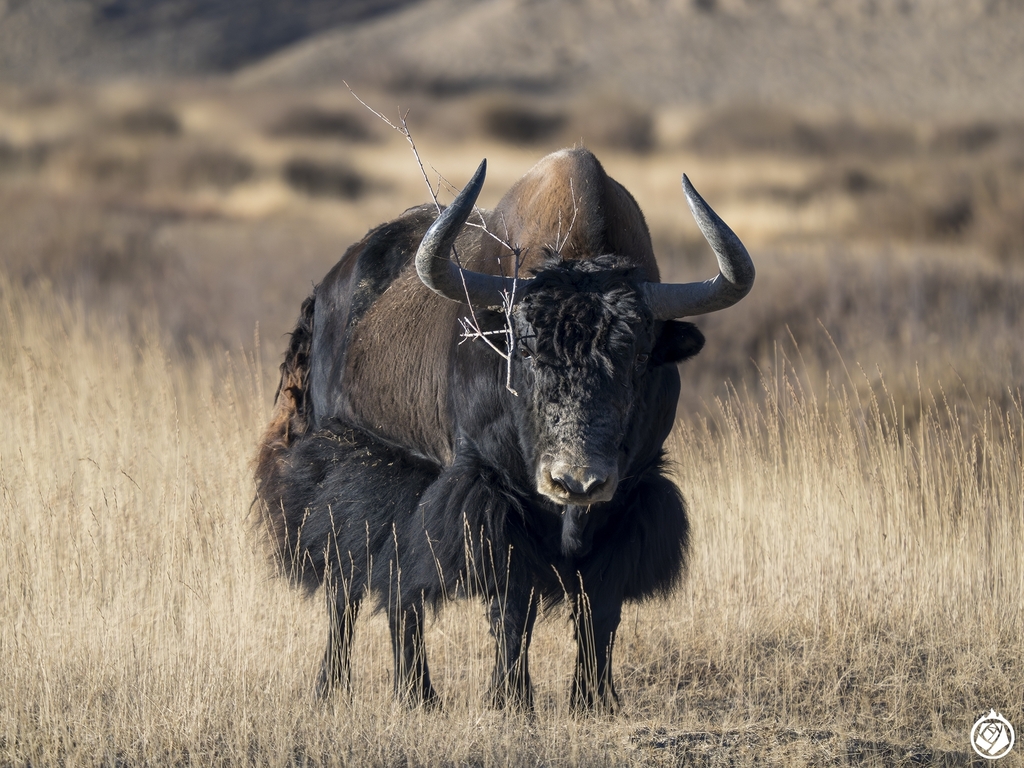
Wild Yak
Bos mutus
The wild yak (Bos mutus) is a large, wild bovine native to the Himalayas. It is the ancestor of the domestic yak (Bos grunniens).
From the article Wild yak on Wikipedia (CC BY-SA), quoted section by section
Description
The wild yak is heavily built with a bulky frame, sturdy legs, and rounded cloven hooves. To protect against the cold, the udder in females and the scrotum in males are small, and covered in a layer of hair. Females have four teats. Both sexes have long shaggy hair, with a dense woolly undercoat over the chest, flanks, and thighs for insulation against the cold. In males especially, this undercoat may form a long "skirt" that can reach the ground. The tail is long and horse-like, and the coat is typically black or dark brown, covering most of the body, with a grey muzzle. Wild golden-brown individuals have been reported, which are known as the wild golden yak (Chinese: 金色野牦牛; pinyin: jīnsèyě máoniú). It is considered an endangered subspecies in China, with an estimated population of 170 wild individuals. Two morphological types have been identified, so-called Qilian and Kunlun. The wild yak is among the largest extant bovid species. Adults stand about 160 to 205 cm (63 to 81 in) tall at the shoulder, and weigh 0.5–1.2 t (0.55–1.32 short tons). The head and body length is 240 to 380 cm (94 to 150 in), not counting the tail of 60 to 100 cm (24 to 39 in). The females are about one-third the weight and are about 30% smaller in their linear dimensions when compared to bull wild yaks. Domesticated yaks are somewhat smaller.
Range & habitat
The wild yak once ranged up to southern Siberia to the east of Lake Baikal. Fossil remains were recovered in Denisova Cave. Today, the wild yak occurs primarily in northern Tibet and western Qinghai, extending into the southernmost parts of Xinjiang and into Ladakh in India; small, isolated populations of wild yak also live farther afield, primarily in western Tibet and eastern Qinghai. It was thought to be regionally extinct in Nepal in the 1970s, but was rediscovered in Humla in 2014. The primary habitat of the wild yak consists of treeless uplands between 3,000 and 5,500 m (9,800 and 18,000 ft), dominated by mountains and plateaus. It's most common in alpine tundra with a relatively thick carpet of grasses and sedges rather than the more barren steppe country. The wild yak is considered extinct in Bhutan, and also in Kazakhstan, Mongolia and southern Russia, but it's not certain whether it occurred in these countries after the year 1500.
Wikipedia: “Distribution and habitat”
What it does
The diet of wild yaks consists largely of grasses and sedges, such as Carex, Stipa, and Kobresia. They also eat a smaller amount of herbs, winterfat shrubs, and mosses, and have even been reported to eat lichen. Historically, the main natural predator of the wild yak has been the Himalayan wolf, but Himalayan black bears, Himalayan brown bears and snow leopards have also been reported as predators in some areas, likely of young or infirm wild yaks. Thubten Jigme Norbu, the elder brother of the 14th Dalai Lama, reported on his journey from Kumbum in Amdo to Lhasa in 1950:
Before long I was to see the vast herds of drongs with my own eyes. The sight of those beautiful and powerful beasts who from time immemorial have made their home on Tibet's high and barren plateaux never ceased to fascinate me. Somehow these shy creatures manage to sustain themselves on the stunted grass roots which is all that nature provides in those parts. And what a wonderful sight it is to see a great herd of them plunging head down in a wild gallop across the steppes. The earth shakes under their heels and a vast cloud of dust marks their passage. At nights they will protect themselves from the cold by huddling up together, with the calves in the centre. They will stand like this in a snow-storm, pressed so close together that the condensation from their breath rises into the air like a column of steam. …
Wikipedia: “Behaviour and ecology”
Listen
Looking for field recordings…
Where it lives
Recorded sightings
—
geo-referenced records in GBIF, from museums, herbaria and field observers.
Drag the globe to turn it. Dots are where records exist, not a range map; darker means more records.
In the stacks
Searching the stacks…
Every page naming Bos mutus in the Biodiversity Heritage Library →
This page is assembled live from iNaturalist, GBIF, Wikipedia, the Source Library and the Internet Archive. It is not yet part of the hand-edited codex. iNaturalist taxon 890122.