- Plants
- ›Vascular Plants
- ›flowering plants
- ›Dicots
- ›Gentians, Dogbanes, Madders, and Allies
- ›Dogbane Family
- ›Apocynoideae
- ›Malouetieae
- ›Pachypodiinae
- ›Pachypodium
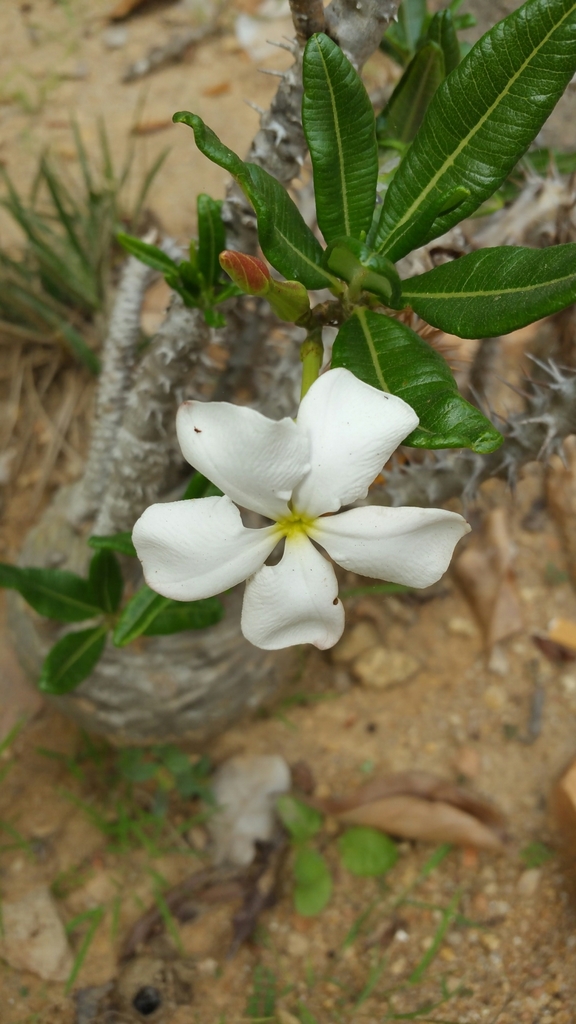
Pachypodium ambongense
Pachypodium ambongense is a species of plant in the family Apocynaceae. It was first published as a species of the genus Pachypodium in 1924 by the botanist Henri Louis Poisson.
Having a habit as a shrub that is 1–2 m (3+1⁄2–6+1⁄2 ft) and bottle-shaped, Pachypodium ambongense inhabits the western low, open deciduous forest of Madagascar on a substrate of Mesozoic calcareous rock. It is fairly rare to the landscape, perhaps, suggesting a more specialized environment needed for it to grow. It is known by common name in Madagascar as "Songosongo" or "Betono."
From the article Pachypodium ambongense on Wikipedia (CC BY-SA), quoted section by section
What it does
Pachypodium ambongense grows on strongly eroded, Mesozoic calcareous rocks where the fissures are filled with humus. in the low open deciduous forest of the Western Forest zone, tolerating full sun to part sun. This habitat is consistency with the general tendency of Pachypodium to inhabit the western side of the island. Growing on a calcareous substrate suggests that this plant prefers only basic soil conditions, as Rapanarivo et al. did not find P. ambongense growing on other substrates as some species of Pachypodium do. Also its preference for low open forest mean that it can be found growing at an altitude of 100 m (328 feet) or less. The plants that are often associated with its habitat are: Adenia firingalavensis Harms (Passifloraceae); Aloe sp. (Asphodelaceae); Cissus sp. (Vitaceae); Euphorbia viguieri (Euphorbiaceae); Lomatophyllum sp. (Liliaceae); Pachypodium rutenbergianum (Apocynaceae); Pandanus sp. (Pandanaceae); Uncarina sakalava Uncarina perrieri (Pedaliaceae); and Xerosicyos perrieri (Cucurbitaceae). Associated plants are key to understanding the ecology of a taxon because they often act as site indicators as to what the habitat consists of in the landscape and within the climate.
Wikipedia: “Ecology”
How it is grown
The[substrate should be loose peat with lime gravel. Temperatures from Spring to Autumn, as varied by night and day, should be between 18 °C (64.4 °F) and 38 °C (100.4 °F). To keep it in the winter temperatures should be between nocturnal 15 °C (59 °F) and diurnal 20 °C (68 °F). While in the dry season, moisten the soil only when the soil dries out completely, then only water slightly; so that the soil does not dry out completely. After the dry season, it needs a lot of water. It flowers after the Dry Season. When the Dry Season begins it does not say by Röösli or Rapanarivo et al.'s account of the habitat. Presumably, Winter would be the dry season unless otherwise noted, as is the case for Pachypodium namaquanum. In fact, Rowley states that all Pachypodium can be kept growing year round so long the temperature is like normal growing temperatures, which can be achieved under lights and in a Greenhouse. Growing year-round would likely interfere with the taxon's bloom cycle, it stand to reason.
Wikipedia: “Based on W. Röösli within Rapanarivo et al. "Cultivation"”
Where it lives
Recorded sightings
—
geo-referenced records in GBIF, from museums, herbaria and field observers.
Drag the globe to turn it. Dots are where records exist, not a range map; darker means more records.
In the stacks
Searching the stacks…
Every page naming Pachypodium ambongense in the Biodiversity Heritage Library →
This page is assembled live from iNaturalist, GBIF, Wikipedia, the Source Library and the Internet Archive. It is not yet part of the hand-edited codex. iNaturalist taxon 885135.