- Plants
- ›Vascular Plants
- ›flowering plants
- ›Dicots
- ›Buttercups, Poppies, and Allies
- ›buttercup family
- ›Anemones, buttercups, larkspurs and allies
- ›anemones and allies
- ›Hepatica
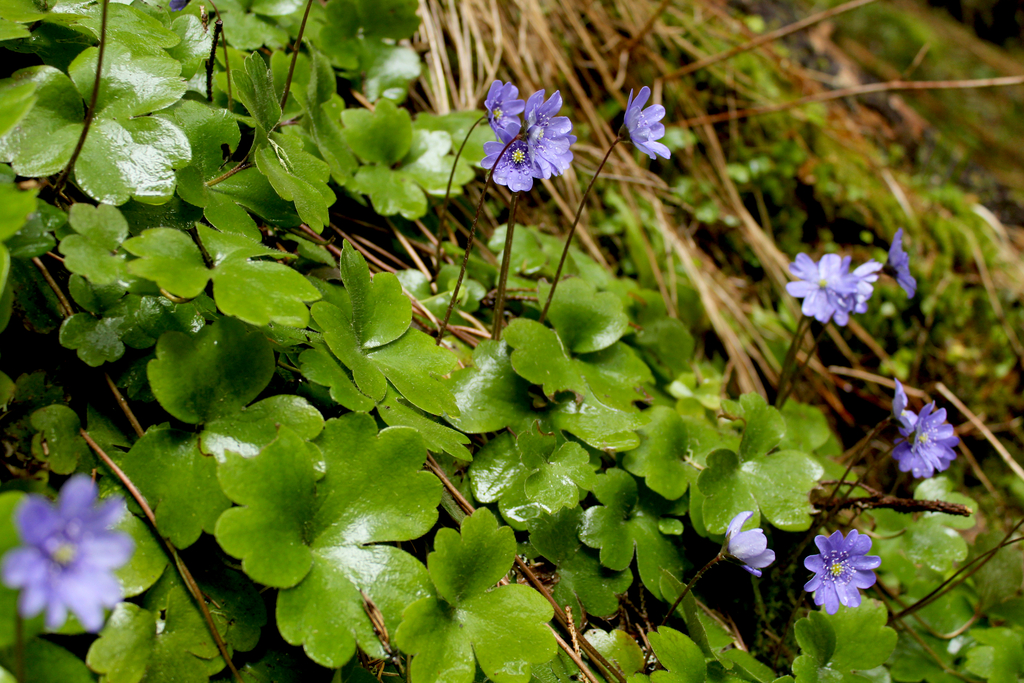
large blue hepatica
Hepatica transsilvanica
Hepatica transsilvanica, called the large blue hepatica, is a species of flowering plant in the genus Hepatica, native to the Carpathian Mountains of Romania. It has gained the Royal Horticultural Society's Award of Garden Merit.
From the article Hepatica transsilvanica on Wikipedia (CC BY-SA), quoted section by section
In human culture
Hepatica transsilvanica has an evolutionary origin as a hybrid species. Molecular phylogenetics studies have confirmed that it is an allotetraploid, meaning it formed when two different parent species hybridized, and the chromosome count doubled. Its maternal parent is Hepatica nobilis, a widespread European species with entirely lobed leaves, while its paternal parent is Hepatica falconeri, a diploid species native to Central Asia with crenate (scalloped) leaves. This hybrid origin is evidenced by several lines of genetic research. Analysis of nuclear DNA sequences shows patterns consistent with contributions from both parent species, while the plant's plastid DNA (inherited maternally) closely matches that of H. nobilis. The hybrid nature is further supported by the plant's intermediate leaf morphology and its tetraploid chromosome count (n=28), compared to the diploid count (2n=14) of H. nobilis. Dating analyses suggest this hybridization event occurred about 3 million years ago, during the late Pliocene epoch. This makes H. transsilvanica substantially older than many European plant species, with its origin predating the major Quaternary glaciation cycles that reshaped much of Europe's flora.
Wikipedia: “Evolutionary history”
Where it lives
Recorded sightings
—
geo-referenced records in GBIF, from museums, herbaria and field observers.
Drag the globe to turn it. Dots are where records exist, not a range map; darker means more records.
In the stacks
Searching the stacks…
Every page naming Hepatica transsilvanica in the Biodiversity Heritage Library →
This page is assembled live from iNaturalist, GBIF, Wikipedia, the Source Library and the Internet Archive. It is not yet part of the hand-edited codex. iNaturalist taxon 881547.