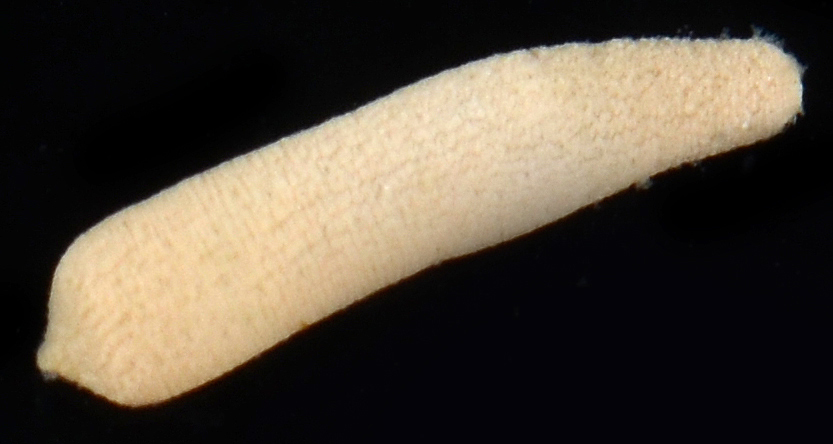
Brown Peanut Worm
Golfingia vulgaris
Golfingia vulgaris is a marine invertebrate belonging to the phylum Sipuncula, the peanut worms. It is a cylindrical, unsegmented worm with a crown of tentacles around the mouth. It lives in burrows in shallow seas in various parts of the world.
From the article Golfingia vulgaris on Wikipedia (CC BY-SA), quoted section by section
Description
Like other sipunculans, the body is divided into a larger rear end known as the trunk and a narrower front end known as the introvert. The trunk is cylindrical and can reach 200 mm in length but is more commonly 20–50 mm. It varies in colour from grey to white to yellow-brown. The two ends of the trunk are often pigmented dark brown or black. The introvert can be retracted into the trunk by the retractor muscles of which there are usually four but occasionally three. The introvert bears many dark brown, slightly bent hooks. These are arranged irregularly unlike the similar species Golfingia elongata where the hooks are arranged in rings. Young specimens have a crown of around 20 small, finger-like tentacles arranged in a circle around the mouth. As the worm grows the number of tentacles can increase to over 150 and they are arranged in three or more circles. The entoproct Loxosomella phascolosomata often attaches itself to the worm.
Range & habitat
It has a widespread but patchy distribution around the world. It occurs in the eastern Atlantic Ocean from Greenland and Scandinavia south to West Africa and also occurs in the Mediterranean Sea, Adriatic Sea and Red Sea. It is found locally in the western Pacific Ocean and there is a record from the eastern Pacific off British Columbia. The subspecies G. v. herdmani is found in parts of the Indian Ocean and around Australia. It is found in mud, sand and gravel at depths of 5–2000 m, mainly occurring in waters less than 500 m deep. There is also one record from 5,540 m down in the Kuril–Kamchatka Trench. G. v. herdmani occurs in warm, shallow water.
Wikipedia: “Distribution and habitat”
Where it lives
Recorded sightings
—
geo-referenced records in GBIF, from museums, herbaria and field observers.
Drag the globe to turn it. Dots are where records exist, not a range map; darker means more records.
In the stacks
Searching the stacks…
Every page naming Golfingia vulgaris in the Biodiversity Heritage Library →
This page is assembled live from iNaturalist, GBIF, Wikipedia, the Source Library and the Internet Archive. It is not yet part of the hand-edited codex. iNaturalist taxon 874030.