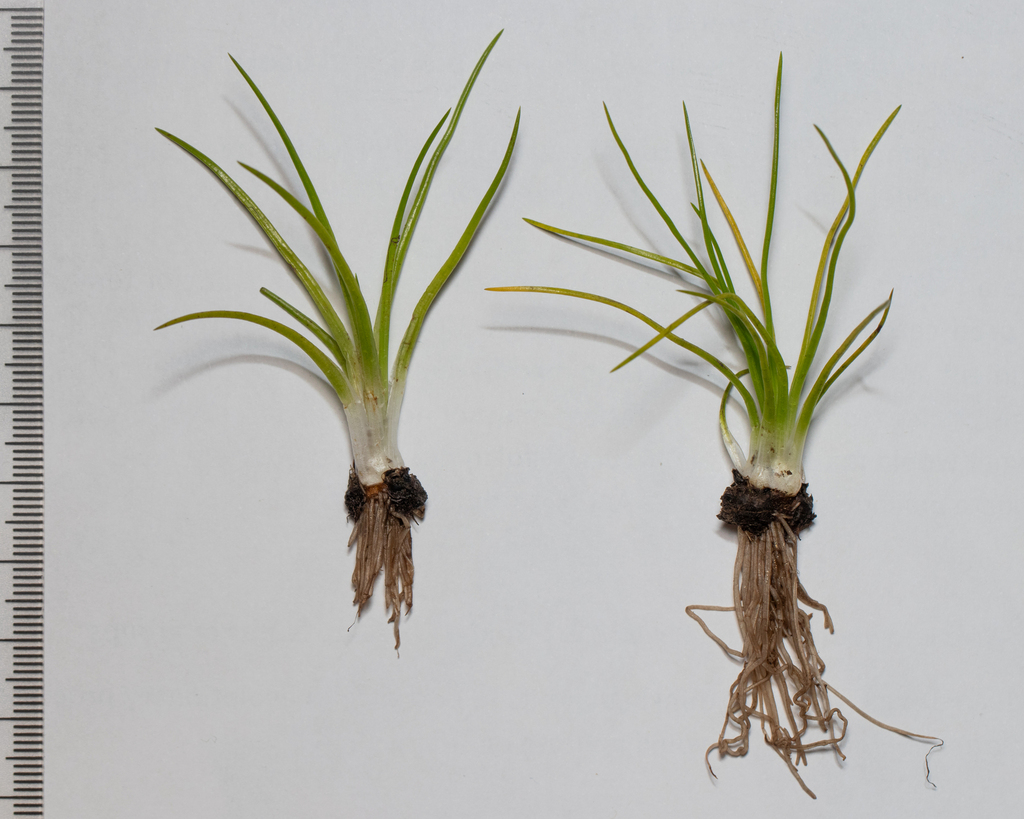
Victory Quillwort
Isoetes stephanseniae
Isoetes stephanseniae, the granite quillwort, is a species of quillwort from South Africa, named for A. J. Stephansen, who discovered it in 1927. Of very limited distribution, it is known to survive only as one population in seasonal pools over granite near Stellenbosch, where it is threatened by the encroachment of alien species and eutrophication from the sewage works on whose grounds it grows. Like other quillworts, it bears a tuft of leaves with distinctively sculpted megaspores. It is most similar to Isoetes capensis, the cape quillwort, which occurs in the same province; both hold their leaves at a 45-degree angle, unlike most South African quillworts which have leaves stiffly erect.
From the article Isoetes stephanseniae on Wikipedia (CC BY-SA), quoted section by section
Description
The granite quillwort is a small, somewhat grasslike plant of aquatic habitats. During summer dormancy, it survives as a two-lobed pseudocorm, with blackish-brown, leathery bud scales that are triangular in shape, about 3 millimetres (0.1 in) long and 3 millimetres (0.1 in) wide at the base. They sometimes have a hairlike tip extending them an additional 3 millimetres (0.1 in). From these buds grow 5 to 15 leaves, which are linear and acicular (needle-like) in shape, ranging from 40 to 130 millimetres (1.6 to 5.1 in) long and about 1.5 millimetres (0.059 in) wide. The leaves are held loosely upright at about a 45-degree angle, similar to I. capensis but unlike the more erect I. stellenbossiensis. The leaves widen at their base to about 4 millimetres (0.2 in) wide to accommodate sporangia, and bear a narrow wing of membranous-textured tissue at their margins there. The ligules at the base of the leaf blades are cordate-triangular in shape, pale in colour, darkening at their base, and up to 1 millimetre (0.04 in) long. A flap of tissue known as the velum completely covers the opening of the sporangium. The megaspores are 0.45 to 0.62 millimetres (0.018 to 0.024 in) in diameter and gray-white in colour. …
Range & habitat
The granite quillwort is endemic to the Stellenbosch area of the Western Cape of South Africa. The Stellenbosch Flats, where it occurs on seasonally wet ground, have been very much urbanized since its discovery. Of the two populations known, one was destroyed by the expansion of Stellenbosch University; the remaining one is protected on the grounds of the local sewerage works. It grows in vernal pools over granite and in the surrounding marshy grassland.
Wikipedia: “Distribution and habitat”
What it does
During the summer, the pools and marshlands where the species occurs dry up, and it becomes dormant, with the pseudocorm waiting until the first rain to put up new leaves. It occupies sites that are wetter and hold water longer than I. stellenbossiensis, which also occurs on the Stellenbosch Flats.
Wikipedia: “Ecology”
Where it lives
Recorded sightings
—
geo-referenced records in GBIF, from museums, herbaria and field observers.
Drag the globe to turn it. Dots are where records exist, not a range map; darker means more records.
In the stacks
Searching the stacks…
Every page naming Isoetes stephanseniae in the Biodiversity Heritage Library →
This page is assembled live from iNaturalist, GBIF, Wikipedia, the Source Library and the Internet Archive. It is not yet part of the hand-edited codex. iNaturalist taxon 872865.