- Plants
- ›Vascular Plants
- ›flowering plants
- ›Dicots
- ›pinks, cactuses, and allies
- ›cacti
- ›globular cacti, moonlight cacti, torch cacti, and allies
- ›Trichocereeae
- ›Aylostera
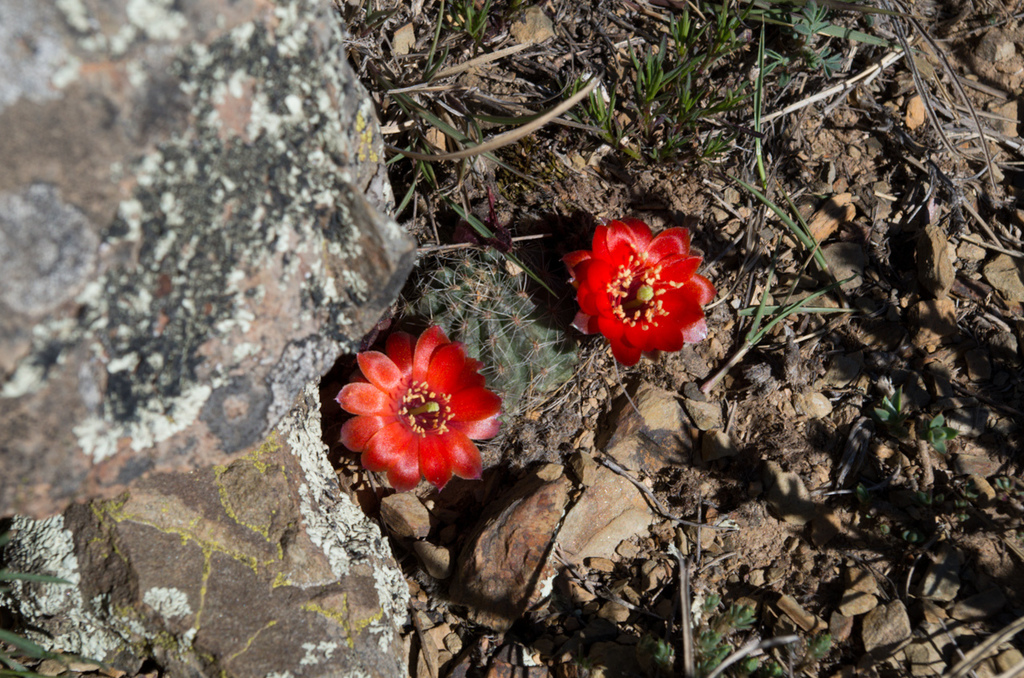
Aylostera steinmannii
Aylostera steinmannii is a species of flowering plant in the cactus family.
From the article Aylostera steinmannii on Wikipedia (CC BY-SA), quoted section by section
Description
Aylostera steinmannii is a small, clustering cactus species. Its stems are spherical to short-cylindrical, growing up to 2 centimeters tall and 1 to 3.5 centimeters in diameter. It has a thick, beet-like root. The plant has 8 to 10 spirally arranged ribs, which are divided into low tubercles. Its oval areoles vary in color from brown to whitish. The cactus lacks central spines, but has 8 to 13 marginal spines that are yellowish-white. These spines are needle-like, slender, flexible, and can be either protruding or spreading—often intertwined—and measure 3 to 10 millimeters long. The bell-shaped flowers are bright red to violet, up to 5 centimeters long, and about 4 centimeters in diameter. The pericarpel and floral tube are sparsely covered with grayish hairs. The stigmas are pale yellow or sometimes a delicate pale green. This species is native to regions from Bolivia to northwestern Argentina, primarily growing in tropical mountain environments.
Range & habitat
Aylostera steinmannii is found in northwest Argentina (in the provinces of Jujuy and Salta) and Bolivia (in the departments of Cochabamba, Chuquisaca, La Paz, Tarija, Potosí, and Oruro). The species is native to montane tropical areas, and occurs at elevations from 3,400 to 3,800m. In 2010, the species was assessed as of Least Concern, facing no major threats. IUCN notes that the population is stable, and that the species is locally abundant. The species is cultivated as an ornamental plant in specialized collections.
Wikipedia: “Distribution”
Where it lives
Recorded sightings
—
geo-referenced records in GBIF, from museums, herbaria and field observers.
Drag the globe to turn it. Dots are where records exist, not a range map; darker means more records.
In the stacks
Searching the stacks…
Every page naming Aylostera steinmannii in the Biodiversity Heritage Library →
This page is assembled live from iNaturalist, GBIF, Wikipedia, the Source Library and the Internet Archive. It is not yet part of the hand-edited codex. iNaturalist taxon 871229.