- Plants
- ›Vascular Plants
- ›flowering plants
- ›Dicots
- ›magnolias, nutmegs, and allies
- ›custard-apples
- ›Annonoideae
- ›Xylopieae
- ›Xylopia
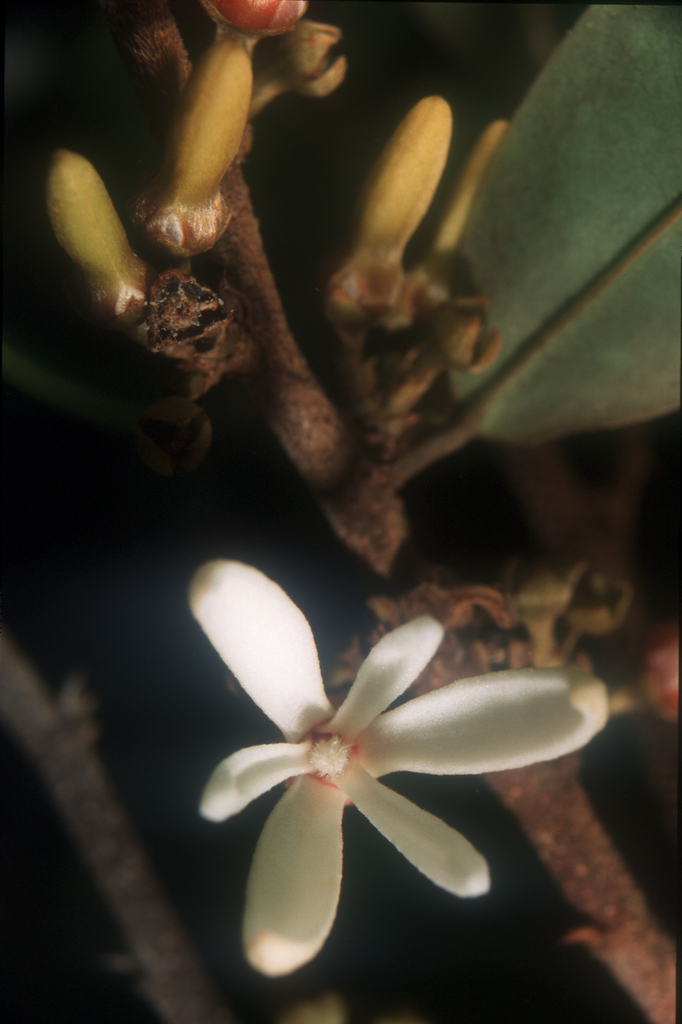
Xylopia calophylla
Xylopia calophylla is a species of plant in the Annonaceae family. It is native to
Bolivia, Brazil, Colombia, Ecuador, Peru and Venezuela. Robert Elias Fries, the botanist who first formally described the species, named it after its beautiful leaves (Latinized forms of Greek καλλι-, calli- and φυλλον, phullon).
From the article Xylopia calophylla on Wikipedia (CC BY-SA), quoted section by section
Description
It is a medium-sized tree. The young branches are densely covered in soft, silky, rust-colored hairs, but as they mature they become hairless. The branches have reddish bark and often have lenticels. Its elliptical, papery leaves are 8-10 by 2.5-3.5 centimeters. The leaves have short, pointed bases and tapering, somewhat blunted tips, with the tapering portion 5-10 millimeters long. The leaves are differently colored on their upper and lower sides. The upper sides are shiny and hairless. The lower sides are densely covered in silvery hairs that lay flat against the surface. The midribs of the leaves are impressed on their upper surface and very prominent on their lower surface. The leaves have secondary veins that are also impressed on the upper surface and form a network pattern. Its petioles are 5-6 millimeters long, covered in soft hairs, with a groove on their upper side. Its Inflorescences occur in axillary positions. The flowers are on pedicels that are up to 3 millimeters long, packed together in dense groupings, and covered in gold-colored silky hairs. Its flowers have 3 egg-shaped sepals that are 2 by 2 millimeters, with pointed tips. The base of the sepals are fused at their margins. The sepals have silky hairs on their lower surfaces and are hairless on their upper surfaces. Its 6 petals are arranged in two rows of 3. …
Where it lives
Recorded sightings
—
geo-referenced records in GBIF, from museums, herbaria and field observers.
Drag the globe to turn it. Dots are where records exist, not a range map; darker means more records.
In the stacks
Searching the stacks…
Every page naming Xylopia calophylla in the Biodiversity Heritage Library →
This page is assembled live from iNaturalist, GBIF, Wikipedia, the Source Library and the Internet Archive. It is not yet part of the hand-edited codex. iNaturalist taxon 869929.