- Plants
- ›Vascular Plants
- ›flowering plants
- ›monocots
- ›Agaves, Orchids, Irises, and Allies
- ›agave and allies
- ›Hyacinth subfamily
- ›hyacinth tribe
- ›Prospero
- ›Prospero autumnale
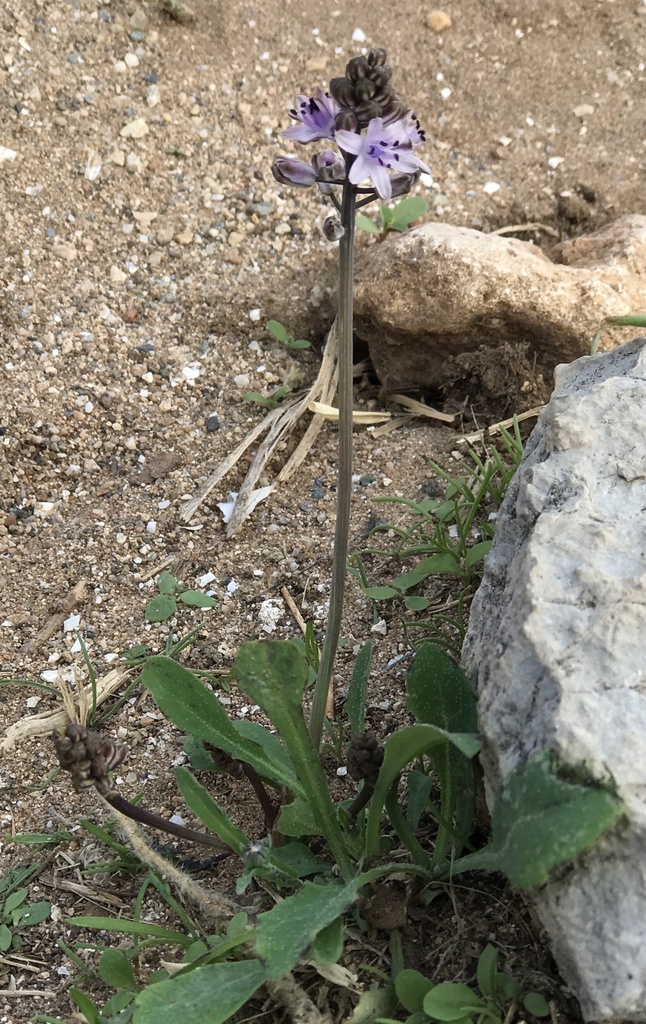
Prospero rhadamanthi
Prospero rhadamanthi is a species of flowering plant of the family Asparagaceae, subfamily Scilloideae endemic to Crete, Greece. It is a diploid species in the Prospero autumnale cryptic species complex. This delicate autumn-flowering plant produces pale pink nodding flowers on slender stems after its grass-like leaves emerge. First collected in 1996 from Petres Gorge near Karoti in Crete at low elevations (5–80 metres), it was recognized as a distinct species in 2000.
From the article Prospero rhadamanthi on Wikipedia (CC BY-SA), quoted section by section
Description
Prospero rhadamanthi is a bulbous perennial that develops from a nearly spherical to ovoid underground bulb measuring about 1.6–2 cm in length and 1.3–1.8 cm in width, enclosed within a brown papery tunic. In autumn, before the flowers open, the plant produces between five and fourteen slender, grass-like leaves up to 20 cm long and 1.2–2 mm wide. Soon after, one or two leafless flowering stems (scapes), each about 1 mm thick, rise to a height of 12–16 cm and carry between five and twenty-eight nodding flowers on stalks (pedicels) 4–7 mm long. Each flower bears six pale pink perianth segments measuring approximately 6 mm by 2 mm, with a distinct green keel on the underside. The stamens consist of lanceolate filaments, also pale pink and about 4 mm long, arising from a white base. The ovary is pale violet, around 2 mm long and 1.5 mm in diameter, topped by a style roughly 1.8 mm long. Following pollination, the plant forms a spherical capsule roughly 3 mm in diameter, which contains black seeds about 1.8–2 mm in length. Chromosome studies have established a diploid number of 2n = 14. The species was first collected by Franz Speta in May 1996 from Petres Gorge near Karoti, at elevations of 5–80 m.
Where it lives
Recorded sightings
—
geo-referenced records in GBIF, from museums, herbaria and field observers.
Drag the globe to turn it. Dots are where records exist, not a range map; darker means more records.
In the stacks
Searching the stacks…
Every page naming Prospero rhadamanthi in the Biodiversity Heritage Library →
This page is assembled live from iNaturalist, GBIF, Wikipedia, the Source Library and the Internet Archive. It is not yet part of the hand-edited codex. iNaturalist taxon 862622.