- Plants
- ›Vascular Plants
- ›flowering plants
- ›monocots
- ›Agaves, Orchids, Irises, and Allies
- ›amaryllis, onions, and allies
- ›onion subfamily
- ›Allieae
- ›Allium
- ›Anguinum
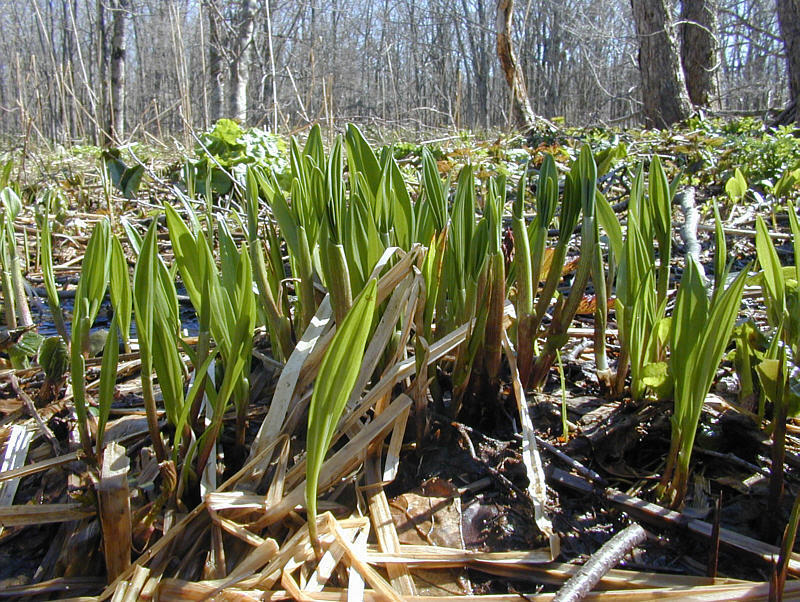
Siberian onion
Allium ochotense
Allium ochotense, or the Siberian onion, is a primarily East Asian species of wild onion native to northern Japan, Korea, China, and the Russian Far East, as well as Attu Island in Alaska.
Some authors have considered A. ochotense as belonging to the same species as A. victorialis, but more recent authorities have treated it as a distinct species.
From the article Allium ochotense on Wikipedia (CC BY-SA), quoted section by section
Description
Allium ochotense grows to 20–30 cm (8–12 in) in height, with a strong garlic-like odor, and has "bulbs.. surrounded by a grayish-brown, netlike coating. The leaves are 1–3 glabrous, broadly elliptic,... perianth (flower) whitish-green". The plant is slow-growing, and aside from seed-propagation, "A. victorialis has two vegetative propagation systems; one is tillering and the other is adventitious buds". The plant has an intense garlic-like odor (cf. allicin content) that is thought more intense than garlic itself.
Range & habitat
Allium ochotense is centered in the Amur River basin area, thus, it occurs in the Amur, Khabarovsk, Primorye regions of Siberia, and into Sakhalin and Kuril Islands within the Russian Far East. In China, the plant grows in Inner Mongolia and China (Heilongjiang, Jilin, Liaoning), Hebei, Henan, Anhui, Hubei, Zhejiang, Shaanxi, Shanxi, Gansu, and Sichuan). The range also includes Korea, in Ulleungdo and the high mountains (over 1,000 metres (3,300 ft)) in the Korean Peninsula, including Paektu Mountain, and Japan (Hokkaido and Honshu), in colonies from Hokkaido down to the Kinki area (Nara Prefecture), in coniferous and mixed forested wetlands in subalpine terrain. The plant's range extends nominally into the United States, but A. ochotense is only found natively growing on Attu Island, the westernmost island of the Aleutian archipelago. There are colonies on Unalaska Island, but they are thought to be introduced.
Wikipedia: “Distribution”
How it is grown
From around 1990, it has been grown horticulturally in Hokkaido and snowy regions on the eastern side of Honshū. Outbreaks of plant disease have been reported in these onion paddy farms. It requires approximately four years from sowing to harvest.
Cultivars. At Utsunomiya University's Agriculture Department, the research group led by then-assistant professor Nobuaki Fujishige developed an A. ochotense × A. tuberosum (garlic chives) hybrid, which they dubbed gyōjana (行者菜). It resembles the garlic chive in outward appearance, but inherits the thick-stalked trait of A. victorialis, and like the garlic chive, is ready for harvest after 1 year. It has been sold in the commercial market since 2008 in Nagai, Yamagata.
Wikipedia: “Cultivation”
In human culture
Allium is the ancient Latin name for garlic. The specific epithet, ochotense, was given by Yarosláv Ivánovich Prokhánov (Яросла́в Ива́нович Проха́нов) [1902–1965], a Soviet botanist, systematist, geographer, geneticist, Doctor of Biological Science, and professor. It was presumably named in reference to the Okhotsk region of Russia, a place where this species is known to occur.
Wikipedia: “Etymology”
Where it lives
Recorded sightings
—
geo-referenced records in GBIF, from museums, herbaria and field observers.
Drag the globe to turn it. Dots are where records exist, not a range map; darker means more records.
In the stacks
Searching the stacks…
Every page naming Allium ochotense in the Biodiversity Heritage Library →
This page is assembled live from iNaturalist, GBIF, Wikipedia, the Source Library and the Internet Archive. It is not yet part of the hand-edited codex. iNaturalist taxon 855312.