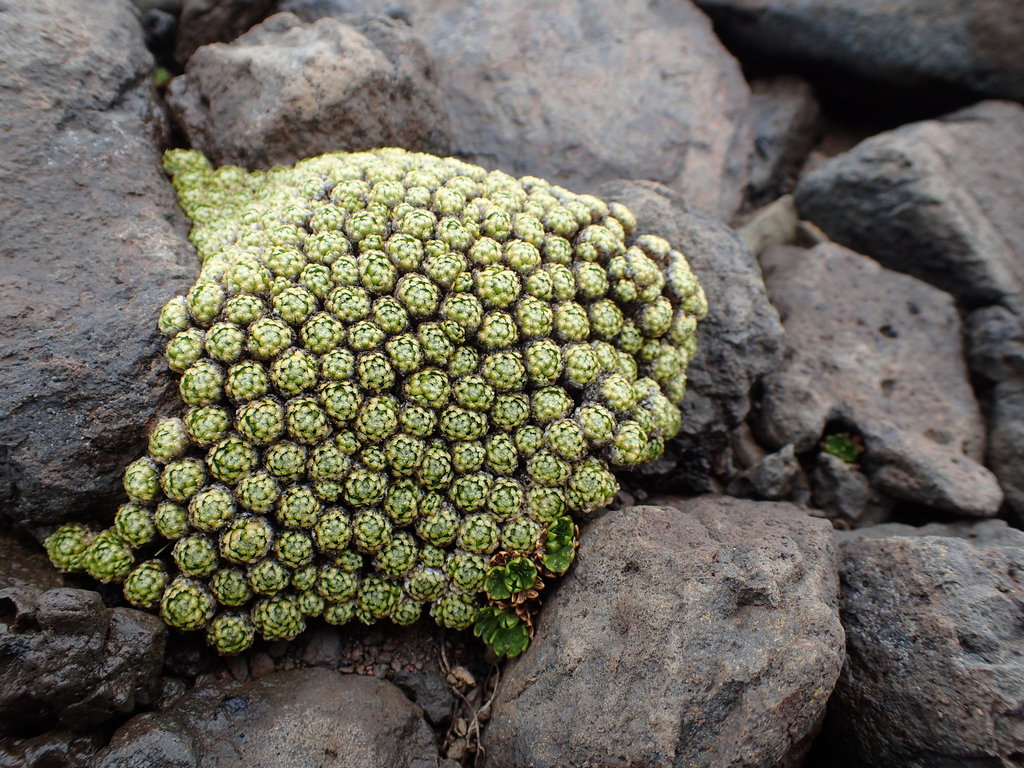
Lyallia Cushion
Lyallia kerguelensis
Lyallia kerguelensis, commonly called the lyallia cushion (coussin de lyallia in French), is a species of flowering cushion plant in the monotypic genus Lyallia in the Montiaceae family. It is sometimes placed in the Hectorellaceae or the Portulacaceae. The generic name honours British botanist and naval officer David Lyall who served as assistant surgeon on HMS Terror on the Antarctic exploring expedition led by James Clark Ross from 1839 to 1843. Lyall was a friend and
From the article Lyallia on Wikipedia (CC BY-SA), quoted section by section
Description
Lyallia kerguelensis is a perennial that forms round cushions, usually 20–40 centimeters across, but occasionally up to 1 meter in diameter. Individual cushions have a mean diameter of 12.79 cm and mean height of 6.06 cm. The plants have an extensive root system with a large main root and many fine branching roots. Plants can live for at least 16 years. The flowers are tiny and mostly green. They are found are at the ends of the stems in the leaf axils, where the leaves attach to the stems, usually in clusters of two to four. Each flower has two somewhat green membrane-like sepals that fuse at the base. The four petals have a similar texture. Each flower has three stamens, but about one third of fully opened flowers only have two functional anthers. Each translucent red-brown capsule has one or two kidney shaped black seeds. Unlike most plants endemic to the islands in the south Indian Ocean, its seeds are not highly viable.
Range & habitat
The species is endemic to the Kerguelen Islands in the subantarctic, part of the French Southern and Antarctic Lands in the southern Indian Ocean. It grows in small populations on moraines and fellfields, from the sea shore to about 300 meters above sea level, at a mean elevation of 132.22 m. It is present, but rare on the main island of the group, but is more common on Long Island in the Gulf of Morbihan. Both Lyallia kerguelensis and Pringlea antiscorbutica were definitely present on the Kerguelen Islands during the late glaciation of the early Holocene some 10,000 years ago. It is also probable that they are survivors from the richer group of plants that grew on the islands prior to the extensive glacial cover of the Pleistocene, prior to about 2.58 million years ago.
Wikipedia: “Range and habitat”
Where it lives
Recorded sightings
—
geo-referenced records in GBIF, from museums, herbaria and field observers.
Drag the globe to turn it. Dots are where records exist, not a range map; darker means more records.
In the stacks
Searching the stacks…
Every page naming Lyallia kerguelensis in the Biodiversity Heritage Library →
This page is assembled live from iNaturalist, GBIF, Wikipedia, the Source Library and the Internet Archive. It is not yet part of the hand-edited codex. iNaturalist taxon 854071.