- Plants
- ›Vascular Plants
- ›flowering plants
- ›Dicots
- ›Sunflowers, Bellflowers, Fanflowers, and Allies
- ›fanflower family
- ›Goodenia
- ›Monochila
- ›Monochila
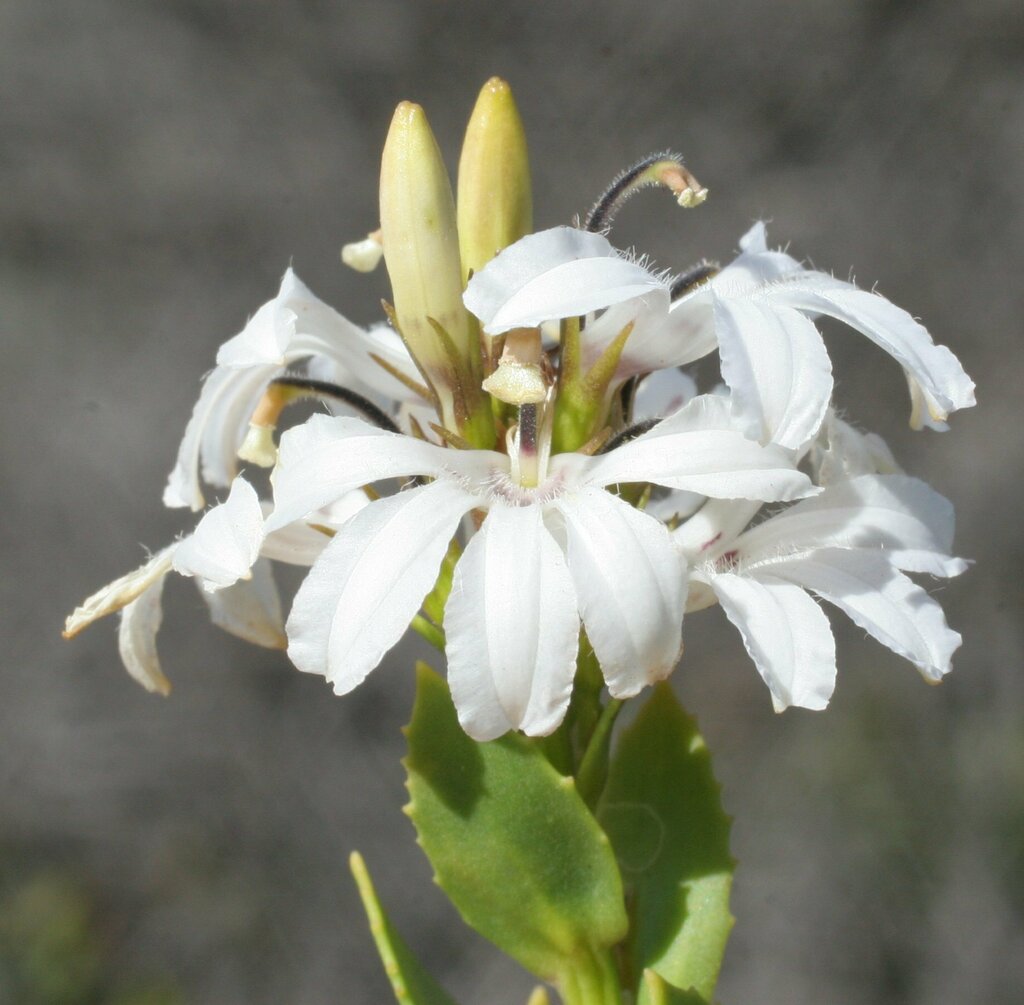
Goodenia decursiva
Goodenia decursiva is a species of flowering plant in the family Goodeniaceae and endemic to the south coast of Western Australia. It is an erect shrub with dense, more or less stem-clasping, toothed, elliptic to egg-shaped leaves almost obscuring the stem, and compact thyrses of white flowers.
From the article Goodenia decursiva on Wikipedia (CC BY-SA), quoted section by section
Description
Goodenia decursiva is an erect, glabrous shrub that typically grows to a height of 1 m (3 ft 3 in). The leaves are elliptic to egg-shaped and toothed, 10–35 mm (0.39–1.38 in) long, 8–12 mm (0.31–0.47 in) wide, more or less stem-clasping and densely arranged up the stem and almost obscuring it. The flowers are arranged in compact thyrses up to 100 mm (3.9 in) long on a peduncle up to 100 mm (3.9 in) long, with linear bracts up to 50 mm (2.0 in) long at the base, each flower on a pedicel 1–2 mm (0.039–0.079 in) long. The sepals are linear, about 9 mm (0.35 in) long and the corolla is white and 15–18 mm (0.59–0.71 in) long. The lobes of the corolla are about 8 mm (0.31 in) long with wings about 2 mm (0.079 in) wide. Flowering occurs from September to January and the fruit is a cylindrical capsule about 9 mm (0.35 in) long.
Range & habitat
This goodenia grows in sandy soil on granite outcrops and hills, mostly near the sea, along the south coast of Western Australia between Esperance and Israelite Bay in the Esperance Plains and Mallee biogeographic regions.
Wikipedia: “Distribution and habitat”
Where it lives
Recorded sightings
—
geo-referenced records in GBIF, from museums, herbaria and field observers.
Drag the globe to turn it. Dots are where records exist, not a range map; darker means more records.
In the stacks
Searching the stacks…
Every page naming Goodenia decursiva in the Biodiversity Heritage Library →
This page is assembled live from iNaturalist, GBIF, Wikipedia, the Source Library and the Internet Archive. It is not yet part of the hand-edited codex. iNaturalist taxon 851354.