- Plants
- ›Vascular Plants
- ›flowering plants
- ›Dicots
- ›Sunflowers, Bellflowers, Fanflowers, and Allies
- ›fanflower family
- ›Dampiera
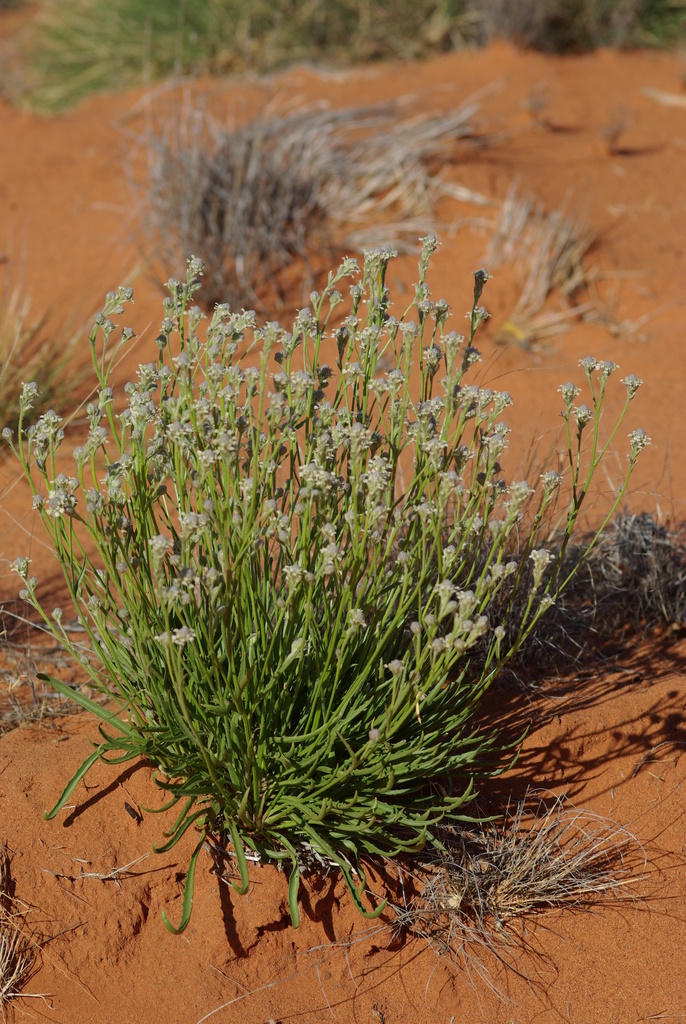
Dampiera dentata
Dampiera dentata is a plant in the family Goodeniaceae, native to Western Australia and the Northern Territory.
From the article Dampiera dentata on Wikipedia (CC BY-SA), quoted section by section
Description
Dampiera dentata is a perennial herb growing up to 40 cm, with no surface covering except for the inflorescence. The basal leaves are stalkless (sessile) and conspicuously toothed. The leaf blade is 5-16 cm by 3-15 mm. The flowers are stalkless, and arranged in heads which lengthen into spikes which are up to 15 cm long when in fruit. The sepals are just tufts of silky hairs. The corolla is 5-6 mm long with silky hairs on the outside. The ovary is 2 to 2.5 mm long, and the fruit is ellipsoidal and about 2 mm in diameter. It mainly flowers from September to November.
Range & habitat
It is found in central Western Australia and in the far south-west of the Northern Territory, on screes, and gravels and sandy soils.
Wikipedia: “Distribution and habitat”
In human culture
It was first described by Muhammad Tahir M. Rajput in 1980. The specific epithet, dentata, is a Latin adjective, dentatus, -a, um, meaning "having teeth", "toothed", or "dentate", which is derived from the Latin noun, dens ("tooth").
Wikipedia: “Taxonomy & etymology”
Where it lives
Recorded sightings
—
geo-referenced records in GBIF, from museums, herbaria and field observers.
Drag the globe to turn it. Dots are where records exist, not a range map; darker means more records.
In the stacks
Searching the stacks…
Every page naming Dampiera dentata in the Biodiversity Heritage Library →
This page is assembled live from iNaturalist, GBIF, Wikipedia, the Source Library and the Internet Archive. It is not yet part of the hand-edited codex. iNaturalist taxon 851247.