- Animals
- ›Chordates
- ›Vertebrates
- ›Cartilaginous Fishes
- ›Sharks and Rays
- ›Sharks
- ›Galean Sharks
- ›Ground Sharks
- ›Requiem Sharks
- ›Carcharhinus
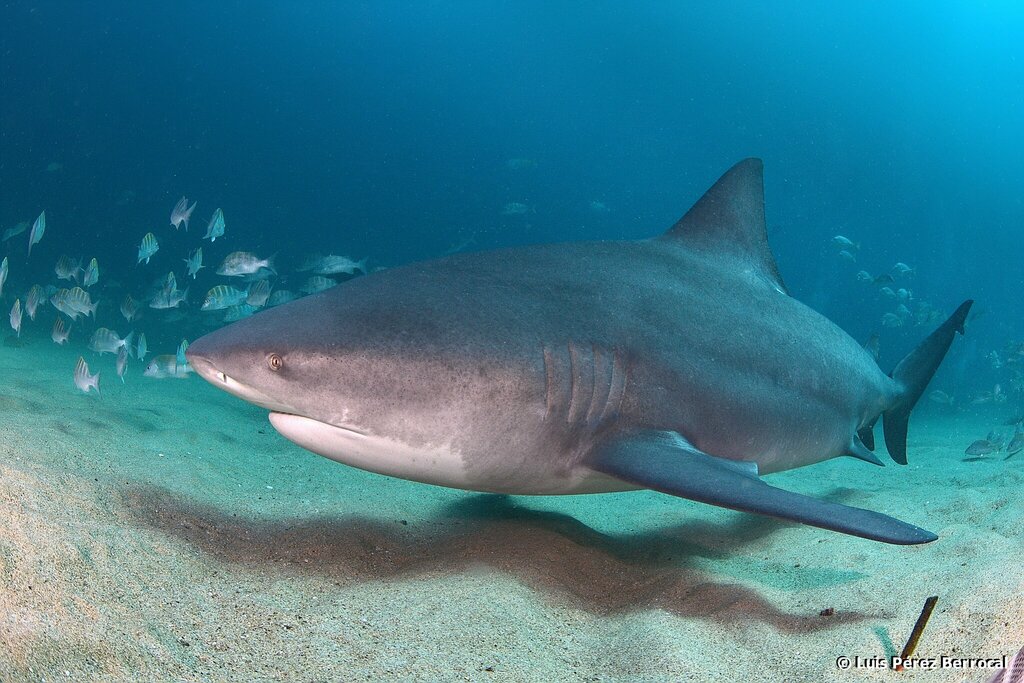
Bull Shark
Carcharhinus leucas
The bull shark (Carcharhinus leucas), also known as the Zambezi shark (informally zambi) in Africa and Lake Nicaragua shark in Nicaragua, is a species of requiem shark commonly found worldwide in warm, shallow waters along coasts and in rivers. It is known for its aggressive nature, and presence mainly in warm, shallow brackish and freshwater systems including estuaries and (usually) lower reaches of rivers. Their aggressive nature has led to ongoing shark-culling efforts near beaches to protect beachgoers, which is one of the causes of bull shark populations continuing to decrease. Bull sharks are listed as vulnerable on the IUCN Red List.
Bull sharks are euryhaline and can thrive in both salt and fresh water. They are known to travel far up rivers, and have been known to travel up the Mississippi River as far as Alton, Illinois, about 1,100 kilometres (700 mi) from the ocean, but few freshwater interactions with humans have been recorded. Larger-sized bull sharks are responsible for a large part of nearshore shark attacks, and may be responsible for many attacks involving unidentified species.
From the article Bull shark on Wikipedia (CC BY-SA), quoted section by section
Description
Bull sharks are large and stout, with females being larger than males. The bull shark can be up to 81 cm (2 ft 8 in) in length at birth. Adult female bull sharks average 2.4 m (8 ft) long and typically weigh 130 kg (290 lb), whereas the slightly smaller adult male averages 2.25 m (7 ft) and 95 kg (209 lb). While a maximum size of 3.5 m (11 ft) is commonly reported, a single record exists of a female specimen of exactly 4.0 m (13 ft). A 3.25 m (10.7 ft) long pregnant individual reached 450 kg (990 lb). The maximum weight of the 4.0 m (13 ft) long pregnant female can be over 600 kg (1,300 lb), ranking it among the largest of the requiem sharks. Bull sharks are wider and heavier than other requiem sharks of comparable length, and are grey on top and white below. The second dorsal fin is smaller than the first. The bull shark's caudal fin is longer and lower than that of the larger sharks, and it has a small snout, and lacks an interdorsal ridge. Bull sharks have a bite force up to 5,914 newtons (1,330 lbf), weight for weight the highest among all investigated cartilaginous fishes.
Exceptional specimens. In early June 2012, off the coast of the Florida Keys near the western part of the Atlantic Ocean, a female believed to measure at least 2.4 m (8 ft) and 360–390 kg (800–850 lb) was caught by members of the R.J. Dunlap Marine Conservation Program. …
Wikipedia: “Anatomy and appearance”
Range & habitat
The bull shark is commonly found worldwide in coastal areas of warm oceans, in rivers and lakes, and occasionally salt and freshwater streams if they are deep enough. It is found to a depth of 150 m (490 ft), but does not usually swim deeper than 30 m (98 ft). In the Atlantic, it is found from Massachusetts to southern Brazil, and from Morocco to Angola. Populations of bull sharks are also found in several major rivers, with more than 500 bull sharks thought to be living in the Brisbane River. One was reportedly seen swimming the flooded streets of Brisbane, Queensland, Australia, during the 2010–11 Queensland floods. Several were sighted in one of the main streets of Goodna, Queensland, shortly after the peak of the January 2011, floods. A large bull shark was caught in the canals of Scarborough, just north of Brisbane within Moreton Bay. Still greater numbers are in the canals of the Gold Coast, Queensland. In the warmer months of the year, bull sharks frequent Sydney Harbour. In the Pacific Ocean, it can be found from Baja California to Ecuador. The bull shark has traveled 4,000 km (2,500 mi) up the Amazon River to Iquitos in Peru and north Bolivia. It also lives in freshwater Lake Nicaragua, in the Ganges and Brahmaputra Rivers of West Bengal, and Assam in Eastern India and adjoining Bangladesh. It can live in water with a high salt content as in St. …
Wikipedia: “Distribution and habitat”
What it does
The bull shark is a marine apex predator, capable of taking a variety of prey. The bull shark's diet consists mainly of bony fish and small sharks, including other bull sharks, and stingrays. Their diet can also include turtles, birds, dolphins, terrestrial mammals, crustaceans, and echinoderms. They hunt in murky waters where it is harder for the prey to see the shark coming. Bull sharks have been known to use the bump-and-bite technique to attack their prey. After the first initial contact, they continue to bite and tackle prey until the prey is unable to flee. The bull shark is a solitary hunter, though may briefly pair with another bull shark to make hunting and tricking prey easier. Sharks are opportunistic feeders, and the bull shark is no exception to this, as it is part of the Carcharhinus family of sharks. Normally, sharks eat in short bursts, and when food is scarce, sharks digest for a much longer period of time in order to avoid starvation. As part of their survival mechanism, bull sharks will regurgitate the food in their stomachs in order to escape from a predator. This is a distraction tactic; if the predator moves to eat the regurgitated food the bull shark can use the opportunity to escape.
Wikipedia: “Diet”
In human culture
The name "bull shark" comes from the shark's stocky shape, broad, flat snout, and aggressive, unpredictable behavior. In India, the bull shark may be confused with the Sundarbans or Ganges shark. In Africa, it is also commonly called the Zambezi River shark, or just "zambi". Its wide range and diverse habitats result in many other local names, including Ganges River shark, Fitzroy Creek whaler, van Rooyen's shark, Lake Nicaragua shark, river shark, freshwater whaler, estuary whaler, Swan River whaler, cub shark, and shovelnose shark.
Wikipedia: “Etymology”
Where it lives
Recorded sightings
—
geo-referenced records in GBIF, from museums, herbaria and field observers.
Drag the globe to turn it. Dots are where records exist, not a range map; darker means more records.
In the stacks
Searching the stacks…
Every page naming Carcharhinus leucas in the Biodiversity Heritage Library →
This page is assembled live from iNaturalist, GBIF, Wikipedia, the Source Library and the Internet Archive. It is not yet part of the hand-edited codex. iNaturalist taxon 84996.