- Plants
- ›Vascular Plants
- ›flowering plants
- ›Dicots
- ›Gentians, Dogbanes, Madders, and Allies
- ›Gelsemiaceae
- ›Gelsemium
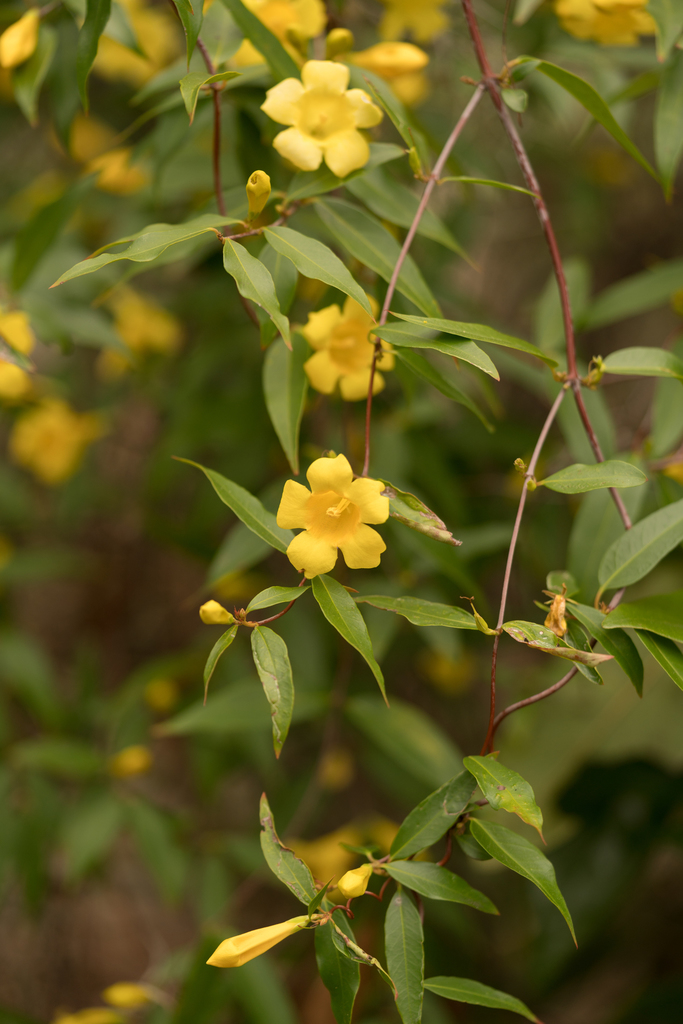
yellow jessamine
Gelsemium sempervirens
Gelsemium sempervirens is a twining vine in the family Gelsemiaceae, native to subtropical and tropical America: Honduras, Guatemala, Belize, Mexico (Chiapas, Oaxaca, Veracruz, Puebla, Hidalgo), and southeastern and south-central United States (from Texas to Virginia). It has a number of common names including yellow jessamine or confederate jessamine or jasmine, Carolina jasmine or jessamine, evening trumpetflower, gelsemium and woodbine.
Yellow jessamine is the state flower of South Carolina.
From the article Gelsemium sempervirens on Wikipedia (CC BY-SA), quoted section by section
What it does
Gelsemium sempervirens is insect pollinated and is recorded to have been visited in northern Florida by Bombus impatiens, Ceratina, Habropoda laboriosa, Lasioglossum reticulatum, Osmia sandhouseae, and Xylocopa virginica.
Wikipedia: “Ecology”
Toxicity
All parts of this plant contain the toxic strychnine-related alkaloids gelsemine and gelseminine and should not be consumed. The sap may cause skin irritation in sensitive individuals. Children, mistaking this flower for honeysuckle, have been poisoned by sucking the nectar from the flower. The nectar is also toxic to honeybees, which may cause brood death when gathered by the bees. The nectar may, however, be beneficial to bumblebees. It has been shown that bumblebees fed on gelsemine have a reduced load of Crithidia bombi in their fecal matter after 7 days, although this difference was not significant after 10 days. Reduced parasite load increases foraging efficiency, and pollinators may selectively collect otherwise toxic secondary metabolites as a means of self-medication. The plant can be lethal to livestock.
How it is grown
Despite the hazards, this is a popular garden plant in warmer areas, frequently being trained to grow over arbors or to cover walls. In the UK, it has won the Royal Horticultural Society's Award of Garden Merit. It can be grown outdoors in mild and coastal areas of the UK (to a lower limit of −5 °C (23 °F)), but elsewhere must be grown under glass. It requires a sheltered position in full sun or light shade.
Wikipedia: “Cultivation”
In human culture
Some 19th century sources identified Gelsemium sempervirens as a folk remedy for various medical conditions. William Bartram encountered this species (then referred to as Bignonia sempervirens) on his travels along the coasts of the Carolinas and Georgia in 1773.
Wikipedia: “History”
Where it lives
Recorded sightings
—
geo-referenced records in GBIF, from museums, herbaria and field observers.
Drag the globe to turn it. Dots are where records exist, not a range map; darker means more records.
In the old herbals & bestiaries

In the stacks
Searching the stacks…
Every page naming Gelsemium sempervirens in the Biodiversity Heritage Library →
This page is assembled live from iNaturalist, GBIF, Wikipedia, the Source Library and the Internet Archive. It is not yet part of the hand-edited codex. iNaturalist taxon 83070.