- Plants
- ›Vascular Plants
- ›flowering plants
- ›monocots
- ›lilies, supplejacks, and allies
- ›Herb-Paris, False Hellebores, Trilliums and allies
- ›Melanthieae
- ›Amianthium
fly poison
Amianthium muscitoxicum
Amianthium is a genus of perennial monocot plants found in eastern North America. The genus contains only one species, known as Amianthium muscitoxicum. Its common names include "fly poison" and "stagger grass". The species name muscitoxicum comes from a direct Latin translation of "fly poison": muscae = flies, toxicum = poison. The entire plant is poisonous to an array of species, including humans, and the bulb is particularly toxic. A. muscitoxicum was first recorded by Thomas Walter in his work Flora Caroliniana in 1788.
From the article Amianthium on Wikipedia (CC BY-SA), quoted section by section
Description
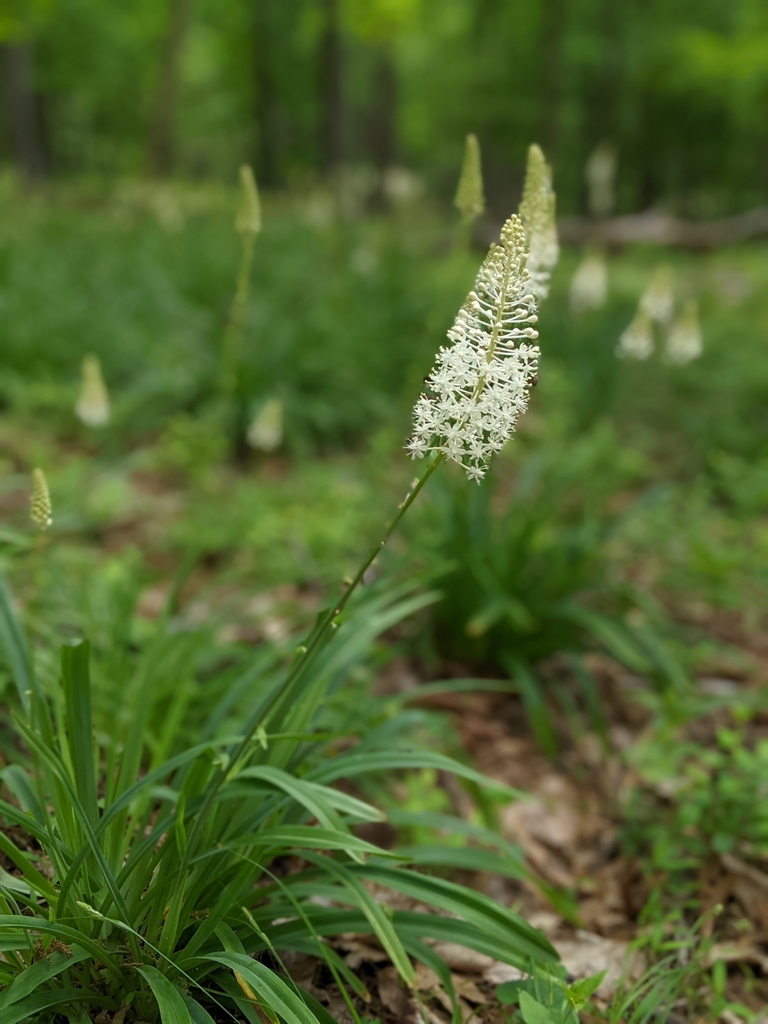
Amianthium muscitoxicum blooms between May and July with small white flowers that turn greenish or purplish with age. Its flowers form an indeterminate bracteate raceme inflorescence. It blooms from the bottom of the inflorescence upwards, eventually forming small, bright orange fruits in the late summer or fall.
A. muscitoxicum can grow 1–4 feet tall. Its main leaves are at the base of the plant; they are thin and can grow more than 12in long. It also has leaves along the length of the stem, but they are very reduced.
Range & habitat
Amianthium muscitoxicum is native to the eastern United States from New York to Florida and can be found as far west as Missouri and Oklahoma. Its native habitats include oak forests, bogs, low pinelands, savannas, meadows, and sandhills. It does best in partial shade, with 1–2 hours of direct sunlight. Companion plants include: longleaf pine, willow oak, mountain laurel, blueberries, galax, heartleaf, foamflowers, smilacina, Soloman's seal, dwarf iris, jack-in-the-pulpit, black cohosh, grasses.
Wikipedia: “Habitat and Distribution”
At the table
Amianthium muscitoxicum's common name "fly poison," comes from its use by early colonists as a way to control flies. The bulbs can be ground down and mixed with something sweet, such as molasses or honey, to attract flies. When flies drink it, they become unstable and have difficulty moving. After 24 hours or so, if the flies have not been removed, the poison will wear and off and they are seemingly fine.
Wikipedia: “Uses”
Toxicity
Amianthium muscitoxicum contains toxic alkaloids, and as such, is highly poisonous when ingested by livestock, humans and other animals. Four toxic alkaloids were isolated from the plant in 1953: jervine, two unknown ester alkaloids, and amianthine (an alkamine). These compounds are found in all parts of the plant, with especially high concentrations in the bulbs. Historical experiments tested the toxicity on sheep and cattle. Observed symptoms included cessation of eating and excess production of saliva, nausea followed by vomiting, rapid pulse, rapid and irregular respiration, weakness, and difficulty walking. When fatal, death occurred in about an hour. This is the origin for "stagger grass" as a common name for this plant.
Where it lives
Recorded sightings
—
geo-referenced records in GBIF, from museums, herbaria and field observers.
Drag the globe to turn it. Dots are where records exist, not a range map; darker means more records.
In the stacks
Searching the stacks…
Every page naming Amianthium muscitoxicum in the Biodiversity Heritage Library →
This page is assembled live from iNaturalist, GBIF, Wikipedia, the Source Library and the Internet Archive. It is not yet part of the hand-edited codex. iNaturalist taxon 83015.