- Plants
- ›Vascular Plants
- ›flowering plants
- ›monocots
- ›Agaves, Orchids, Irises, and Allies
- ›Orchids
- ›Orchidoid Orchids
- ›Diurideae
- ›Diuridinae
- ›Diuris
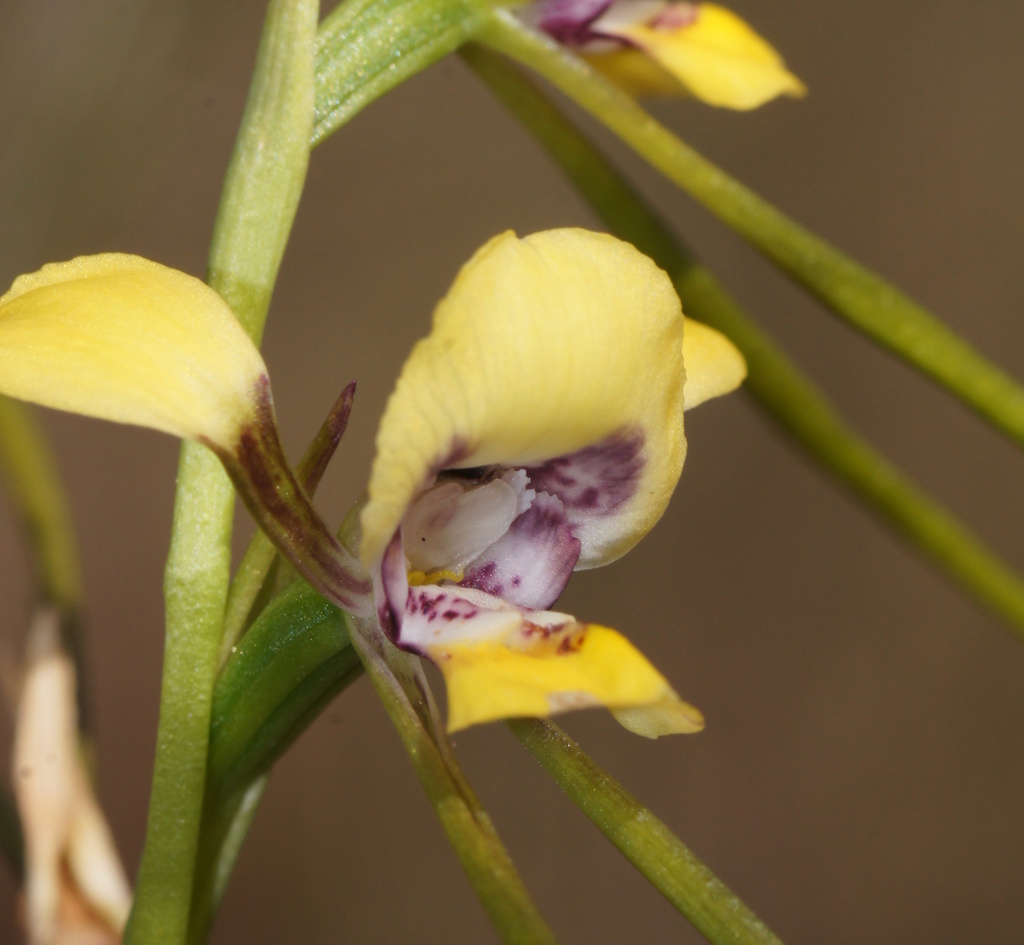
long-tailed donkey orchid
Diuris tricolor
Diuris tricolor, commonly known as the long-tailed donkey orchid or pine donkey orchid, is a species of orchid that is endemic to New South Wales, although a single plant has been found in Victoria. It has up to three grass-like leaves and up to six orange-coloured to yellow flowers with white and purplish tints. The lateral sepals are unusually long.
From the article Diuris tricolor on Wikipedia (CC BY-SA), quoted section by section
Description
Diuris tricolor is a tuberous, perennial herb with up to three linear leaves 200–300 mm (8–10 in) long, 3–4 mm (0.1–0.2 in) wide and folded lengthwise. Between two and six orange-coloured to yellow flowers with white and purplish tints, 25–30 mm (0.98–1.2 in) wide are borne on a flowering stem 200–400 mm (8–20 in) tall. The dorsal sepal curves upwards, 10–15 mm (0.4–0.6 in) long, 6–9 mm (0.2–0.4 in) wide and broadly egg-shaped. The lateral sepals are narrow linear, 20–65 mm (0.8–3 in) long, much less than 1 mm (0.04 in) wide and turned downwards. The petals are more or less erect or turned backwards, egg-shaped to elliptic, the blade 10–16 mm (0.4–0.6 in) long and 6–10 mm (0.2–0.4 in) wide on a reddish purple stalk 3–7 mm (0.1–0.3 in) long. The labellum is 8–12 mm (0.3–0.5 in) long and has three lobes. The centre lobe is egg-shaped, 6–9 mm (0.2–0.4 in) long and wide with a central ridge. The side lobes are 3–4.5 mm (0.1–0.2 in) long and about 2 mm (0.08 in) wide. There are two callus ridges about 4 mm (0.2 in) long near the mid-line of the labellum. Flowering occurs from September to November.
Range & habitat
Long-tailed donkey orchid grows in grassland and forest in south-east Queensland, sporadically south from Deepwater in New South Wales, and in the Australian Capital Territory. A single specimen has been recorded in Victoria, just south of the border.
Wikipedia: “Distribution”
Where it lives
Recorded sightings
—
geo-referenced records in GBIF, from museums, herbaria and field observers.
Drag the globe to turn it. Dots are where records exist, not a range map; darker means more records.
In the stacks
Searching the stacks…
Every page naming Diuris tricolor in the Biodiversity Heritage Library →
This page is assembled live from iNaturalist, GBIF, Wikipedia, the Source Library and the Internet Archive. It is not yet part of the hand-edited codex. iNaturalist taxon 829531.