- Plants
- ›Vascular Plants
- ›flowering plants
- ›monocots
- ›Agaves, Orchids, Irises, and Allies
- ›Orchids
- ›Orchidoid Orchids
- ›Diurideae
- ›Diuridinae
- ›Diuris
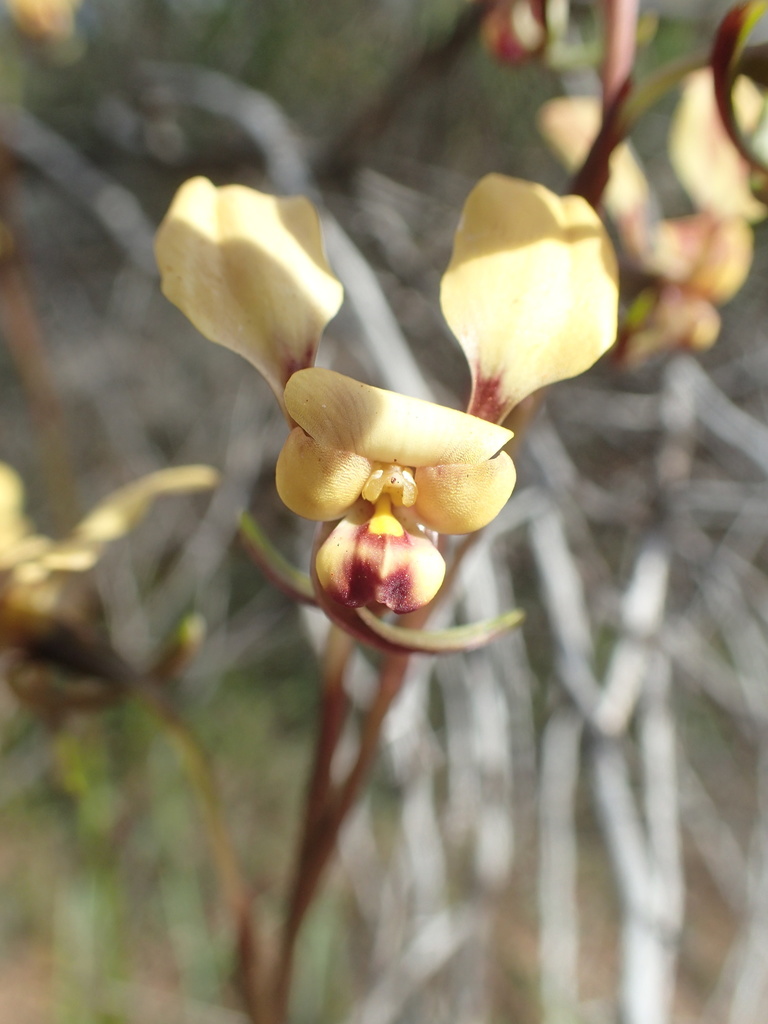
Diuris refracta
Diuris refracta, commonly known as dainty donkey orchid, is a species of orchid that is endemic to the south-west of Western Australia. It has two or three linear to lance-shaped leaves and up to six yellow flowers with reddish markings.
From the article Diuris refracta on Wikipedia (CC BY-SA), quoted section by section
Description
Diuris refracta is a tuberous, perennial herb with two or three linear to lance-shaped, bright green leaves 50–200 mm (2.0–7.9 in) long and 3–7 mm (0.12–0.28 in) wide. Up to six yellow flowers with reddish markings, 25–40 mm (0.98–1.57 in) long and 20–30 mm (0.79–1.18 in) wide are borne on a flowering stem 150–350 mm (5.9–13.8 in) tall. The dorsal sepal is egg-shaped, sharply turned back, 8–10 mm (0.31–0.39 in) long and 9–12 mm (0.35–0.47 in) wide, the lateral sepals narrowly oblong, down-turned and crossed with curved tips, 13–20 mm (0.51–0.79 in) long and 3.0–3.5 mm (0.12–0.14 in) wide. The petals are elliptic, 12–14 mm (0.47–0.55 in) long and 8–10 mm (0.31–0.39 in) wide on a stalk 3–6 mm (0.12–0.24 in) long. The labellum is 6–9 mm (0.24–0.35 in) long with three lobes - the centre lobe broadly wedge-shaped, 6–8 mm (0.24–0.31 in) long and 8–9 mm (0.31–0.35 in) wide, the side lobes spread widely apart and oblong to egg-shaped, 8–10 mm (0.31–0.39 in) long and 4–6 mm (0.16–0.24 in) wide. There is a single smooth, yellow callus ridge 4–5 mm (0.16–0.20 in) long, along the mid-line of the labellum. Flowering occurs from mid July to September.
Range & habitat
Dainty donkey orchid grows in moist open forest, shrubland and heathland on slopes, in the area between Northampton, Bindoon, Perenjori and Goomalling in the Avon Wheatbelt, Geraldton Sandplains, Jarrah Forest and Swan Coastal Plain bioregions of south-western Western Australia.
Wikipedia: “Distribution and habitat”
Where it lives
Recorded sightings
—
geo-referenced records in GBIF, from museums, herbaria and field observers.
Drag the globe to turn it. Dots are where records exist, not a range map; darker means more records.
In the stacks
Searching the stacks…
Every page naming Diuris refracta in the Biodiversity Heritage Library →
This page is assembled live from iNaturalist, GBIF, Wikipedia, the Source Library and the Internet Archive. It is not yet part of the hand-edited codex. iNaturalist taxon 829520.