- Plants
- ›Vascular Plants
- ›flowering plants
- ›monocots
- ›Agaves, Orchids, Irises, and Allies
- ›Orchids
- ›Orchidoid Orchids
- ›Diurideae
- ›Diuridinae
- ›Diuris
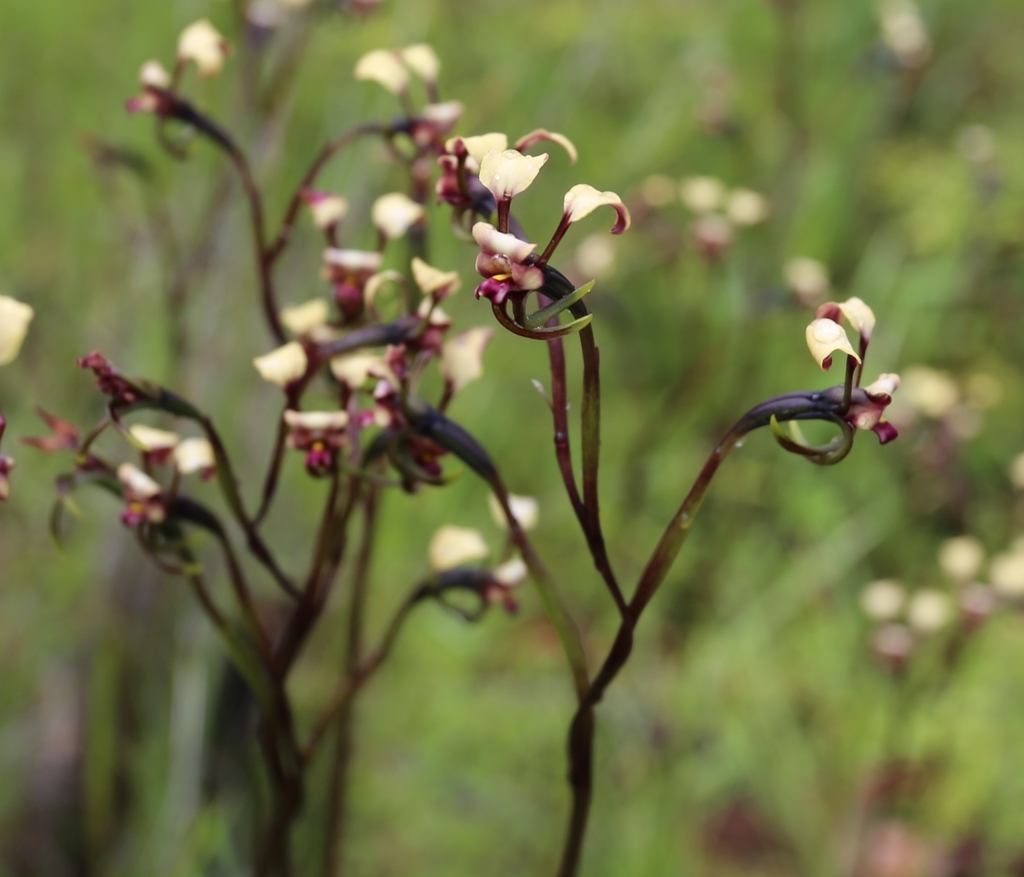
Diuris recurva
Diuris recurva, commonly called the mini donkey orchid is a species of orchid that is endemic to the south-west of Western Australia. It has one or two leaves at its base, up to six small pale yellow and brownish flowers and grows in winter-wet places between Badgingarra and Kalbarri.
From the article Diuris recurva on Wikipedia (CC BY-SA), quoted section by section
Description
Diuris recurva is a tuberous, perennial herb with one or two linear leaves that are 100–150 mm (4–6 in) long, about 5 mm (0.2 in) wide and folded lengthwise. Up to six pale yellow flowers with brownish to dark burgundy-coloured markings, 16–20 mm (0.6–0.8 in) long and 12–16 mm (0.5–0.6 in) wide are borne on a flowering stem 200–300 mm (8–10 in) tall. The dorsal sepal curves upwards, often backwards and is egg-shaped with the narrower end towards the base, about 8 mm (0.3 in) long and 7 mm (0.3 in) wide. The lateral sepals are linear to lance-shaped, green or reddish, 9–12.5 mm (0.4–0.5 in) long, about 2 mm (0.08 in) wide, turned downwards and usually crossed over each other. The petals are more or less erect with an egg-shaped blade 10–13 mm (0.4–0.5 in) long and 4–6.5 mm (0.16–0.26 in) wide on a greenish-brown stalk 4–6 mm (0.16–0.24 in) long. The labellum is 4–5 mm (0.16–0.20 in) long and has three lobes. The centre lobe is spatula-shaped, 3–4.5 mm (0.1–0.2 in) wide and dark reddish brown with yellow patches. The side lobes are 4–5 mm (0.16–0.20 in) long and 3 mm (0.1 in) wide and curve backwards. There is a single raised, ridge-like callus along the mid-line of the labellum. Flowering occurs in July and August.
Range & habitat
Mini donkey orchid grows mostly in winter-wet heath between Badgingarra and Kalbarri in the Avon Wheatbelt, Geraldton Sandplains and Jarrah Forest biogeographic regions.
Wikipedia: “Distribution and habitat”
Where it lives
Recorded sightings
—
geo-referenced records in GBIF, from museums, herbaria and field observers.
Drag the globe to turn it. Dots are where records exist, not a range map; darker means more records.
In the stacks
Searching the stacks…
Every page naming Diuris recurva in the Biodiversity Heritage Library →
This page is assembled live from iNaturalist, GBIF, Wikipedia, the Source Library and the Internet Archive. It is not yet part of the hand-edited codex. iNaturalist taxon 829519.