- Plants
- ›Vascular Plants
- ›flowering plants
- ›monocots
- ›Agaves, Orchids, Irises, and Allies
- ›Orchids
- ›Orchidoid Orchids
- ›Diurideae
- ›Diuridinae
- ›Diuris
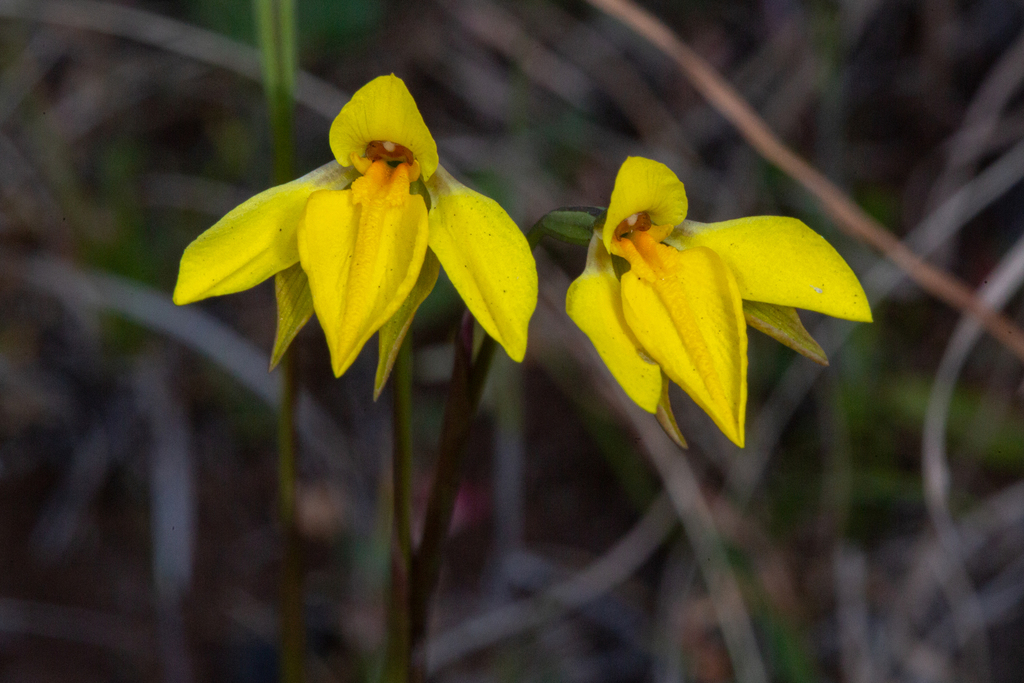
Diuris pedunculata
Diuris pedunculata, commonly known as the small snake orchid, is a species of orchid which is endemic to New South Wales. It usually has two leaves at its base and one or two yellow and orange flowers with purple markings. It originally occurred in scattered populations between Tenterfield and the Hawkesbury River but because of habitat loss is now only known from the New England Tableland.
From the article Diuris pedunculata on Wikipedia (CC BY-SA), quoted section by section
Description
Diuris pedunculata is a tuberous, perennial herb with two erect, linear to thread-like leaves 40–120 mm (2–5 in) long and 1–2 mm (0.04–0.08 in) wide. One or two pale yellow flowers with an orange labellum, 15–20 mm (0.6–0.8 in) wide are borne on a flowering stem 60–180 mm (2–7 in) tall. The dorsal sepal is narrow egg-shaped, angled upwards, 7–10 mm (0.3–0.4 in) long and 5–6 mm (0.20–0.24 in) wide. The lateral sepals are lance-shaped with the narrower end towards the base, 15–20 mm (0.6–0.8 in) long, about 3 mm (0.1 in) wide and angled downwards. The petals are narrow elliptic, 9–14 mm (0.4–0.6 in) long, 4–5.5 mm (0.16–0.22 in) wide, spread apart from each other and droop downwards on a dark coloured stalk 2–3 mm (0.08–0.1 in) long. The labellum is 14–16 mm (0.55–0.63 in) long and has three lobes. The centre lobe is broadly egg-shaped, 7–10 mm (0.3–0.4 in) wide and the side lobes are triangular, about 2 mm (0.08 in) long and 1 mm (0.04 in) wide. There are between two irregular ridge-like calli 5–7 mm (0.2–0.3 in) long at the base of the mid-line of the labellum. Flowering occurs in August and September.
Range & habitat
The small snake orchid was originally found in scattered populations between Tenterfield and the Hawkesbury River but is now only known mostly from areas around Armidale, Uralla, Guyra and Ebor. It grows in moist, grassy places and in open forest. Similar orchids occurring in south-east New South Wales, the Australian Capital Territory, Victoria and Tasmania have been reinterpreted as Diuris subalpina.
Wikipedia: “Distribution and habitat”
What it does
This orchid appears use sexual deception, attracting mostly males of the native bee species, Halictus lanuginosus for pollination, even though the flowers produce nectar and emit a strong scent that attract other insects.
Wikipedia: “Ecology”
Where it lives
Recorded sightings
—
geo-referenced records in GBIF, from museums, herbaria and field observers.
Drag the globe to turn it. Dots are where records exist, not a range map; darker means more records.
In the stacks
Searching the stacks…
Every page naming Diuris pedunculata in the Biodiversity Heritage Library →
This page is assembled live from iNaturalist, GBIF, Wikipedia, the Source Library and the Internet Archive. It is not yet part of the hand-edited codex. iNaturalist taxon 829510.