- Plants
- ›Vascular Plants
- ›flowering plants
- ›monocots
- ›Agaves, Orchids, Irises, and Allies
- ›Orchids
- ›Orchidoid Orchids
- ›Diurideae
- ›Diuridinae
- ›Diuris
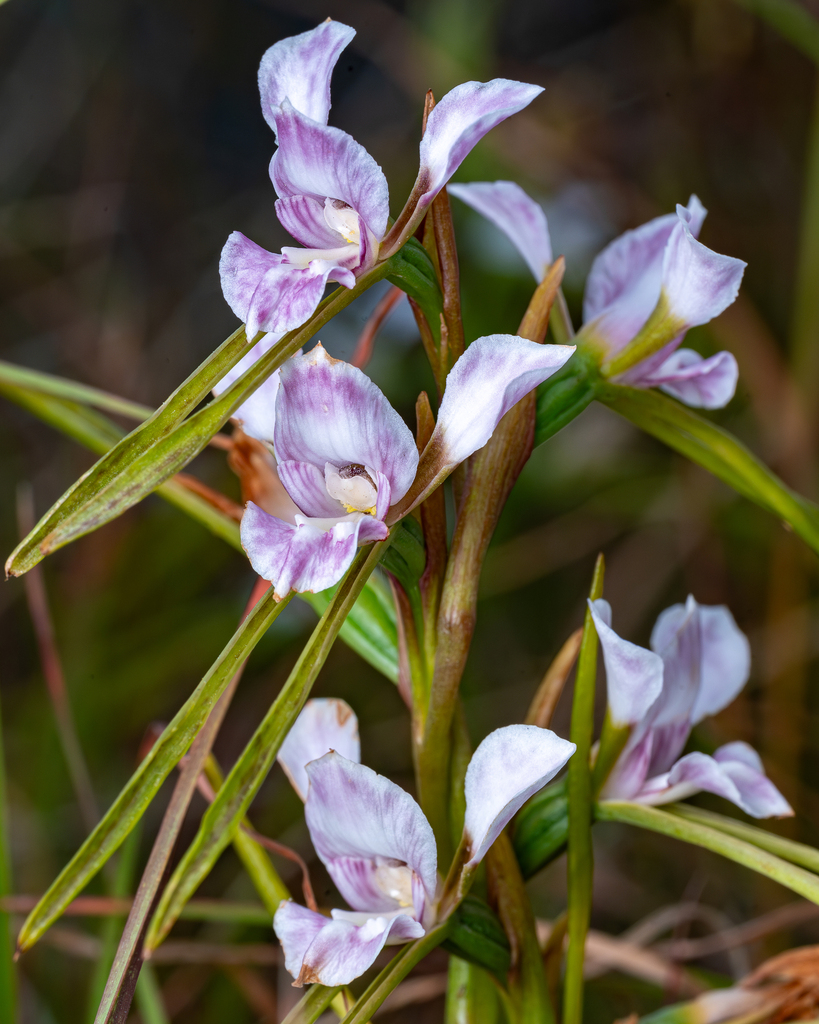
Diuris fragrantissima
Diuris fragrantissima, commonly called the fragrant doubletail or Sunshine diuris, is a species of orchid which is endemic to a small area to the west of Melbourne. It has two linear leaves at its base and up to twelve white flowers with mauve or pale purple markings with unusually long lateral sepals. Only about thirty plants survive in grassland near Sunshine.
From the article Diuris fragrantissima on Wikipedia (CC BY-SA), quoted section by section
Description
Diuris fragrantissima is a tuberous, perennial herb with two linear leaves 100–180 mm (4–7 in) long, 5–10 mm (0.2–0.4 in) wide and folded lengthwise. Up to twelve white flowers with mauve or pale purple markings, 30–35 mm (1.2–1.4 in) wide are borne on a flowering stem 100–200 mm (4–8 in) tall. The dorsal sepal is erect, egg-shaped, 12–15 mm (0.5–0.6 in) long and 8–12 mm (0.3–0.5 in) wide. The lateral sepals are narrow lance-shaped, 50–85 mm (2–3 in) long, about 2 mm (0.08 in) wide, turned downwards at an angle and almost parallel to each other. The petals are erect or turned backwards with an elliptic or egg-shaped blade 9–12 mm (0.4–0.5 in) long and 6–8 mm (0.2–0.3 in) wide on a green stalk 5–8 mm (0.2–0.3 in) long. The labellum is 9–12 mm (0.4–0.5 in) long and has three lobes. The centre lobe is fan-shaped or heart-shaped, 8–10 mm (0.3–0.4 in) long, 7–10 mm (0.3–0.4 in) wide with a raised ridge along its midline and wrinkled edges. The side lobes are erect, irregularly shaped, 3.5–5 mm (0.1–0.2 in) long and about 2 mm (0.08 in) wide. There are two ridge-like calli 4–5 mm (0.16–0.20 in) long near the base of the mid-line of the base of the labellum. Flowering occurs in October and November.
Range & habitat
At the time of European settlement, D. fragrantissima was plentiful in the grasslands to the west of Melbourne, but as early as 1934, W.H. Nicholls noted that it had become scarce. The population continued to decline until only one plant survived in the wild in 1992. About thirty wild plants of Diuris fragrantissima survive in grassland near Sunshine and others have been introduced to a small reserve near Altona. The populations at both Sunshine and Altona are under great stress due to the encroachment of industrial and residential development. Ecological processes such as the loss of natural pollinators also threaten this species. About 200 individuals survive in cultivation, mostly at Melbourne Zoo and the Royal Botanic Gardens Victoria.
Wikipedia: “Distribution and habitat”
Where it lives
Recorded sightings
—
geo-referenced records in GBIF, from museums, herbaria and field observers.
Drag the globe to turn it. Dots are where records exist, not a range map; darker means more records.
In the stacks
Searching the stacks…
Every page naming Diuris fragrantissima in the Biodiversity Heritage Library →
This page is assembled live from iNaturalist, GBIF, Wikipedia, the Source Library and the Internet Archive. It is not yet part of the hand-edited codex. iNaturalist taxon 829490.