- Plants
- ›Vascular Plants
- ›flowering plants
- ›Dicots
- ›carrots, ivies, and allies
- ›carrot family
- ›Apioideae
- ›Pyramidoptereae
- ›Crithmum
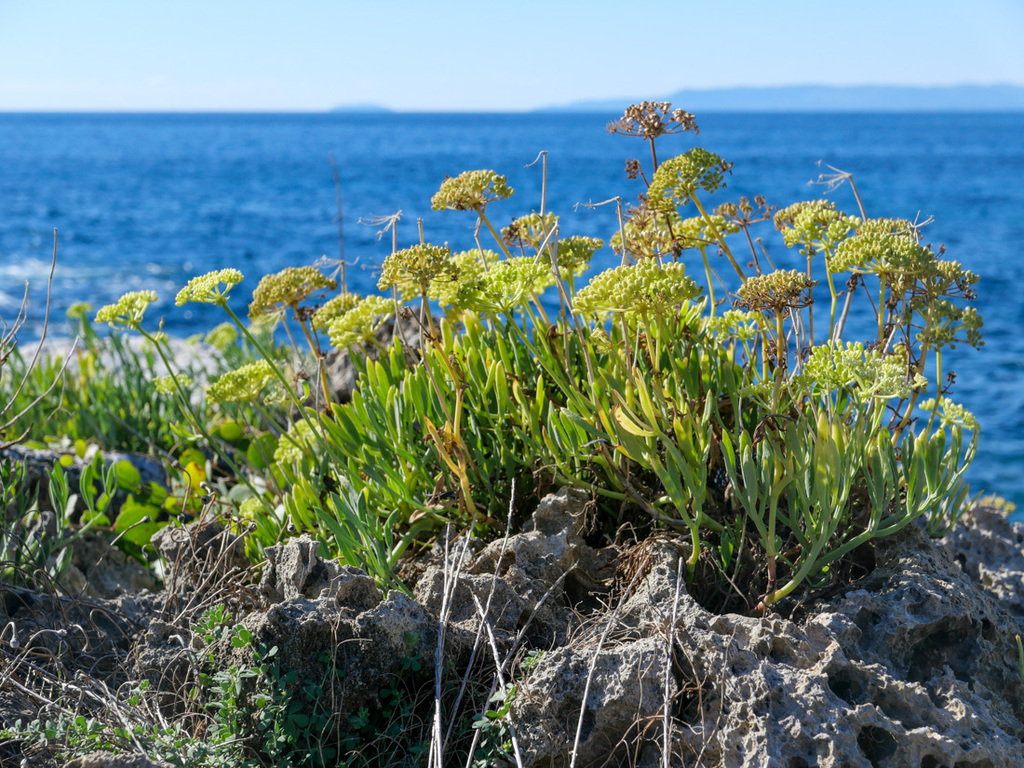
rock samphire
Crithmum maritimum
Crithmum is a monospecific genus of flowering plants in the carrot family, Apiaceae. It currently consists of just one species, Crithmum maritimum, but when it was originally published by Linnaeus (in Species Plantarum vol. 1, p. 246) he included two species. The other, listed as C. pyrenaicum, is now called Libanotis pyrenaica or Seseli libanotis.
Modern accounts usually separate rock samphire into a separate genus. It is distinguished from Seseli (Libanotis) by the yellow (not white) flowers and from Silaum by its fleshy leaves and four (not 0-3) bracts.
From the article Crithmum on Wikipedia (CC BY-SA), quoted section by section
Description
Rock samphire is a perennial herbaceous plant growing to about 30 cm tall with a sprawling growth habit. It has a long yellowish taproot which smells of carrot, and usually several stems arising from the base. Each stem is up to about 50 cm long, typically decumbent (lying flat but turning up towards the tip), greyish-green in colour and sometimes branched. The whole plant is quite glabrous (hairless) and succulent (fleshy), although the base of the stems become woody in the summer. The leaves are arranged alternately along the stems. An individual leaf is up to 15 cm long by about 11 cm wide, and deeply divided into narrow, succulent segments in a twice- or thrice-pinnate structure (ternate or palmate). The individual segments are almost tubular with a flattened pointed tip. The leaf has a long petiole which clasps the stem. The foliage smells of furniture polish and tastes hot and peppery. Its flowering period is long, sometimes lasting all year in Britain. The inflorescences arise from the leaf axils, with long (up to 5 cm) peduncles, and consist of compound umbels with 8-36 rays. Each umbellule bears between 8 and 20 flowers on short pedicels about 5 mm long. There are 5-10 bracts at the base of the rays and 6-8 bracteoles at the base of the pedicels. All the flowers are monoecious with 5 sepals, 5 petals, 5 stamens and two styles. …
Range & habitat
Rock samphire occurs on coastlines throughout much of Europe north to the British Isles and southern Scandinavia, Macaronesia, parts of West Asia and North Africa. It is also naturalised some places in the USA, including Monterey Bay in California, and along the coast of New South Wales, where it grows on sand, shingle and rocky cliffs. Within its range, populations are considered to be stable or often increasing, leading to a status of LC (least concern), although on the edge of its range, as in Bulgaria, it is sometimes considered to be threatened.
Wikipedia: “Distribution and status”
What it does
Rock samphire is a facultative halophyte which grows in crevices on cliffs, along rocky shorelines, sea defences, on shingle and sometimes on sandy beaches.
Wikipedia: “Habitat and ecology”
At the table
Rock samphire or sea fennel has fleshy, divided aromatic leaves that Culpeper described as having a "pleasant, hot and spicy taste". The plant can be prepared much like marsh samphire (Salicornia europaea); the stems and leaves should be washed and cooked, while the stems, leaves and young seed pods can be pickled, perhaps in salted and spiced vinegar. The fresh leaves may be used in salads. Dried and ground sea fennel can also be used as a salt substitute. Sea fennel pickle in olive oil or vinegar is a traditional food of Italy (Marche region), Croatia (Dalmatia), Greece, and Montenegro (Bay of Kotor). It is known as Paccasassi del Conero and used as an antipasto, to accompany fish and meat dishes and to garnish pizza and sandwiches.
Nutrition. Sea fennel has nutritional value, and is rich in antioxidants.
Wikipedia: “Uses”
How it is grown
In Britain, rock samphire is cultivated in gardens, where it grows readily in a light, rich soil. In the United Kingdom the uprooting of wild plants is illegal under the Wildlife and Countryside Act.
Wikipedia: “Cultivation”
In human culture
In the 17th century, Shakespeare in King Lear referred to the dangerous practice of collecting rock samphire from cliffs. In the 19th century, samphire was shipped in casks of seawater from the Isle of Wight to market in London at the end of May each year. Rock samphire used to be cried in London streets as "Crest Marine". The reclaimed piece of land adjoining Dover, formed from spoil from the Channel Tunnel and called "Samphire Hoe", is named after rock samphire: people formerly harvested rock samphire from the neighbouring cliffs.
Wikipedia: “In culture”
Where it lives
Recorded sightings
—
geo-referenced records in GBIF, from museums, herbaria and field observers.
Drag the globe to turn it. Dots are where records exist, not a range map; darker means more records.
In the old herbals & bestiaries

Ortus sanitatis
1491 · p.110

Commentaries on the Six Books of Pedanius Dioscorides on Medical Matter
Pietro Andrea Mattioli · 1565 · p.662

Commentaries on the Six Books of Pedanius Dioscorides on Medical Matter
Pietro Andrea Mattioli · 1565 · p.658

Commentaries on the Six Books of Pedanius Dioscorides on Medical Matter
Pietro Andrea Mattioli · 1565 · p.659
In the stacks
Searching the stacks…
Every page naming Crithmum maritimum in the Biodiversity Heritage Library →
This page is assembled live from iNaturalist, GBIF, Wikipedia, the Source Library and the Internet Archive. It is not yet part of the hand-edited codex. iNaturalist taxon 82602.