- Plants
- ›Vascular Plants
- ›Ferns
- ›Leptosporangiate Ferns
- ›Polypod Ferns
- ›eupolypods II
- ›sensitive ferns and allies
- ›Onoclea
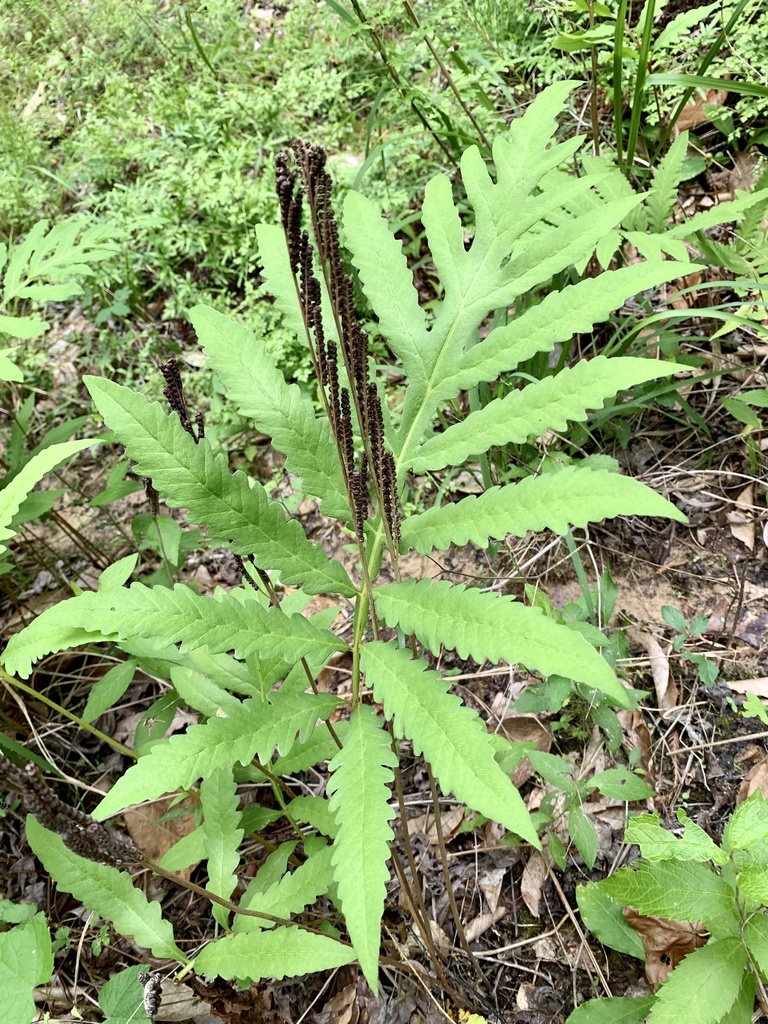
sensitive fern
Onoclea sensibilis
Onoclea sensibilis, the sensitive fern, also known as the bead fern, is a coarse-textured, medium to large-sized deciduous perennial fern. The name comes from the observation by early American settlers that it was very sensitive to frost, the fronds dying quickly when first touched by it. It is sometimes treated as the only species in Onoclea, but some authors do not consider the genus monotypic.
From the article Onoclea sensibilis on Wikipedia (CC BY-SA), quoted section by section
Description
The sterile and fertile fronds of Onoclea sensibilis have independent stalks originating from the same rhizome, quite different from other ferns. The bright, yellow-green trophophylls (sterile fronds) are deeply pinnatifid and are typically borne at intervals along the creeping rhizome. The sterile fronds are deciduous with trophopods, swollen bases, that serve as over winter storage organs. The sterile fronds of O. var. sensibilis have a length of 1–1.3 m (3.3–4.3 ft) with 5–11 pinnae, leaf pairs, evenly spaced along the stipe. O. var. interrupta Maxim. fronds are shorter, 20–50 cm (7.9–19.7 in) long, with fewer pinnae, only 5–8 pairs.
The sporophylls (fertile fronds) are smaller, 20–45 cm (7.9–17.7 in) in length, non-green at maturity and have very narrow pinnae. They are persistent, standing 2–3 years. The sori comprise clusters of sporangia (spore cases) 2–4 mm (1/10–1/6 in) in diameter, like beads, on upright fertile fronds, hence the common name Bead fern. Sori are typically bilaterally symmetrical, though leaf forms have been observed with pinnae fertile only on a single side of the rachis. This form, named O. sensibilis L. F. hemiphyllodes (Kiss & Kümmerle, 1926) and a second, O. sensibilis L. F. obtusilobata having flat pinnules (not curled or bead shaped), were deemed to be variations not meriting taxonomic recognition (J. M. Beitel et al. …
Range & habitat
Onoclea sensibilis is native to Northern Hemisphere temperate regions; the Russian Far East, China and Eastern Asia, and a wide native distribution in Northern America. It ranges from Newfoundland south to Florida and west to Texas, the Rocky Mountains, North and South Dakota, Quebec, and Manitoba. It has become naturalized in western Europe and New Zealand. Onoclea sensibilis can be found at elevations from sea level up to 1,500 metres (4,900 ft) in fresh water habitats, not brackish, as its spore germination ceases at salt (NaCl) levels ≥ 0.6%, moderately saline water and higher. Onoclea sensibilis grows best in moist shaded or partially shaded areas, dwelling in a variety of swamp and wood habitats: wet meadows, thickets and bogs, as well as stream and riverbanks and roadside ditches. It tolerates extremely wet soils, appearing in soggy ground or at the very edge of water in shade or sun. The plant can tolerate dryer conditions in shade. It prefers acidic (pH <6.8), loose, sandy to loam, limestone-based soils.
Wikipedia: “Distribution and habitat”
What it does
The Onoclea sensibilis plant has remained essentially unchanged over millions of years. A fifty-seven million year old fossil of Paleocene epoch flora shows specimens virtually identical to modern samples. It has a life cycle featuring alternation of generations, sexual and asexual reproduction; its sporophyte generation matures in autumn, casts its spores in the spring and the gametophyte generation follows. Sporophytes require 5–10 years of growth before reaching their mature fern height. Sensitive ferns propagate by both spore dispersion and rhizome growth. Its growth clusters attract local fauna where small wildlife find habitat, deer bed upon its dense mat and in winter wild turkeys use the fertile spore stalks as a secondary food source. They can become aggressive and a nuisance if established near preferable vegetation. The University of Maine's Cooperative Extension: Maine Wild Blueberries classifies the sensitive fern as a herbaceous broadleaf weed. Its deciduous fronds do not tolerate freezing temperatures, however, the plant survives USDA hardiness zones 4–8, or minimum temperatures of −20 to −15 °C (−4 to 5 °F) having the Royal Horticultural Society's H6 rating. …
Wikipedia: “Ecology”
At the table
Onoclea sensibilis has limited value for food use, considered a famine food by some and reserved for times of scarcity. Cooking heat eliminates its thiaminase content. The Haudenosaunee treated Onoclea sensibilis as an early springtime vegetable, prepared like spinach, the fiddleheads cooked and "seasoned with salt, pepper or butter" (Waugh, 1916). After removing the "brown scales" (sori), leaves were processed likewise. Its young shoots have been sold as delicacies in Asian markets.
Wikipedia: “Food”
In medicine
Onoclea sensibilis has two internally-synthesized chemical defenses against insects. Ingesting any part of the plant introduces thiaminase enzymes and phytoecdysteroid hormones which can disrupt an insect's molting cycle, preventing its full development.
Wikipedia: “Pharmacology”
How it is grown
It is cultivated as an ornamental plant in traditional and native plant gardens, and in natural landscaping and habitat restoration projects. It has gained the Royal Horticultural Society's Award of Garden Merit. Gardeners employ rhizome division and are aided by spore harvesting guides. Its decomposing fronds make an effective mulch, suppressing undergrowth. Plantings can become aggressive, weedy if not sited properly.
Wikipedia: “Horticultural”
In human culture
Onoclea sensibilis' name was descriptive. Onoclea comes from the Greek onos, meaning a vessel, and kleio, meaning to close, describing the closely rolled sori on its fertile fronds. Its species, from the Late Latin sensibilis, means sensitive, describing its high sensitivity to autumn's first frost and to drought.
Wikipedia: “Etymology”
Where it lives
Recorded sightings
—
geo-referenced records in GBIF, from museums, herbaria and field observers.
Drag the globe to turn it. Dots are where records exist, not a range map; darker means more records.
In the stacks
Searching the stacks…
Every page naming Onoclea sensibilis in the Biodiversity Heritage Library →
This page is assembled live from iNaturalist, GBIF, Wikipedia, the Source Library and the Internet Archive. It is not yet part of the hand-edited codex. iNaturalist taxon 82576.