- Plants
- ›Vascular Plants
- ›Ferns
- ›Leptosporangiate Ferns
- ›Polypod Ferns
- ›eupolypods II
- ›sensitive ferns and allies
- ›Matteuccia
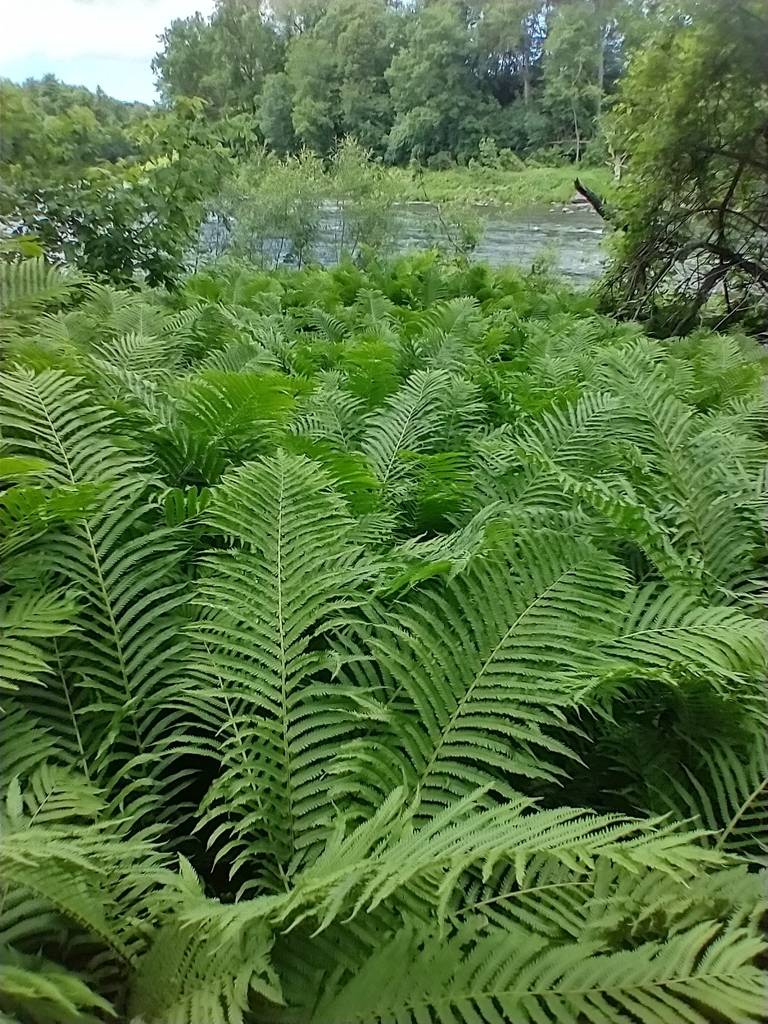
ostrich fern
Matteuccia struthiopteris
Matteuccia is a genus of ferns with one species, Matteuccia struthiopteris (common names ostrich fern, fiddlehead fern or shuttlecock fern). It is a crown-forming, colony-forming plant, occurring in temperate regions of the Northern Hemisphere in central and northern Europe, northern Asia, and northern North America. The species epithet struthiopteris comes from Ancient Greek words, struthio meaning ostrich and pterion meaning wing.
From the article Matteuccia on Wikipedia (CC BY-SA), quoted section by section
Description
The fronds are dimorphic, with the deciduous green sterile fronds being almost vertical, 100–170 cm (39–67 in) tall and 20–35 cm (7.9–13.8 in) broad, long-tapering to the base but short-tapering to the tip, so that they resemble ostrich plumes, hence the name. The fertile fronds are shorter, 40–65 cm (16–26 in) long, brown when ripe, with highly modified and constricted leaf tissue curled over the sporangia; they develop in autumn, persist erect over the winter and release the spores in early spring. Along with Dryopteris goldieana, it is one of the largest species of fern in eastern North America.
Range & habitat
It is a crown-forming, colony-forming plant, occurring in temperate regions of the Northern Hemisphere in central and northern Europe, northern Asia, and northern North America. It grows from a completely vertical crown, favoring riverbanks and sandbars, but sends out lateral stolons to form new crowns. It can thus form dense colonies resistant to destruction by floodwaters.
Wikipedia: “Distribution”
At the table
The ostrich fern is a popular ornamental plant in gardens. It has gained the Royal Horticultural Society's Award of Garden Merit. While choosing a place of planting it should be taken into account that this fern is very expansive and its leaves often lose their beauty throughout the summer, especially if not protected from wind and hail. The tightly wound immature fronds, called fiddleheads, are also used as a cooked vegetable, and are considered a delicacy mainly in rural areas of northeastern North America. It is considered inadvisable to eat uncooked fiddleheads. Brown "scales" are inedible and should be scraped or rinsed off. The sprouts are also picked all over Japan, ("kogomi" in Japanese) as well as in other Asian regions, where they are considered a delicacy. Additionally, in Norway, fiddleheads were apparently used in the manufacture of beer, and in Russia, in the control of gut parasites. Matteuccia species are used as food plants by the larvae of some Lepidoptera species including Sthenopis pretiosus.
Wikipedia: “Cultivation and uses”
Where it lives
Recorded sightings
—
geo-referenced records in GBIF, from museums, herbaria and field observers.
Drag the globe to turn it. Dots are where records exist, not a range map; darker means more records.
In the stacks
Searching the stacks…
Every page naming Matteuccia struthiopteris in the Biodiversity Heritage Library →
This page is assembled live from iNaturalist, GBIF, Wikipedia, the Source Library and the Internet Archive. It is not yet part of the hand-edited codex. iNaturalist taxon 82574.