- Plants
- ›Vascular Plants
- ›flowering plants
- ›Dicots
- ›Buttercups, Poppies, and Allies
- ›buttercup family
- ›Columbines and Meadow-Rues
- ›Aquilegia
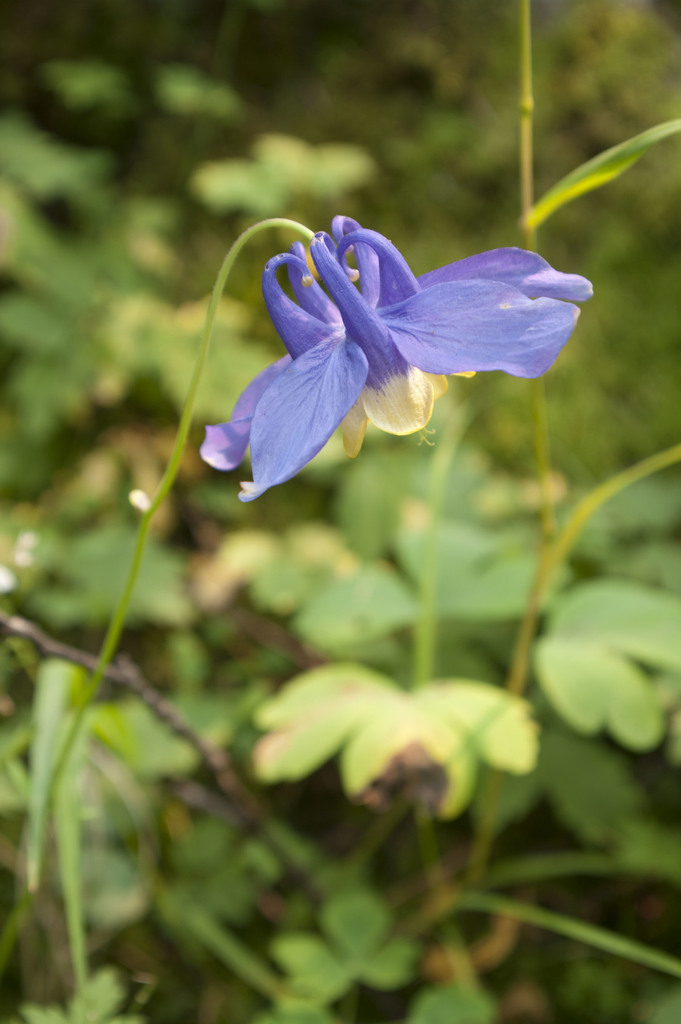
Aquilegia amurensis
Aquilegia amurensis is a partially accepted species of flowering plant in the genus Aquilegia (columbines) in the family Ranunculaceae that is native to northeast Asia. Its natural range is in the northern Greater Khingan mountain range and Amur River of China, as well as Siberian Russia, Mongolia, and possibly North Korea.: 64 Flowers of this plant have petal blades that are whitish or white-tipped, with blue-violet nectar spurs and sepals. The plant is rarely cultivated.
From the article Aquilegia amurensis on Wikipedia (CC BY-SA), quoted section by section
Description
Aquilegia amurensis grows to be about 50 centimetres (20 in) tall. It possesses leaves in a basal arrangement (sprouting from base of the shoot), seldom if ever with leaves on the stem. The leaflets are glabrous (smooth) on their topsides with soft, downy bottoms. The leaflets are trisected to their base. The petioles are extremely slender and subglabrous, extending between 6 centimetres (2.4 in) and 15 centimetres (5.9 in) in length. The plant's flowers are suberect with blue-violet nectar spurs and sepals. The spurs are particularly hooked and have lengths of between 10 millimetres (0.39 in) and 15 millimetres (0.59 in) long. A. amurensis's sepals are elliptical with lengths of between 15 millimetres (0.59 in) and 25 millimetres (0.98 in) long that curve to an acute point. The petal blades are oblong, spreading roughly along the floral axis. The blades range between 7 millimetres (0.28 in) and 12 millimetres (0.47 in) long and are whitish or white-tipped. The stamen are exserted (extending beyond the length of the pedals) and capped with yellow anthers that are 1 millimetre (0.039 in) long. A variety, A. amurensis var. albiflora, possesses white flowers. When compared to Aquilegia sibirica, A. amurensis emulates its leafless stems and hooked spurs but deviates with more acute sepals, pilose leaflets and pedicels, less nodding flowers, and follicles that are not glabrous.
Range & habitat
The plant is native to the northern Greater Khingan mountain range and Amur River of China, as well as Siberian Russia, Mongolia, and possibly North Korea. A 2017 paper in Phytotaxa claimed to be the first to record A. amurensis as present in China. Wang and Zhang mapped the range of A. amurensis extending through northern China and eastern Siberian Russia. Botanist Philip A. Munz described the type locality of the species as "R. Lagar, near Radde, Amur, Siberia". Roy Lancaster included an image of A. amurensis in his Travels in China: A Plantman's Paradise. The plant pictured was found the Changbai Mountains on the Chinese side of the nation's border with North Korea. The range of A. amurensis possibly extends over this border. Munz noted that the Soviet botanist Vladimir Leontyevich Komarov had reported A. amurensis in northern Korea from the Yalu River.
Wikipedia: “Distribution”
How it is grown
In his 1946 Aquilegia: The Cultivated and Wild Columbines, Munz said that he was aware of seeds being offered for sale by a Japanese company. He added that he was not aware of any other cultivation of the species. As of 2003, American botanist Robert Nold reported that the plant was "rarely, if ever, encountered in cultivation".
Wikipedia: “Cultivation”
Where it lives
Recorded sightings
—
geo-referenced records in GBIF, from museums, herbaria and field observers.
Drag the globe to turn it. Dots are where records exist, not a range map; darker means more records.
In the stacks
Searching the stacks…
Every page naming Aquilegia amurensis in the Biodiversity Heritage Library →
This page is assembled live from iNaturalist, GBIF, Wikipedia, the Source Library and the Internet Archive. It is not yet part of the hand-edited codex. iNaturalist taxon 82477.