- Plants
- ›Vascular Plants
- ›flowering plants
- ›Dicots
- ›Buttercups, Poppies, and Allies
- ›buttercup family
- ›Columbines and Meadow-Rues
- ›Aquilegia
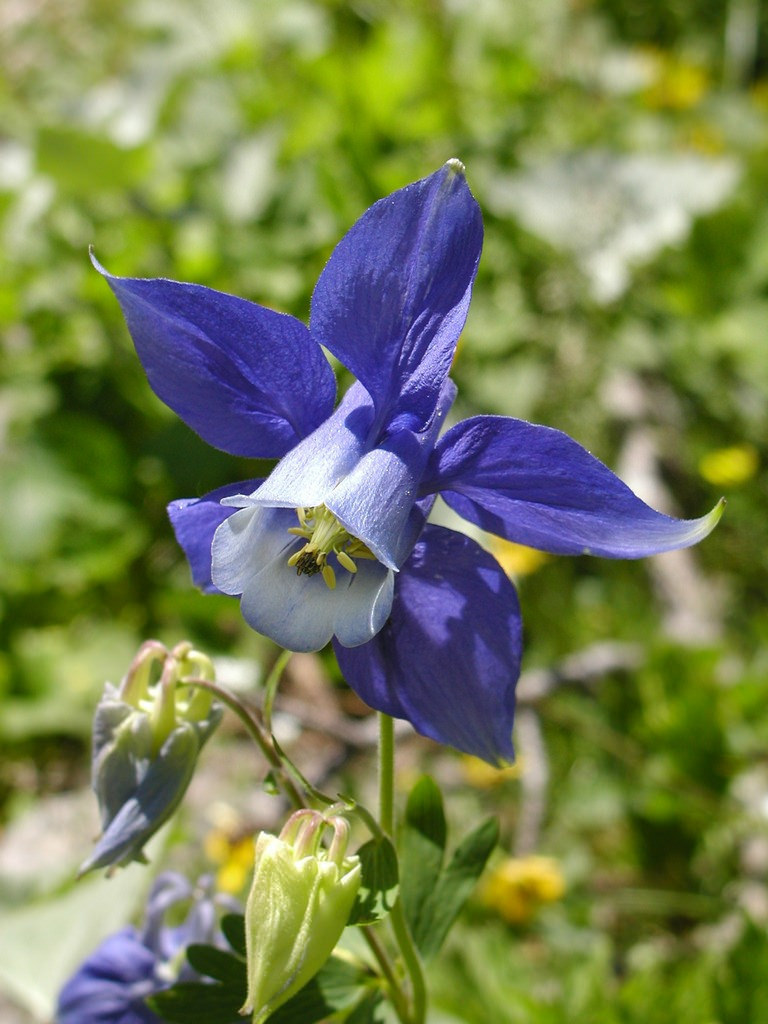
Alpine Columbine
Aquilegia alpina
Aquilegia alpina, often called the alpine columbine or breath of God, is a perennial species of flowering plant in the family Ranunculaceae, native to the western and central Alps. Though rare in its Swiss, Austrian, and Italian range, it is commonly found in the French Maritime Alps. A. alpina is appreciated for its light blue to blue-purple flowers.
The species has been in cultivation for several centuries, but plants sold as A. alpina are often hybrids with other Aquilegia species or different columbine species entirely. True A. alpina plants possess straight or slightly curved nectar spurs, distinguishing it from other species and hybrids with hooked spurs. At 21.5 mm (0.85 in) long, these spurs are the longest of any Eurasian member of the genus Aquilegia.
From the article Aquilegia alpina on Wikipedia (CC BY-SA), quoted section by section
Description
Aquilegia alpina is a perennial that grows to between 15 cm (5.9 in) and 60 cm (24 in) tall. Leaves are biternate and in a basal arrange (growing from the base of the stem). The lower portions of the stems are pilose and the upper portions are densely pubescent. The middle leaflets are between 22 mm (0.87 in) and 28 mm (1.1 in) long and between 24 mm (0.94 in) and 34 mm (1.3 in) wide. They are petioluled. Plants feature between one and three (occasionally up to 5) flowers per stem. Each flower is nodding. The flowers are bright light blue to blue-purple, measuring 6–9 cm (2.4–3.5 in) across. The species's nectar spurs at the tip of the flower is straight or only slightly curved, and are the longest of the Eurasian species of Aquilegia at 21.5 mm (0.85 in). The spreading sepals range in shape from lance-ovate to wider and are between 3 cm (1.2 in) and 4.5 cm (1.8 in) long. The plant's flowers are considered to possess unusual beauty. Robert Nold described the American botanist Philip A. Munz as having "almost broke down completely" when Munz described A. alpina as "one of the most beautiful of all the Aquilegias". The British botanist Reginald Farrer was similarly appreciative of the flower's appearance.
Range & habitat
The species is native to subalpine regions of France, Switzerland, Austria, and Italy, at altitudes from 1,300–1,900 m (4,300–6,200 ft), typically in rocky areas and stony pastures with carbonate bedrock. In the subalpine meadows of southwestern Switzerland, Austria, and northwestern Italy, the plant is rare. However, it is present with greater commonality in the Maritime Alps of France.
Wikipedia: “Distribution and habitat”
What it does
Aquilegia alpina flowers from July to September, and is pollinated by bees. Hybrid A. alpina with hooked nectar spurs that were cultivated in the United States have been observed being foraged by the moth species Hemaris thysbe.
Pests and diseases. The flowers are known to be attacked by the gall midge species Macrolabis aquilegiae and the aphid Nasonovia werderi. Most recorded parasites of A. alpina attack the leaves: the leaf miner Phytomyza minuscula and cabbage whitefly Aleyrodes proletella, the oomycete Peronospora aquilegiicola which causes the disease Aquilegia downy mildew, and the fungi Erysiphe aquilegiae var. aquilegiae (causing powdery mildew), Puccinia actaeae-elymi, and Puccinia agrostidis.
Wikipedia: “Ecology”
How it is grown
Aquilegia alpina has a long history of cultivation and was a common offering by 1946. Most plants sold as A alpina are instead crosses between multiple Aquilegia species, a phenomenon common across the genus and the result of hundreds of years of cultivation. By 1946, Munz said that supposed "A. alpina" plants were generally hybridizations incorporating Aquilegia vulgaris; this lineage is discernible in the hooked nectar spurs typical of these plants. Other plants labeled A. alpina were instead Aquilegia bertolonii. Nold noted that Munz's observations remained true in 2003.
Wikipedia: “Cultivation”
Where it lives
Recorded sightings
—
geo-referenced records in GBIF, from museums, herbaria and field observers.
Drag the globe to turn it. Dots are where records exist, not a range map; darker means more records.
In the stacks
Searching the stacks…
Every page naming Aquilegia alpina in the Biodiversity Heritage Library →
This page is assembled live from iNaturalist, GBIF, Wikipedia, the Source Library and the Internet Archive. It is not yet part of the hand-edited codex. iNaturalist taxon 82476.