- Plants
- ›Vascular Plants
- ›flowering plants
- ›Dicots
- ›beeches, oaks, walnuts, and allies
- ›wax trees and shrubs
- ›Myrica
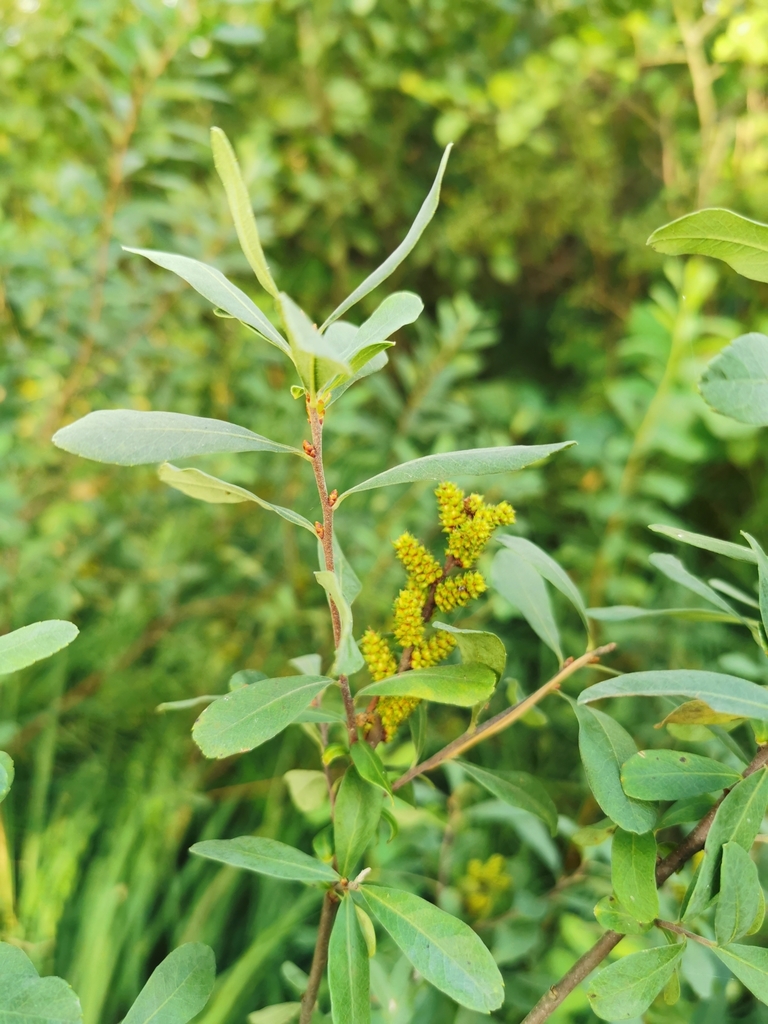
bog myrtle
Myrica gale
Myrica gale is a species of flowering plant in the genus Myrica, native to northern and western Europe and parts of northern North America. Common names include bog-myrtle and sweetgale. It is a deciduous shrub growing to 1–2 m tall. The leaves are spirally arranged, simple, 2–5 cm long, oblanceolate with a tapered base and broader tip, and a crinkled or finely toothed margin. The flowers are catkins, with male and female catkins on separate plants (dioecious). The...
From the article Myrica gale on Wikipedia (CC BY-SA), quoted section by section
Description
Myrica gale is an aromatic deciduous shrub growing to 2 metres (6+1⁄2 feet) tall, and often forms extensive dense clonal colonies from root suckers. The leaves are spirally arranged, simple, glaucous grey-green, 2–6 centimetres (3⁄4–2+1⁄4 inches) long, oblanceolate with a tapered base and broader tip, and a crinkled or finely toothed margin. Flowering is in spring, before the leaves emerge; the flowers are catkins, with the yellowish to orange-brown male catkins, and red to purple female catkins, usually on separate plants (dioecious), but occasionally on the same plant (monoecious), and individual plants may change sex from one year to another. The fruit is a small, waxy drupe. Main components of essential oils are: 1,8-cineole, α-pinene, limonene, selina-3(7)-diene, and (E)-nerolidol. The main components found in both leaf and flower essential oils are monoterpene hydrocarbons: α-pinene (12.3, 23.5.%),p-cymene (12.8, 4.9%), and limonene (11.0, 5.6%), respectively and oxygenated monoterpenes: 1,8-cineole (28.6, 44.2%).
What it does
Use by wildlife: Myrica gale is eaten in small quantities by birds. It is a favorite food of beavers and provides good habitat for salmon and water birds.
Wikipedia: “Ecology”
At the table
The foliage has a sweet resinous scent and is a traditional insect repellent, used by campers to keep biting insects out of tents. It is also a traditional component of royal wedding bouquets and is used variously in perfumery and as a condiment. In Scotland, UK, it has been traditionally used to ward off the Highland midge, and it is marketed as an insect repellent and as an ingredient in some soaps.
Food and medicine. Dried leaves and fruits have been used as a spice in soups and stews and as a flavouring for beer; roots and bark are used as a source of yellow dye for calfskin and wool;
catkins and fruits as a source of wax for candles; and leaf and fruit infusions as an insecticide. It has been also used in traditional medicine as a remedy for stomach and cardiac disorders. Its volatile oil also has a role in resistance to fungal pathogens. The leaves can be dried to make tea, and both the nutlets and leaves can be used (either chopped or dried) to make a seasoning. In northwestern Europe (Germany, Belgium and the Netherlands), it was much used in a mixture called gruit as a flavouring for beer from the Middle Ages to the 16th century, but it fell into disuse after hops supplanted gruit herbs for political and economic reasons. …
Wikipedia: “Uses”
In human culture
Queen Victoria was given a sprig of bog-myrtle which she planted on the Isle of Wight. Her daughter used some myrtle from this plant in her wedding bouquet, starting a royal tradition.
Wikipedia: “In culture”
Where it lives
Recorded sightings
—
geo-referenced records in GBIF, from museums, herbaria and field observers.
Drag the globe to turn it. Dots are where records exist, not a range map; darker means more records.
In the stacks
Searching the stacks…
Every page naming Myrica gale in the Biodiversity Heritage Library →
This page is assembled live from iNaturalist, GBIF, Wikipedia, the Source Library and the Internet Archive. It is not yet part of the hand-edited codex. iNaturalist taxon 82203.