- Plants
- ›Vascular Plants
- ›conifers
- ›conifers
- ›cypress family
- ›Cypresses, Cedars, Junipers, and Allies
- ›Callitropsis
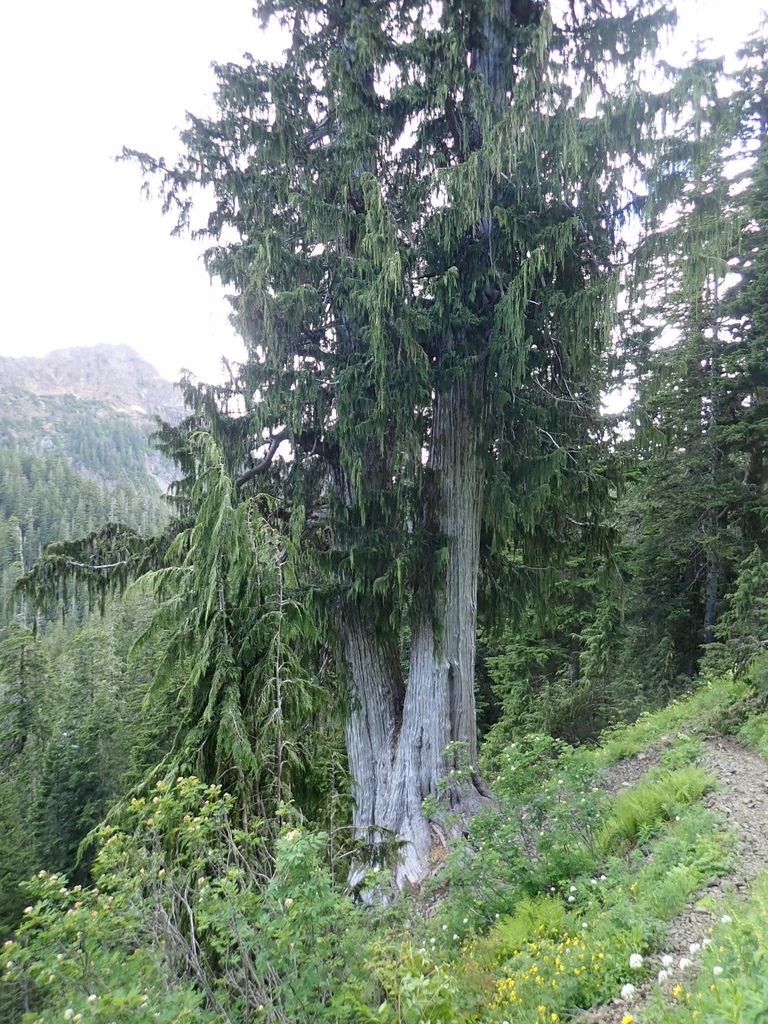
Alaska yellow cedar
Callitropsis nootkatensis
Callitropsis nootkatensis is a species of coniferous tree in the cypress family, Cupressaceae, native to the coastal regions of northwestern North America. It is the sole species in the monotypic genus Callitropsis.
This species has many common names, including: Nootka cypress, yellow cypress, Alaska cypress, Nootka cedar, yellow cedar, Alaska cedar, and Alaska yellow cedar. The specific epithet nootkatensis is derived from the species being from the area of Nootka Sound on the west coast of Vancouver Island, Canada. Both locations are named for the older European name Nootka, given the Nuu-chah-nulth First Nation.
From the article Callitropsis nootkatensis on Wikipedia (CC BY-SA), quoted section by section
Description
Callitropsis nootkatensis is a coniferous tree that usually grows to 40 meters (131 ft) tall, and exceptionally to 60 m (200 ft), with diameters up to 3.4 to 4 m (11 to 13 ft). The bark is thin, smooth and purplish when young, turning flaky and gray. The branches are commonly pendulous, with foliage in flat sprays and dark green scale-leaves measuring 3–5 millimeters (1⁄8–3⁄16 in) long. The cones, maturing biannually, have 4 (occasionally 6) scales, and resemble the cones of Cupressus lusitanica (another species which can show foliage in flat sprays), except being somewhat smaller, typically 8–14 mm (5⁄16–9⁄16 in) in diameter; each scale has a pointed triangular bract about 1.5–2 mm long, again similar to other Cupressus and unlike the crescent-shaped, non-pointed bract on the scales of Chamaecyparis cones. The winged seeds are small, thus dispersing at a close range; additionally, only a small percentage is viable. The Caren Range on the west coast of British Columbia is home to the oldest Nootka cypress specimens in the world, with one specimen found to be 1,834 years old; some specimens may be over 3,000 years old. Callitropsis nootkatensis is one of the parents of the hybrid Leyland cypress; the other parent, Monterey cypress (Hesperocyparis macrocarpa), was also considered to be in the genus Cupressus, but in the North American Hesperocyparis clade, which has generally bee …
Range & habitat
The species grows in moist areas of coastal mountains of the Pacific Northwest, including those of the Cascades, from the Kenai Peninsula in Alaska to the Klamath Mountains in northernmost California. It can be found at elevations higher than those reached by Thuja plicata (western redcedar), sometimes in a krummholz form, and even occupying very rocky sites (near the California-Oregon border). It can be found at elevations of 600 to 750 m (1,970 to 2,460 ft) in Southeast Alaska and between 750 and 2,000 m (2,460 and 6,560 ft) from coastal British Columbia into Oregon. Isolated groves near Nelson, British Columbia, and John Day, Oregon, may be the descendants of local populations dating to the Last Glacial Period.
Wikipedia: “Distribution and habitat”
What it does
The tree benefits from annual precipitation exceeding 150 centimeters (59 in), particularly in deep snow though with temperatures not often dropping below −18 °C (0 °F). Snow tends not to break the flexible branches. It is shade tolerant, but less so than associated mountain hemlock (Tsuga mertensiana) and Pacific silver fir (Abies amabilis), and grows slowly. Anti-fungal chemicals within the tree aid in its longevity. It is also rarely afflicted by insects, although is susceptible to heart rot. In Alaska, where the tree is primarily referred to as "yellow cedar", extensive research has been conducted into large-scale die-offs of yellow cedar stands. These studies have concluded that the tree has depended upon heavy coastal snowpacks to insulate its shallow roots from cold Arctic winters. The impacts of climate change have resulted in thinner, less-persistent snowpacks, in turn causing increased susceptibility to freeze damage. This mortality has been observed over 7% of the species range, covering approximately 10 degrees of latitude from northern southeast Alaska to southern British Columbia. Substantial future mortality is likely due to warming temperatures and decreasing snowpacks. The U.S. Fish & Wildlife Service is reviewing whether to designate the species as threatened or endangered.
Wikipedia: “Ecology”
At the table
The Nootka cypress is used extensively by the indigenous peoples of the Pacific Northwest Coast, along with another cypress, Thuja plicata (western redcedar). While the wood and inner bark of western redcedar was preferred for larger projects like houses and canoes, the stronger inner bark of Nootka cypress was used for smaller vessels and utensils, including canoe paddles and baskets, as well as thread for clothing and blankets. This species has been considered to be one of the finest timber trees in the world and has been exported to China during the last century. The wood has been used for flooring, interior finish and shipbuilding. The tree has extreme heartwood qualities that make it one of the most desired sources of firewood on the West Coast. It burns very hot and lasts a long time as embers. A tree can still be used for firewood up to 100 years after its death.
Construction. The various physical properties of the wood make it an attractive material for both general construction and boatbuilding. Due to its slow growth it is hard and, like other cypress woods, it is durable; it therefore offers good dimensional stability and is resistant to weather, insects, and contact with soil. It works easily with hand or machine tools, turning and carving quite well. It can be fastened with glues, screws, and nails. …
Wikipedia: “Uses”
In human culture
A legend amongst the Nootka peoples of the Hesquiaht First Nation tells of the origins of the Nootka cypress. In the legend, a raven encounters three young women drying salmon on the beach. He asks the women if they are afraid of being alone, or of bears, wolves, and other animals. Each woman responded "no". But when asked about owls, the women were indeed afraid of owls. Hearing this, the trickster raven hid in the forests, and made the calls of an owl. The terrified women ran up the mountains, but turned into Nootka cypress trees when they were out of breath. According to the Nootka, this is why Nootka cypress grows on the sides of mountains, and also why the bark is silky like a woman's hair, and the young trunk is smooth like a woman's body. In Tlingit culture the story of Natsilane describes how a Nootka cypress was used to carve the world's first killer whale.
Wikipedia: “In Indigenous culture”
Where it lives
Recorded sightings
—
geo-referenced records in GBIF, from museums, herbaria and field observers.
Drag the globe to turn it. Dots are where records exist, not a range map; darker means more records.
In the stacks
Searching the stacks…
Every page naming Callitropsis nootkatensis in the Biodiversity Heritage Library →
This page is assembled live from iNaturalist, GBIF, Wikipedia, the Source Library and the Internet Archive. It is not yet part of the hand-edited codex. iNaturalist taxon 820904.